Connect with us

Technology

Graphics Processing Unit (GPU) Market to Grow by USD 388.3 Billion (2024-2028), with AI-Driven Insights on Rising Demand for Advanced Gaming and VR – Technavio

Published

on

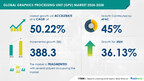
NEW YORK, Oct. 4, 2024 /PRNewswire/ — Report with the AI impact on market trends – The Global Graphics Processing Unit (GPU) market size is estimated to grow by USD 388.3 billion from 2024-2028, according to Technavio. The market is estimated to grow at a CAGR of 50.22% during the forecast period.Increase in demand for advanced gaming and VR experiences is driving market growth, with a trend towards rise in demand for high-performance computing (HPC). However, issues with graphics processing unit upgrading in notebooks poses a challenge – Key market players include Advanced Micro Devices Inc., Alphabet Inc., Apple Inc., Arm Ltd., ASUSTeK Computer Inc., Broadcom Inc., Fujitsu Ltd., Galaxy Microsystems Ltd., Gigabyte Technology Co. Ltd., Imagination Technologies Ltd., Intel Corp., International Business Machines Corp., NVIDIA Corp., Qualcomm Inc., Samsung Electronics Co. Ltd., SAPPHIRE Technology Ltd., Sony Group Corp., Taiwan Semiconductor Manufacturing Co. Ltd., Zebra Technologies Corp., and Zotac Technology Ltd..

AI-Powered Market Evolution Insights. Our comprehensive market report ready with the latest trends, growth opportunities, and strategic analysis- View your snapshot now

Forecast period

2024-2028

Base Year

2023

Historic Data

2017 – 2021

Segment Covered

Type (Integrated GPUs and Discrete GPUs), Application (Computers, Tablets and smartphones, Television, and Gaming consoles), and Geography (APAC, North America, Europe, South America, and Middle East and Africa)

Region Covered

APAC, North America, Europe, South America, and Middle East and Africa

Key companies profiled

Advanced Micro Devices Inc., Alphabet Inc., Apple Inc., Arm Ltd., ASUSTeK Computer Inc., Broadcom Inc., Fujitsu Ltd., Galaxy Microsystems Ltd., Gigabyte Technology Co. Ltd., Imagination Technologies Ltd., Intel Corp., International Business Machines Corp., NVIDIA Corp., Qualcomm Inc., Samsung Electronics Co. Ltd., SAPPHIRE Technology Ltd., Sony Group Corp., Taiwan Semiconductor Manufacturing Co. Ltd., Zebra Technologies Corp., and Zotac Technology Ltd.


Key Market Trends Fueling Growth

The global Graphics Processing Unit (GPU) market is experiencing a notable growth in demand for High Performance Computing (HPC) applications. This trend can be attributed to several factors, including the expanding need for advanced graphics capabilities in industries such as gaming, Virtual Reality (VR), and animation. The increasing intricacy of video games and the escalating popularity of VR experiences necessitate graphics processing units that can deliver high-resolution graphics and seamless performance. In response, manufacturers have developed specialized graphics processing units for HPC, empowering game developers and content creators to elevate visual quality and realism. Another significant driver of this trend is the burgeoning adoption of Artificial Intelligence (AI) and Machine Learning (ML) applications. AI and ML algorithms necessitate substantial computational power for tasks like image and speech recognition, natural language processing, and data analysis. Graphics processing units, with their parallel processing capabilities, are a preferred choice for AI and ML developers. Moreover, industries such as finance, scientific research, and healthcare are increasingly relying on HPC using graphics processing units. In finance, graphics processing units are employed for intricate calculations and simulations in areas like risk analysis, portfolio optimization, and algorithmic trading. In scientific research, they are utilized for data-intensive calculations in fields like genomics, climate modeling, and particle physics. In healthcare, graphics processing units are leveraged for medical imaging, drug discovery, and personalized medicine applications. The escalating demand for HPC in the GPU market is also fueled by advancements in cloud computing and the proliferation of data centers. As businesses shift their workloads to the cloud, there is a requirement for graphics processing units in data centers to manage tasks like rendering, video transcoding, and real-time analytics. Consequently, cloud-based GPU services have emerged, enabling organizations to access high-performance computing resources on demand. These factors are anticipated to amplify the demand for graphics processing units, driving the growth of the market during the forecast period. 

The GPU market is thriving in the digital world, driven by trends in graphics, video rendering, and gaming platforms. According to a recent PwC report, global spending in the gaming industry is projected to reach USD159.3 billion by 2023. GPUs play a crucial role in delivering visuals and fluid gameplay in video games, 3D designs, and virtual reality (VR) and augmented reality (AR) applications. In the mainstream business sector, GPUs are used for AI applications like fraud detection, conversational AI solutions, and cryptocurrency mining. The rapid evolution of AI, machine learning, and computing technologies is increasing the demand for GPUs in areas like design, development, optimization, and data processing. However, ethical concerns around user data, GDPR, and biased algorithms are creating regulatory scrutiny. Skilled engineers, developers, data scientists, AI researchers, and machine learning experts are in high demand to address these challenges and optimize the use of GPUs in this complex technology landscape. The market for GPUs is expected to continue growing as the technology becomes more integrated into our daily lives through wearable technologies, computing technologies, and other emerging applications. 

Insights on how AI is driving innovation, efficiency, and market growth- Request Sample!

Market Challenges

The global graphics processing unit (GPU) market in notebooks is facing a persistent challenge with the limitation of GPU upgrades. This issue is a concern for both manufacturers and consumers due to the compact design of notebooks. Notebooks prioritize portability and compactness, leading to thermal and space constraints, making it challenging to accommodate upgrades. In contrast, desktop computers offer more room for expansion and can easily accommodate larger, more powerful GPUs. Another reason for this issue is the proprietary nature of notebook designs. Many manufacturers restrict users from upgrading key components, including GPUs, creating a dependency on the manufacturer for future upgrades. The lack of standardized GPU form factors for notebooks further complicates matters. Unlike desktop GPUs, which follow standard form factors like PCI Express, notebook GPUs come in various shapes and sizes, making it difficult for consumers to find compatible upgrades for their specific notebook models. This issue becomes more significant as the demand for high-performance gaming and professional-grade graphics applications increases. With technology advancing at a rapid pace, users find themselves unable to fully utilize new features and enhancements due to outdated GPU capabilities. These factors are expected to hinder the growth of the GPU market for notebooks during the forecast period.The GPU market is experiencing significant growth due to increasing demand from gaming and data center industries. Gaming applications, online gaming, and e-gaming are major drivers, with compatibility and multiple device support being key challenges. Location independence and low-cost high-quality experience are crucial for organizations in the on-premises deployment mode. Data procurement, storage, and machine-learning applications in sectors like AI and online learning/entertainment also fuel demand. Gaming companies like Steam and DirectX 12 GPU manufacturers such as AMD and NVIDIA’s RTX gaming servers are leading the charge. New entrants like Fenghua GPU and SenseTime, using GPUs in Exynos SoCs and P5 instances, are also making waves. The HPC sector’s demand for GPUs in AI and machine learning is also noteworthy. Despite these opportunities, compatibility across platforms and devices remains a challenge. Overall, the GPU market’s future looks bright, with continued innovation and advancements in frame buffer technology.

Insights into how AI is reshaping industries and driving growth- Download a Sample Report

Segment Overview 

This graphics processing unit (gpu) market report extensively covers market segmentation by

Type 1.1 Integrated GPUs1.2 Discrete GPUsApplication 2.1 Computers2.2 Tablets and smartphones2.3 Television2.4 Gaming consolesGeography 3.1 APAC3.2 North America3.3 Europe3.4 South America3.5 Middle East and Africa

1.1 Integrated GPUs- The Global GPU Market experienced steady growth in 2020, driven by increasing demand for advanced graphics in gaming, virtual reality, and artificial intelligence applications. Major players like NVIDIA, AMD, and Intel dominated the market, offering high-performance GPUs for various industries. The market is expected to continue expanding due to rising adoption in data centers and automotive sectors. Companies invest in research and development to improve energy efficiency and enhance computing capabilities.

Download complimentary Sample Report to gain insights into AI’s impact on market dynamics, emerging trends, and future opportunities- including forecast (2024-2028) and historic data (2017 – 2021) 

Research Analysis

The GPU market is experiencing significant growth due to the increasing demand for artificial intelligence (AI) and machine learning (ML) applications. GPUs, or Graphics Processing Units, are specialized processors designed for handling complex mathematical calculations, making them ideal for AI and ML development. The adoption of GPUs in AI-powered solutions is driving innovation in various industries, including gaming, graphics, virtual reality (VR), healthcare, manufacturing, real estate, and data centers. In the gaming industry, the latest RTX gaming servers and DirectX 12 GPUs offer enhanced graphics processing capabilities for gaming experiences. For creative technologies, GPUs are essential for rendering high-definition 3D content and optimizing design workflows. In the field of HPC (High Performance Computing), GPUs are used for scientific simulations and big data analytics. Cloud-based analytics applications and AI-powered solutions are also driving the demand for GPU as a Service (GPUaaS), enabling businesses to access powerful GPU resources on-demand. The use of GPUs in VR, healthcare, and real estate industries is also on the rise, as they offer faster processing times and improved accuracy for complex mathematical calculations. Overall, the GPU market is poised for continued growth as more industries discover the benefits of these powerful processing units.

Market Research Overview

The Graphics Processing Unit (GPU) market is experiencing rapid growth due to the increasing demand for AI, RTX gaming servers, GPUaaS, HPC, and other advanced technologies. GPUs, as electronic processors specialized in graphics and video rendering, play a crucial role in the digital world, powering video games, 3D designs, virtual reality (VR), and augmented reality (AR) on gaming platforms and wearable technologies. The global spending on the gaming industry is projected to reach new heights, with mainstream businesses adopting GPUs for various applications, including fraud detection, conversational AI solutions, and visuals. The emergence of AI, machine learning, and big data technology is driving the industry expansion, with GPUs providing the computational power needed for complex mathematical calculations and analyzing large databases. The use of GPUs in AI applications, such as image recognition and interference times, is also leading to design and development optimizations. However, the use of GPUs in AI and other emerging technologies raises ethical concerns, including GDPR, user data, and biased algorithms. Regulatory scrutiny is increasing, and skilled engineers and developers are in high demand to address these challenges and ensure the responsible use of this rapidly evolving technology. Meanwhile, GPUs continue to be a key component in the digital world, from PC games and mobile titles to specialized processors and display enhancements. Companies like Imagination Technology and its GPU IP and API system are leading the way in this field, while the adoption of GPUs in industries such as healthcare, manufacturing, and supply chain is set to accelerate. In summary, the GPU market is a dynamic and complex technology landscape, driven by the demands of AI, gaming, HPC, and other emerging applications. The role of GPUs in powering the digital world and enabling new innovations is undeniable, but the challenges of ethical use and regulatory compliance must also be addressed to ensure a sustainable and responsible future for this rapidly evolving technology.

Table of Contents:

1 Executive Summary
2 Market Landscape
3 Market Sizing
4 Historic Market Size
5 Five Forces Analysis
6 Market Segmentation

TypeIntegrated GPUsDiscrete GPUsApplicationComputersTablets And SmartphonesTelevisionGaming ConsolesGeographyAPACNorth AmericaEuropeSouth AmericaMiddle East And Africa

7 Customer Landscape
8 Geographic Landscape
9 Drivers, Challenges, and Trends
10 Company Landscape
11 Company Analysis
12 Appendix

About Technavio

Technavio is a leading global technology research and advisory company. Their research and analysis focuses on emerging market trends and provides actionable insights to help businesses identify market opportunities and develop effective strategies to optimize their market positions.

With over 500 specialized analysts, Technavio’s report library consists of more than 17,000 reports and counting, covering 800 technologies, spanning across 50 countries. Their client base consists of enterprises of all sizes, including more than 100 Fortune 500 companies. This growing client base relies on Technavio’s comprehensive coverage, extensive research, and actionable market insights to identify opportunities in existing and potential markets and assess their competitive positions within changing market scenarios.

Contacts

Technavio Research
Jesse Maida
Media & Marketing Executive
US: +1 844 364 1100
UK: +44 203 893 3200
Email: media@technavio.com
Website: www.technavio.com/

View original content to download multimedia:https://www.prnewswire.com/news-releases/graphics-processing-unit-gpu-market-to-grow-by-usd-388-3-billion-2024-2028-with-ai-driven-insights-on-rising-demand-for-advanced-gaming-and-vr—technavio-302267044.html

SOURCE Technavio

Continue Reading
Click to comment

Leave a Reply

Your email address will not be published. Required fields are marked *

Technology

Tradr to Ring Opening Bell at Cboe to Celebrate SpaceX ETF Launches

Published

on

By

Tradr ETFs will ring Cboe’s Opening Bell on June 15 to celebrate the launch of SPCM and SPCG, ETFs providing 200% leveraged long and short exposure to the newly public SpaceX stock.

Firm to commemorate the launch of SPCM and SPCG from the center of the world’s largest options trading floor

NEW YORK, June 14, 2026 /PRNewswire/ — Tradr ETFs, a provider of ETFs designed for sophisticated investors and professional traders, today announced that its team will ring the Opening Bell at Cboe Global Markets at 8:30 am on Monday, June 15, 2026. The ceremony, to be broadcast live on CNBC, will commemorate the expected start of trading for the Tradr 2X Long SpaceX Daily ETF (Cboe: SPCM) and the Tradr 2X Short SpaceX Daily ETF (Cboe: SPCG).

We’re excited to bring both bullish and bearish leveraged exposure to one of the market’s most closely watched stocks

SPCM and SPCG seek to provide traders with 200% leveraged bullish and bearish exposure to SpaceX (Nasdaq: SPCX), one of the most anticipated public offerings in market history.

“Few companies have captured the imagination of investors quite like SpaceX, and we’re proud to mark the launch of SPCM and SPCG by ringing the Opening Bell at Cboe,” said Russell Tencer, President of Tradr ETFs. “Cboe has been an outstanding partner to Tradr since our inception, and there is no better place to celebrate products built for traders by traders. We’re excited to bring both bullish and bearish leveraged exposure to one of the market’s most closely watched stocks and to do so from the center of the options trading world.”

Monday’s expected launch expands Tradr’s growing lineup of leveraged ETFs focused on the rapidly evolving space economy. The firm also offers the Tradr 2X Long ASTS Daily ETF (Cboe: ASTX) and the Tradr 2X Long FLY Daily ETF (Cboe: FLYT), providing 200% leveraged long exposure to two other closely watched companies helping shape the future of space-based communications and aerospace innovation.

Tradr’s lineup of 65 leveraged ETFs represents over $7 billion in assets under management. Some of its notable tickers on trending stocks include SNXX and SNDQ, which provide long and short exposure to SanDisk (SNDK). Tradr’s strategies can be accessed through most brokerage platforms and allow investors to avoid the hassle of using margin and the complexity of options trading. The firm continues its mission of providing sophisticated investors with innovative trading tools that enhance their ability to express market views with precision and efficiency.

For detailed information on Tradr ETFs and the significant risks involved with leveraged ETFs, please visit www.tradretfs.com.

About Tradr ETFs
Tradr ETFs are designed for sophisticated investors and professional traders who are looking to express high conviction investment views. The strategies include leveraged and inverse ETFs that seek short or long exposure to actively traded stocks and ETFs.

IMPORTANT RISK INFORMATION
Tradr ETFs are for sophisticated investors and professional traders with high conviction views and are very different from most other ETFs. The Funds are intended to be used as short-term trading vehicles and pursue leveraged investment objectives, which means they are riskier than alternatives that do not use leverage because the Funds magnify the performance of their underlying security. The volatility of the underlying security may affect a Fund’s return as much as, or more than, the return of the underlying security.

Investors in the fund should: (a) understand the risks associated with the use of leverage; (b) understand the consequences of seeking inverse and leveraged investment results; (c) for short ETFs, understand the risk of shorting; (d) intend to actively monitor and manage their investment. Fund performance will likely be significantly different than the benchmark over periods longer than the specified reset period and the performance may trend in the opposite direction than its benchmark over periods other than that period.

Leverage increases the risk of a total loss of an investor’s investment, may increase the volatility of the Funds, and may magnify any differences between the performance of the Funds and their reference security. The Funds seek leveraged investment results for a specific period (daily, monthly or quarterly). The exact exposure of an investment in the Fund intra-period will depend upon the movement of the reference security from the end of the prior period until the time of investment by the investor.

The Fund will not attempt to position its portfolio to ensure it does not gain or lose more than a maximum percentage of its net asset value on a given trading day. As a consequence, investors in a Fund that seeks two times daily performance would lose all of their money if the Fund’s underlying security moves more than 50% in a direction adverse to the Fund on a given trading day.

ETFs involve risk including possible loss of the full principal value. There is no assurance that the Fund will achieve its investment objective. Principal risks and other important risks may be found in the prospectus. Past performance does not guarantee future results.

ETF shares are bought and sold at market price (not NAV) and are not individually redeemed from the ETF. There can be no guarantee that an active trading market for ETF shares will develop or be maintained, or that their listing will continue or remain unchanged. Buying or selling ETF shares on an exchange may require the payment of brokerage commissions and frequent trading may incur brokerage costs that detract significantly from investment returns.

Investors should carefully consider the investment objectives, risks, charges and expenses of the Funds. This and other important information about the Fund is contained in the Prospectus, which can be obtained by visiting www.tradretfs.com. The Prospectus should be read carefully before investing.

Distributed by ALPS Distributors, Inc, which is not affiliated with AXS Investments or its Tradr ETFs. AXI000965

View original content to download multimedia:https://www.prnewswire.com/news-releases/tradr-to-ring-opening-bell-at-cboe-to-celebrate-spacex-etf-launches-302799509.html

SOURCE Tradr ETFs

Continue Reading

Technology

Changan Group Unveils Its In-house Developed ADAS — SDA Pilot

Published

on

By

CHONGQING, China, June 14, 2026 /PRNewswire/ — At the 28th Chongqing International Auto Exhibition, Changan Group showcased its full brand lineup including CHANGAN NEVO, CHANGAN DEEPAL and AVATR at Hall N8, and officially launched its self-developed Advanced Driver-Assistance System, SDA Pilot.

At the press conference, Zhu Huarong, Chairman of Changan Group, stated: “Changan will work together with partners and users worldwide to make ADAS better, more practical, and more accessible, protecting every journey with smart technology.” It is announced that the CHANGAN NEVO Q06 will come standard with SDA Pilot across all trim levels and hit its domestic market in the second half of 2026.

SDA Pilot Takes the Spotlight: Three-tier Safety Defenses Upgrade the ADAS Experience

As Changan’s latest technological achievement in smart mobility, SDA Pilot breaks the boundaries of traditional physical safety and establishes three comprehensive safety defense systems covering physical well-being, mental comfort and emotional interaction.

The entry-level SDA Pilot Pro comes standard with LiDAR, capable of identifying obstacles in low-light conditions such as at night or in tunnels two seconds faster than the human eye. Supported by the globally leading SDA Central Ring Network Architecture, the system cuts response time by an additional 150 milliseconds. SDA Pilot Max, leverages over 20 million high-quality real-world driving data segments for training, delivering exceptional perception and predictive capabilities to confidently navigate complex, high-frequency commuting scenarios. The top-tier SDA Pilot Ultra is integrated with the VLM (Vision Language Model), which greatly enhances the vehicle’s environmental perception and enables interactive advanced driver-assistance functions, turning the vehicle into an intuitive travel companion. In the future, an active driver incapacitation protection function will also be introduced to safeguard driving safety at the first moment.

While continuously evolving its ADAS user experience, Changan remains committed to its safety bottom line, clearly reminding: “Driver assistance is not autonomous driving. Drivers are still required to take on the core responsibilities of real-time monitoring and taking over control at any time.”

Advancing the “1445” Global Strategy: 17 Years of Intelligent R&D Build Solid Safety Foundations

Changan Group lives by the tenet of “Intelligence defines Changan.” As a core component of the “1445” Global Strategy that underpins four transformation priorities (The four priorities refer to: intelligent mobility, electrification, a unified ecosystem, and globalization), intelligent mobility stands as the primary driving force for Changan’s upgrading. The company is committed to building a world-class auto group with global competitiveness and independent core technologies, aiming to rank among the world’s top 10 automobile brands by 2030. The launch of SDA Pilot marks a landmark achievement of this strategy in the advanced driving-assistance sector.

Behind this technological breakthrough lies a solid intelligent foundation built by Changan over 17 years. Since establishing its intelligent R&D team in 2009, Changan has forged ahead in uncharted technological territories and built the China’s only national key laboratory dedicated to intelligent vehicle safety technology — CHANGAN SDA LAB. The lab supports round-the-clock global collaborative testing with more than 400,000 virtual simulation scenarios.

Over the past five years, more than 2,000 Changan engineers have completed over 5 million kilometers of real-road tests across Chongqing’s notoriously complex road conditions, covering 185 typical driving scenarios. Rich field experience has been embedded into the system, which keeps evolving based on user feedback and forms the unshakable safety strength of SDA Pilot.

Empowered by intelligent technologies, Changan continues to accelerate its global footprint. To date, the group has established 22 overseas manufacturing bases with an annual capacity of 350,000 vehicles, and 1,124 overseas sales outlets, covering 118 countries and regions, with 41 global models launched. In 2025, Changan’s overseas sales reached 637,000 vehicles, a year-on-year increase of 18.9%.

Since the start of 2026, Changan has made successive moves in its globalization strategy: launching the Vast Ocean Plan 2.0 during the AutoChina 2026 in Beijing, establishing four core principles: long-term development, localization, systematization, and responsible ESG practices; and more recently, partnering with the Portuguese Football Federation (FPF) to become the Official Global Partner of the Portugal National Football Team, using sports as a bond to deepen global user connections and brand engagement.

View original content to download multimedia:https://www.prnewswire.com/apac/news-releases/changan-group-unveils-its-in-house-developed-adas–sda-pilot-302799729.html

SOURCE Changan Group

Continue Reading

Technology

Kakunin Announces Cryptographic Compliance Shield for Google Gemini and OpenAI Agent Ecosystems

Published

on

By

SaaS Compliance Leader Launches First-Class SDK Integrations for Google Antigravity, OpenAI Swarm, and OpenAI Assistants API to Meet Strict MiCA and EU AI Act Standards.

LONDON, June 13, 2026 /PRNewswire-PRWeb/ — Kakunin, the leading compliance infrastructure platform for autonomous AI agents, today announced the release of first-class SDK integrations for Google Antigravity SDK, OpenAI Swarm, and the OpenAI Assistants API.

Autonomous agents are executing high-value, real-world tasks—but without strict boundaries, they represent a massive security risk,” said Palash Bagchi, Founder, at Kakunin.

As organizations move autonomous AI agents from sandboxes to production, securing the tools they run has become a critical operational hurdle. The new integrations allow developers to cryptographically secure and audit agent actions in real time, meeting the strict requirements of upcoming regulations like the EU AI Act and MiCA.

Preventing Agent Drift at the Tool Layer

Instead of relying on prompt engineering or system instructions—which are susceptible to jailbreaks—Kakunin secures agent tool execution at the cryptographic layer:

Pre-Flight Scope Verification: Validates that an agent possesses the required permission scope (e.g., trade.execute, file.write) before executing local code.Active-Agent Enforcement: Dynamically halts execution if the agent’s underlying X.509 certificate has been revoked or suspended.Tamper-Evident Auditing: Automatically logs session starts, prompts, responses, tool successes, and error anomalies.

Ecosystem Compatibility out of the Box

The new releases bring seamless, code-first integrations to the industry’s leading agent frameworks:

Google Antigravity SDK: Hook-based runtime protection that automatically secures Gemini-powered tool workflows.OpenAI Swarm: A lightweight class wrapper (KakuninSwarm) that dynamically gates multi-agent handoffs and task executions.OpenAI Assistants API: A polling-loop helper (handle_assistants_requires_action) that streamlines safety checks and tool output formatting in a single call.

Beyond these core OpenAI and Google environments, the new releases also extend Kakunin’s cryptographic shield to the broader agent development community. Out-of-the-box templates and shims are now available for LangChain (KakuninToolGuard), LlamaIndex (KakuninFunctionToolGuard), CrewAI (KakuninCrewAgent), and AutoGen (KakuninConversableAgent), alongside native middlewares for Next.js API routes and raw client libraries for Go, TypeScript, and Python.

“Autonomous agents are executing high-value, real-world tasks—but without strict boundaries, they represent a massive security risk,” said Palash Bagchi, Founder, at Kakunin. “By bringing cryptographic X.509 validation directly to Google’s and OpenAI’s agent loops, we are giving developers the peace of mind to deploy agents in highly regulated environments like fintech and healthcare.”

Availability

The new SDK integrations are available immediately:

Python Package: Available on PyPI via pip install kakunin.Playground Notebooks: Developers can test the integrations in 1-click via the official OpenAI Cookbook and Google Gemini Cookbook.Reference Samples: Available on the public Kakunin Samples Repository.

To learn more about securing your autonomous agent workflows, visit kakunin.ai/docs. or visit Conversational GTM for more enquiries.

Media Contact
Palash Bagchi, Immortal Reality PA LLC, 1 4125437290, ai@kakunin.ai, https://www.kakunin.ai/

View original content to download multimedia:https://www.prweb.com/releases/kakunin-announces-cryptographic-compliance-shield-for-google-gemini-and-openai-agent-ecosystems-302798798.html

SOURCE Kakunin

Continue Reading

Trending