Connect with us

Technology

Canadian organizations outspending global peers on technology, KPMG survey shows

Published

on

While Canadian organizations have historically underspent on new technology, more than half have seen a 10 percent profit jump from investments in cybersecurity and AI

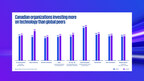
TORONTO, Oct. 24, 2024 /CNW/ – Canadian organizations are investing more in technology solutions than their global peers and seeing impressive returns on their investments, according to the 2024 KPMG Global Tech Survey

The survey of 150 C-suite technology executives and senior leaders from large organizations across Canada showed respondents are currently investing in or planning near-term investments in technologies such as AI and automation, edge computing, quantum computing, cybersecurity, Web 3, data and analytics, cloud computing and other solutions in the next year to support their growth ambitions – outspending their global peers.

“After years of relative underinvestment, Canadian organizations have done a major pivot and are now investing more in technology than their global peers – this is a significant leap forward. With more sustained investments like this, Canada’s productivity could finally see a meaningful boost,” says Stephanie Terrill, KPMG’s Canadian Managing Partner of Digital and Transformation.

Nearly nine in 10 (89 per cent) respondents said their technology investments were driven by successful pilot projects and proof-of-concept testing of various solutions. Among the most profitable technologies over the past two years were artificial intelligence, where more than half (56 per cent) of respondents saw a 10 per cent or more profit increase from their investments; cybersecurity (56 per cent) and data and analytics (53 per cent).

“Experimenting with different technologies not only gives business leaders the confidence to make further tech investments, it also helps build a culture of innovation, and innovative organizations are more productive and profitable,” Ms. Terrill says.

Canada’s productivity crisis is underpinned by chronically low business investment, and our survey clearly shows that when businesses make investments in technology, they improve their productivity and profitability. Canada can advance its competitive position in the world if more businesses commit to making sustainable, long-term investments in technology.”

AI gets and gives a boost

Over the past year, more Canadian organizations have accelerated technology implementations in data and analytics, cybersecurity and cloud computing; but the largest increase was in AI and automation (including generative AI), where nearly all (99 per cent) respondents said they had started implementing AI – a 39 per cent increase from last year.  

Nearly eight in 10 (79 per cent) said they have AI use cases that are either running, in production or being scaled across their organization, and they’re achieving a return on investment. Nearly all (93 per cent) respondents said transformation efforts involving AI and generative AI positively impacted their organization’s profitability.

“Canadian technology leaders understand why implementing AI is transformative for their organizations: nearly eight in 10 said AI is helping knowledge workers in their organization become more productive, leading to improved overall performance,” says Ven Adamov, Partner and National Leader of KPMG in Canada’s Data and Analytics Risk Services.

However, Mr. Adamov notes that among respondents that have started implementing AI, only 38 per cent are proactively progressing against their strategy, while more than half (56 per cent) are either behind schedule or being held up by investment approvals.  

“Organizations that are behind in their AI implementations need to address and remove the barriers that are holding them back. Often, AI investments are delayed because certain risks have not been addressed, or because new or unanticipated risks emerge. Implementing a trusted AI framework from the outset can help reduce the number of unexpected hurdles that pop up during the AI implementation phase. In the absence of prescriptive regulations, there are proven best practices that can be adopted for that purpose,” he adds. 

Barriers to transformation: risk aversion and fear of overspending

Despite increased investments in technologies like AI and the benefits they’re creating for Canadian organizations, nearly eight in 10 (78 per cent) respondents expressed fear of overspending on technology, 11 percentage points higher than the global average.

That fear could stem from risk aversion: more than six in 10 (63 per cent) respondents said risk aversion makes their senior leadership move more slowly than competitors in embracing new technology – seven percentage points higher than the global average.

Sanjay Pathak, Partner and National Leader of Technology Strategy and Digital Transformation Services says that with new technologies like generative AI evolving quickly, there are heightened expectations on IT leaders as well as CEOs and boards to have a deeper level of understanding about new technologies, and if business leaders feel they don’t know enough about technology, it can create a sense of nervousness, hesitation and fear of taking risks.

“Education can help quell those fears and help business leaders become more comfortable with experimenting with and embracing new technologies. The technology function can play a leading role in improving an organization’s technology literacy. Organizations that empower technology executives and give them a voice at the decision-making table are digital leaders. This goes a long way in helping the C-suite, board and workforce understand how to harness new technologies to deliver value,” Mr. Pathak says.  

Mr. Pathak recommends the following strategies for organizations to gain more value from their technology investments:

Tighter alignment between technology and business leaders and business strategyTaking inspiration from industry peers and organizations in other industriesAdopting a “learn fast/fail fast” ethos that encourages experimentation with new technologies in small, controlled use cases.

About the Global Tech Survey

KPMG International surveyed 2,450 technology leaders between May 3 and June 26, 2024.  150 respondents were from Canada, with more than half (52 per cent) identifying as members of the C-suite. 34 per cent were in the consumer and retail sector, 27 per cent in technology, 20 per cent in financial services and the rest from other industries. More than half (53 per cent) had between 1,000 to 9,999 employees, and 30 per cent had 10,000 or more employees. Almost half (47 per cent) of respondents reported annual revenues of US$50 billion to US$99.99 billion; one third reported annual revenues of US$1 billion to US$9.99 billion and 13 per cent reported annual revenues between US $10 billion to US$19.99 billion.

About KPMG in Canada
KPMG LLP, a limited liability partnership, is a full-service Audit, Tax and Advisory firm owned and operated by Canadians. For over 150 years, our professionals have provided consulting, accounting, auditing, and tax services to Canadians, inspiring confidence, empowering change, and driving innovation. Guided by our core values of Integrity, Excellence, Courage, Together, For Better, KPMG employs more than 10,000 people in over 40 locations across Canada, serving private- and public-sector clients. KPMG is consistently ranked one of Canada’s top employers and one of the best places to work in the country. 

The firm is established under the laws of Ontario and is a member of KPMG’s global organization of independent member firms affiliated with KPMG International, a private English company limited by guarantee. Each KPMG firm is a legally distinct and separate entity and describes itself as such. For more information, see kpmg.com/ca.

For media inquiries:
Roula Meditskos
National Communications and Media Relations
KPMG in Canada
(416) 549-7982
rmeditskos@kpmg.ca

SOURCE KPMG LLP

Continue Reading
Click to comment

Leave a Reply

Your email address will not be published. Required fields are marked *

Technology

Caladium Systems Launches Happiffie, India’s First AI-powered Celebration Platform

Published

on

By

CHENNAI, India, July 24, 2026 /PRNewswire/ — Caladium Systems today announced the launch of Happiffie, India’s first AI-powered Celebration Growth Platform, introducing a smarter way for customers to discover, compare, book, and manage celebrations while helping businesses connect with high-intent customers through intelligent technology.

Designed for weddings, birthdays, corporate events, social celebrations, parties, festivals, and more, Happiffie brings together over 400 celebration occasions and 1,000+ celebration experiences on a single AI-powered platform.

India’s celebrations industry continues to rely heavily on referrals, manual coordination, inconsistent pricing, and fragmented vendor discovery. Happiffie addresses these challenges by combining AI-powered recommendations, transparent price discovery, secure bookings, payments, and event management into one seamless platform.

A key innovation is Happiffie’s Reverse Auction, where customers simply submit their celebration requirements and verified vendors compete by offering customised proposals. Instead of spending hours searching and negotiating, customers can compare multiple qualified offers and choose the vendor that best matches their preferences and budget.

“Customers can now book the experience of their choice with the vendor of their choice, in the budget of their choice. At the same time, vendors receive qualified business opportunities matched to their category, location and capabilities, creating value for both sides of the marketplace,” said Pradhyumna T Venkat, Founder & CEO, Happiffie.

“Every major industry eventually reaches a point where technology fundamentally changes how it operates. Travel did. Hospitality did. Mobility did. We believe celebrations are next,” added Pradhyumna.

The platform is powered by Experience Intelligence™, a proprietary framework that combines over 15 years of celebration industry expertise with Artificial Intelligence to deliver smarter recommendations based on customer intent, preferences, and celebration needs.

Whether planning a wedding, birthday, corporate event, baby shower, anniversary, or festival celebration, customers can manage the entire journey—from vendor discovery and quotations to payments and execution—through a single platform.

Alongside its launch, Happiffie has opened registrations for vendor partners across Chennai and Tamil Nadu, with a phased expansion planned across India. The platform aims to build one of the country’s largest AI-powered celebration ecosystems, helping businesses generate qualified leads and grow more efficiently.

“Our vision is not simply to build another marketplace but to create the technology infrastructure that powers celebrations. Reverse Auction is the first step towards building a smarter, more transparent, and AI-driven celebration economy that benefits both customers and businesses alike,” added Pradhyumna.

Built on the experience of planning and executing over 5,000 weddings and celebrations, Happiffie combines deep industry expertise with AI to simplify celebration planning and transform how India celebrates.

For more information, visit www.happiffie.com. Vendor registrations are now open at www.happiffie.com/vendor-registration.

About Happiffie

Happiffie is India’s first AI-powered Celebration Platform, connecting customers, venues, event professionals, and celebration businesses through one intelligent ecosystem. Built on over 15 years of industry expertise, the platform combines Artificial Intelligence with Experience Intelligence™ to deliver smarter celebration planning across more than 1,000 celebration experiences spanning weddings, corporate events, birthdays, social celebrations, parties, and festivals.

Contact

Pradhyumna T Venkat
Founder & CEO
pradhyumna@happiffie.com
+91-7299002990

Logo: https://mma.prnewswire.com/media/3007635/Happiffie_Logo.jpg


View original content to download multimedia:https://www.prnewswire.com/in/news-releases/caladium-systems-launches-happiffie-indias-first-ai-powered-celebration-platform-302834017.html

Continue Reading

Technology

Beko Publishes 2025 Integrated Report, Charting Years of Progress Toward Net Zero

Published

on

By

As Beko releases its 2025 Integrated Report, the company’s third consecutive inclusion on TIME’s global sustainability ranking — retaining the #1 position in its industry — underscores the progress documented within it.

ISTANBUL, July 24, 2026 /PRNewswire/ — Beko published its 2025 Integrated Report, offering a comprehensive account of the company’s financial, environmental and social performance over the past year. In parallel, Beko has been named one of TIME Magazine’s World’s Most Sustainable Companies for the third year running, retaining the #1 position in its industry. The recognition, awarded in partnership with Statista, independently corroborates years of deliberate, measurable progress.

The report documents concrete results across Beko’s global manufacturing footprint. In 2025:

Energy efficiency projects across production sites saved 69,562 GJ of energy, avoiding 5,297 tonnes of CO₂e emissions.Waste recycling across all manufacturing facilities reached 98.6%, against a target of 99%.Renewable energy installed capacity reached 96 MWp, up from 90.2 MWp the prior year. Beko also reached 63.5% green electricity on the path to 100% across all manufacturing by 2030.Water efficiency and rainwater harvesting projects across locations delivered total water savings of 219,114 m3.

Behind these figures is a broader manufacturing transformation. Three of Beko’s manufacturing facilities have been recognised within the World Economic Forum’s Global Lighthouse Network, with the Ulmi plant earning the additional, and rarer, designation of Sustainability Lighthouse. The principles behind Ulmi’s approach are being extended across Beko’s broader manufacturing ecosystem, as the company scales low-impact production. Beko currently operates 13 smart factories globally — equipped with artificial intelligence, machine learning and robotics capabilities — with a target of 17 by the end of 2026.

On the circular economy side, Beko’s refurbishment centres across multiple locations reintroduced more than 148,000 appliances into the market in 2025 alone. The company recycled 1.98 million WEEE units through its own recycling facilities since 2014, and used 31,665 tonnes of recycled plastics in its products in 2025.

Across its product portfolio, 72.6% of Beko’s turnover in 2025 came from low-carbon products — a figure that reflects both the scale of the company’s energy-efficient product range and growing consumer demand for appliances that address environmental concerns.

“Being recognised by TIME three years in a row matters because it reflects that sustainability is a foundational part of Beko’s business,” said Can Dinçer, CEO of Beko. “Our factories undergo a twin transformation where we encounter both decarbonization and digitalization. That progress is deliberate and measurable, and our Integrated Report sets out exactly how. As the world prepares for COP31, the most credible thing a company can do is demonstrate its work rather than declare it. That is what we are doing.”

TIME’s annual list evaluates more than 5,000 companies worldwide across environmental and social performance, transparency and ESG reporting. Beko’s continued inclusion under increasingly rigorous standards points to a business model where sustainability is structurally embedded across operations, supply chains and product portfolios.

In addition to its Integrated Report, the Company has also published its second TSRS-compliant sustainability report, prepared in accordance with the Türkiye Sustainability Reporting Standards (TSRS), Türkiye’s adoption of the IFRS Sustainability Disclosure Standards issued by the International Sustainability Standards Board (ISSB). The report is publicly available and provides detailed disclosures on the company’s climate-related risks, opportunities, governance, strategy and performance.

About Beko

Beko is an international home appliance company with a strong global presence, operating through subsidiaries in more than 55 countries with a workforce of around 45,000 employees and production facilities spanning multiple regions—including Europe, Asia, Africa, and the Middle East. Beko has 22 brands owned or used with a limited license (Arçelik, Beko, Whirlpool*, Grundig, Hotpoint, Arctic, Ariston*, Leisure, Indesit, Blomberg, Defy, Dawlance, Hitachi*, Voltas Beko, Singer*, ElektraBregenz, Flavel, Bauknecht, Privileg, Altus, Ignis, Polar). Beko is the largest white goods company in Europe with its market share (based on volumes) and reached a consolidated turnover of 10.7 billion Euros in 2025. Beko’s 28 R&D and Design Centers & Offices across the globe are home to over 2,000 R&D employees and hold more than 4,500 international registered patent applications to date. The company has achieved the highest score in the S&P Global Corporate Sustainability Assessment (CSA) in the DHP Household Durables industry for the seventh consecutive year (based on the results dated 16 October 2025).** The company has been recognized as the 89th most sustainable company on TIME Magazine and Statista’s 2026 list of the World’s Most Sustainable Companies and has been the sector leader for three consecutive years. Beko’s vision is ‘Respecting the World, Respected Worldwide.’ 

www.bekocorporate.com

*Licensee limited to certain jurisdictions.
**The data presented belongs to Arçelik A.Ş., a parent company of Beko.


View original content to download multimedia:https://www.prnewswire.com/news-releases/beko-publishes-2025-integrated-report-charting-years-of-progress-toward-net-zero-302833974.html

SOURCE Beko

Continue Reading

Technology

JustMarkets Releases Market Analysis on How Foreign Exchange Markets React to CPI Surprises

Published

on

By

HO CHI MINH CITY, Vietnam, July 24, 2026 /PRNewswire/ — JustMarkets today released a new market analysis examining how foreign exchange markets react to Consumer Price Index (CPI) surprises and outlining key considerations for traders preparing for inflation data releases. The analysis explains why the gap between actual CPI data and market expectations, rather than the headline inflation figure itself, is often the primary driver of currency market movements.

What people often miss on CPI day is that the number itself isn’t what moves the market. The common reaction is to check whether the headline number is high or low, but it’s all priced in advance. According to JustMarkets, the real driver of EUR/USD is the gap between the actual number and what the market was positioned for.

Even an unchanged reading can cause dollar weakness if traders expect higher inflation, while weaker numbers that beat consensus expectations may drive dollar strength. Citing Federal Reserve research, the price driver is a surprise component rather than the headline.

Why the Expectation Gap Is More Important Than the Level

Forex is driven by expectations for interest rate decisions, with inflation impacting central bank policy. Key factors influencing this reaction include:

Main factors:

Monthly CPI and core CPICore services inflationRevisions to the previous period dataCentral banks policy pricing

Year-over-year data is less important in terms of price impact than monthly and core data.

How to Calculate Surprise

Start with the simplest metric: Surprise = Actual CPI − Consensus CPI. 

Consensus comes from the economic calendar’s forecast and reflects the market positioning. And then you need to check the market reaction through rates. The sequence typically runs: CPI surprise → change in front-end yields → USD movement → the sentiment adjustment.

Traders frequently employ this methodology in combination with the JustMarkets Economic Calendar to track high-impact releases in real time.

What the Intraday Move Actually Looks Like

CPI reactions usually happen in three stages. The first one is a headline shock with the potential algorithm’s reaction within a few seconds. Then comes the interpretation stage, with a time frame of 15-60 minutes and analysis of core numbers and yield confirmation. And then either continuation or reversal happens.

Approaches to Trading CPI Day

There are two common approaches to CPI.

The momentum approach requires the consistency of headlines and core surprises with yields’ confirmation. Most traders wait until the first minute’s candle is closed to avoid false signals.The fade approach requires dislocations like the absence of yield confirmation to FX movement or dislocations between headlines and core numbers. In this case, traders wait 10−20 minutes for exhaustion of the initial move and reversal setup search.

Risk management is crucial. Most traders limit their position size to 0.25%-0.50% of their equity because of widening spreads and slippage. Sometimes the decision to trade off is more optimal during extreme volatility than forced entry.

One Way to Prepare for the Next CPI Day Release

A simple way to get ready is to monitor EUR/USD, GBP/USD, USD/JPY pairs and an economic calendar with events’ importance. The workflow is simple: Economic calendar → release → Trading platform.

The final step brings traders to the execution platform. Many turn to JustMarkets, which offers CFDs on these currency pairs, with execution stability and fast market access that make it well suited for high-volatility macro events.

Disclaimer: For informational purposes only. Trading financial instruments involves significant risk and may not be suitable for all investors. Ensure you understand the risks involved and trade responsibly.

View original content to download multimedia:https://www.prnewswire.com/apac/news-releases/justmarkets-releases-market-analysis-on-how-foreign-exchange-markets-react-to-cpi-surprises-302834023.html

SOURCE Just Global Markets Ltd

Continue Reading

Trending