Connect with us

Technology

Kovrr Reveals New Standardized Approach to Ensure Objectivity to Quantify Cybersecurity Control Impact & Financial Forecasts in New Report

Published

on

Innovative Methodology Aligns Controls from Various Cybersecurity Frameworks, Offering Organizations Clear Insights Into Cybersecurity Risk Reduction and Investment Impact

TEL AVIV, Dec. 11, 2024 /PRNewswire-PRWeb/ — Kovrr, the leading global provider of on-demand cyber risk quantification (CRQ) solutions, unveiled a novel approach to modeling the impact of cybersecurity controls on an organization’s cyber risk exposure. A new report published today offers insights into the new methodology that standardizes the means by which cybersecurity controls from diverse frameworks are evaluated, providing organizations with actionable, accurate insights into risk reduction initiatives and enabling more informed decision-making for security investments.

“By mapping cybersecurity frameworks to a singular control catalog and linking them to real-world adversarial techniques,” said Yakir Golan, CEO. “Kovrr is working to provide organizations with a clear understanding of how their cyber investments translate into operational financial resilience.”

Organizations increasingly rely on widely-known cybersecurity frameworks such as ISO 27001, CIS, and NIST CSF to shape and measure their security strategies. However, inconsistencies in definitions and attack technique mapping have posed obstacles to the strategization process, leaving Chief Information Security Officers (CISOs) to subjectively determine which risk reduction measures effectively reduce exposure, creating space for vulnerabilities to creep through.

Kovrr’s new modeling approach bridges these gaps, providing a unified methodology that allows cybersecurity leaders to feel more confident in their risk-based prioritizations for the upcoming year.

A Unified Framework for Control Impact Analysis

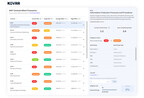
The Quantifying Cybersecurity Control Impacts report outlines Kovrr’s standardized process for aligning security controls across various frameworks and assessing how they mitigate specific adversarial techniques and behaviors. Leveraging the NIST 800-53 cybersecurity control catalog as a common base, Kovrr then maps controls to the types of attack techniques they are designed to prevent according to the MITRE ATT&CK framework, creating a consistent measurement system.

“Enterprises have long expressed the challenges they face capturing control impact when quantifying their cyber risk,” said Yakir Golan, Kovrr CEO. “Our latest modeling update provides clarity and actionable insights, enabling them to more confidently prioritize their security upgrades while aligning efforts with measure risk reduction outcomes.”

Tying Cybersecurity Controls to Real-World Impact

The report highlights Kovrr’s innovative three-stage methodology for standardizing the quantification of cybersecurity control impacts, specifically accounting for the tangible effects of real-world scenarios.

Stage 1: Controls from various cybersecurity frameworks such as ISO, CIS, and NIST CSF are mapped to a common security control catalog, the NIST 800-53, which was originally designed for government use but is increasingly being leveraged by enterprises as the common base. Instead of relying on internal assumptions or unstandardized expert insights, Kovrr instead harnesses guidance from NIST IR 8477.

Stage 2: Controls are linked to attack techniques as categorized by the MITRE ATT&CK framework, which groups these techniques into different adversarial tactics. Kovrr then groups these techniques further into three phases of attack – Initial Access, Network Propagation, and Action on Objective – focusing on them as they are considered the ‘active’ phases.

Stage 3: Control effectiveness is adjusted to account for non-covered techniques, undocumented techniques, such as zero-day vulnerabilities and unknown gaps – which have resulted in events like the 2023 MOVEit breach – tool design and usage limitations, and potential misconfigurations. These calibrations ensure an accurate reflection of the practical impact controls have on mitigating cyber risk in the real world.

To make Kovrr’s standardized control mapping applicable and actionable, the security control impact quantification also takes into account whether specific controls are implemented within the company infrastructure, the likelihood and frequency of adversarial techniques to adjust for the volume and type of attacks, and the company’s unique exposure to potential damages.

Implications for Cybersecurity Decision-Makers

In 2025, as they face budgetary constraints and increasing pressure from senior stakeholders, cybersecurity leaders need an objective, data-driven means of capturing the impact of their security control upgrades. Kovrr’s new cyber risk modeling approach directly addresses this challenge by introducing a standardized methodology that aligns technical controls with measure risk reduction outcomes, enabling cyber risk management to make more informed, strategic decisions.

Moreover, this innovative approach helps to bridge the long-standing gap between technical cybersecurity measures and executive-level priorities by shifting the focus away from subjective impact assumptions to objective, actionable intelligence. “By mapping cybersecurity frameworks to a singular control catalog and linking them to real-world adversarial techniques,” added Golan, “Kovrr is actively working to provide organizations with a clearer understanding of how their cybersecurity investments translate into operational financial resilience.”

For full access to the Quantifying Cybersecurity Control Impacts report, please visit www.kovrr.com/reports/quantifying-cybersecurity-control-impacts.

About Kovrr:

Kovrr’s cyber risk quantification platform empowers enterprise decision-makers to manage cyber exposure more effectively by providing an in-depth risk analysis that drives actionable, financially justified decisions. For more information, please visit www.kovrr.com or follow us on Twitter or LinkedIn.

Media Contact

Naomi Ronen, Kovrr, 972 507095870, naomi@kovrr.com, www.kovrr.com

Twitter, LinkedIn

View original content to download multimedia:https://www.prweb.com/releases/kovrr-reveals-new-standardized-approach-to-ensure-objectivity-to-quantify-cybersecurity-control-impact–financial-forecasts-in-new-report-302328005.html

SOURCE Kovrr

Continue Reading
Click to comment

Leave a Reply

Your email address will not be published. Required fields are marked *

Technology

Chef Robotics Physical AI Models Can Now Automate Baked Goods Packing

Published

on

By

SAN FRANCISCO, April 29, 2026 /PRNewswire/ — Chef Robotics, a leader in physical AI for the food industry, today announced that Chef robots can now automate tray assembly for baked goods packing. The application places baked products, such as burger buns, chocolate chip cookies, biscotti, butter cookies, biscuits, fortune cookies, granola bars, rusks, and shortbreads into trays and packaging containers before sealing.

Watch Chef robots in action.

Baked goods packing has historically been difficult to automate for high-mix production. Each item behaves differently on the production line—a granola bar compresses under the wrong grip, while a biscotti or rusk can crack if placed at the wrong angle. Surface textures range from glazed and smooth to crumbly and irregular, and strict presentation requirements leave little room for error. This variability has made it challenging for automation systems to reliably handle baked goods at production speeds, leaving food manufacturers dependent on manual labor and traditional bakery equipment.

To address this, Chef built its baked goods packing application on its existing piece-picking capability, which uses Chef’s AI-powered computer vision and physical AI models trained across diverse real-world production environments. This allows Chef robots to assess each item’s position, shape, and orientation in real time and determine how to pick the items from the pan and place them quickly and precisely without damaging them.

The baked goods packing application supports four distinct placement capabilities.

First, Chef’s vision system detects the angle at which each item sits in the pan and reorients it after picking, placing it on the tray at the exact angle required, regardless of its original position, enabling retail-ready presentation for SKUs that require precise angular placement.

Second, Chef robots can place multiple baked goods into the same packaging container in a single automated pass, completing full tray assembly without manual intervention.

Third, for packaging containers with multiple small compartments, Chef robots can precisely place items into each designated section, including multiple items in the same compartment, using Chef’s AI vision model to detect compartment positions and orientations in real time.

Fourth, Chef’s vision system identifies the exact center of each tray and places every item at a predefined offset from that center, ensuring a uniform, consistent arrangement across every pack regardless of how trays arrive on the conveyor.

For food manufacturers evaluating bakery systems and baked goods packaging automation, the application offers higher throughput, reduced labor dependency, and consistent presentation across shifts. The capability runs on Chef’s existing robotic hardware and software, allowing manufacturers to deploy it without requiring any changes to their production lines.

Chef’s baked goods packing application is available in the U.S., Canada, Germany, and the UK and is included as part of Chef’s robotics-as-a-service (RaaS) pricing model.

About Chef Robotics
Chef is the first company to have commercialized a scalable AI-driven food robotics solution. With over 104 million servings made in production, Chef leverages ChefOS, an AI platform for food manipulation, to offer a Robotics-as-a-Service solution that helps industry-leading food companies increase production volume and meet demand. Headquartered in San Francisco, CA, Chef aims to empower humans to do what humans do best by accelerating the advent of intelligent machines. Visit https://chefrobotics.ai to learn more.

View original content:https://www.prnewswire.com/news-releases/chef-robotics-physical-ai-models-can-now-automate-baked-goods-packing-302756923.html

SOURCE Chef Robotics

Continue Reading

Technology

Chef Robotics Physical AI Models Can Now Automate Baked Goods Packing

Published

on

By

SAN FRANCISCO, April 29, 2026 /PRNewswire/ — Chef Robotics, a leader in physical AI for the food industry, today announced that Chef robots can now automate tray assembly for baked goods packing. The application places baked products, such as burger buns, chocolate chip cookies, biscotti, butter cookies, biscuits, fortune cookies, granola bars, rusks, and shortbreads into trays and packaging containers before sealing.

Watch Chef robots in action.

Baked goods packing has historically been difficult to automate for high-mix production. Each item behaves differently on the production line—a granola bar compresses under the wrong grip, while a biscotti or rusk can crack if placed at the wrong angle. Surface textures range from glazed and smooth to crumbly and irregular, and strict presentation requirements leave little room for error. This variability has made it challenging for automation systems to reliably handle baked goods at production speeds, leaving food manufacturers dependent on manual labor and traditional bakery equipment.

To address this, Chef built its baked goods packing application on its existing piece-picking capability, which uses Chef’s AI-powered computer vision and physical AI models trained across diverse real-world production environments. This allows Chef robots to assess each item’s position, shape, and orientation in real time and determine how to pick the items from the pan and place them quickly and precisely without damaging them.

The baked goods packing application supports four distinct placement capabilities.

First, Chef’s vision system detects the angle at which each item sits in the pan and reorients it after picking, placing it on the tray at the exact angle required, regardless of its original position, enabling retail-ready presentation for SKUs that require precise angular placement.

Second, Chef robots can place multiple baked goods into the same packaging container in a single automated pass, completing full tray assembly without manual intervention.

Third, for packaging containers with multiple small compartments, Chef robots can precisely place items into each designated section, including multiple items in the same compartment, using Chef’s AI vision model to detect compartment positions and orientations in real time.

Fourth, Chef’s vision system identifies the exact center of each tray and places every item at a predefined offset from that center, ensuring a uniform, consistent arrangement across every pack regardless of how trays arrive on the conveyor.

For food manufacturers evaluating bakery systems and baked goods packaging automation, the application offers higher throughput, reduced labor dependency, and consistent presentation across shifts. The capability runs on Chef’s existing robotic hardware and software, allowing manufacturers to deploy it without requiring any changes to their production lines.

Chef’s baked goods packing application is available in the U.S., Canada, Germany, and the UK and is included as part of Chef’s robotics-as-a-service (RaaS) pricing model.

About Chef Robotics
Chef is the first company to have commercialized a scalable AI-driven food robotics solution. With over 104 million servings made in production, Chef leverages ChefOS, an AI platform for food manipulation, to offer a Robotics-as-a-Service solution that helps industry-leading food companies increase production volume and meet demand. Headquartered in San Francisco, CA, Chef aims to empower humans to do what humans do best by accelerating the advent of intelligent machines. Visit https://chefrobotics.ai to learn more.

View original content:https://www.prnewswire.com/news-releases/chef-robotics-physical-ai-models-can-now-automate-baked-goods-packing-302756923.html

SOURCE Chef Robotics

Continue Reading

Technology

Air Products to Expand Industrial Gas Supply for Samsung Electronics’ Next-Generation Semiconductor Fab in South Korea

Published

on

By

New investment underscores the company’s long-term commitment to Korea and its leading role in the global semiconductor industry 

LEHIGH VALLEY, Pa., April 29, 2026 /PRNewswire/ — Air Products (NYSE:APD), a world-leading industrial gases company and serving Samsung globally, today announced it has been selected by Samsung to supply industrial gases for its new advanced semiconductor fab in Pyeongtaek, Gyeonggi Province, South Korea.

Under the agreement, Air Products will build, own and operate multiple state-of-the-art production facilities and a bulk specialty gas supply system to supply nitrogen, oxygen, argon, and hydrogen for Samsung’s new semiconductor fab. The new facilities are expected to come onstream in multiple phases from 2028 through 2030.

Air Products has a long track record of executing multiple phase expansions in Pyeongtaek to support Samsung’s growing manufacturing needs. This latest project represents Air Products’ largest investment to date in the semiconductor industry and will establish Pyeongtaek as the company’s single largest operations site globally supporting the electronics industry. 

“Air Products is honored to be selected once again by Samsung and to have their continued confidence as a trusted partner supporting their strategic growth plans,” said SR Kim, President, Air Products Korea. “This significant investment reinforces Air Products’ role as a leading global supplier to the semiconductor industry and underscores our long-standing commitment to supporting our strategic customers with safety, reliability, efficiency and excellent service.”

Air Products has served the global electronics industry for more than 40 years, supplying industrial gases safely and reliably to many of the world’s leading technology companies. The company has operated in Korea for more than 50 years and has established a strong position in electronics and manufacturing sectors.

About Air Products

Air Products (NYSE: APD) is a world-leading industrial gases company in operation for over 85 years focused on serving energy, environmental, and emerging markets and generating a cleaner future. The Company supplies essential industrial gases, related equipment and applications expertise to customers in dozens of industries, including refining, chemicals, metals, electronics, manufacturing, medical and food. As the leading global supplier of hydrogen, Air Products also develops, engineers, builds, owns and operates some of the world’s largest clean hydrogen projects, supporting the transition to low- and zero-carbon energy in the industrial and heavy-duty transportation sectors. Through its sale of equipment businesses, the Company also provides turbomachinery, membrane systems and cryogenic containers globally.

Air Products had fiscal 2025 sales of $12 billion from operations in approximately 50 countries. For more information, visit airproducts.com or follow us on LinkedInXFacebook or Instagram.

This release contains “forward-looking statements” within the safe harbor provisions of the Private Securities Litigation Reform Act of 1995. These forward-looking statements are based on management’s expectations and assumptions as of the date of this release and are not guarantees of future performance. While forward-looking statements are made in good faith and based on assumptions, expectations and projections that management believes are reasonable based on currently available information, actual performance and financial results may differ materially from projections and estimates expressed in the forward-looking statements because of many factors, including the risk factors described in our Annual Report on Form 10-K for the fiscal year ended September 30, 2025 and other factors disclosed in our filings with the Securities and Exchange Commission. Except as required by law, we disclaim any obligation or undertaking to update or revise any forward-looking statements contained herein to reflect any change in the assumptions, beliefs or expectations or any change in events, conditions or circumstances upon which any such forward-looking statements are based.

View original content to download multimedia:https://www.prnewswire.com/news-releases/air-products-to-expand-industrial-gas-supply-for-samsung-electronics-next-generation-semiconductor-fab-in-south-korea-302757497.html

SOURCE Air Products

Continue Reading

Trending