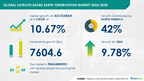
NEW YORK, Dec. 14, 2024 /PRNewswire/ — Report with the AI impact on market trends – The global satellite-based earth observation market size is estimated to grow by USD 7.6 billion from 2024-2028, according to Technavio. The market is estimated to grow at a CAGR of over 10.67% during the forecast period. Use of satellites for advanced environment monitoring is driving market growth, with a trend towards growing demand for small satellites. However, competition from alternate technologies poses a challenge. Key market players include Airbus SE, Antrix Corp. Ltd., BAE Systems Plc, Eagle View Technologies Inc., Geoimage, Global Surface Intelligence Ltd., Imagesat International I.S.I Ltd., Kleos Space S.A., L3Harris Technologies Inc., Lockheed Martin Corp., Maxar Technologies Inc., Northrop Grumman Corp., OHB SE, Orbital Insight Inc., Orbital Micro Systems, Planet Labs PBC, PlanetiQ, Raytheon Technologies Corp., Thales Group, and EarthDaily Analytics.
Key insights into market evolution with AI-powered analysis. Explore trends, segmentation, and growth drivers- View Free Sample PDF
Satellite-based Earth Observation Market Scope
Report Coverage
Details
Base year
2023
Historic period
2018 – 2022
Forecast period
2024-2028
Growth momentum & CAGR
Accelerate at a CAGR of 10.67%
Market growth 2024-2028
USD 7604.6 million
Market structure
Fragmented
YoY growth 2022-2023 (%)
9.78
Regional analysis
North America, APAC, Europe, South America, and Middle East and Africa
Performing market contribution
North America at 42%
Key countries
US, Canada, China, Russia, and UK
Key companies profiled
Airbus SE, Antrix Corp. Ltd., BAE Systems Plc, Eagle View Technologies Inc., Geoimage, Global Surface Intelligence Ltd., Imagesat International I.S.I Ltd., Kleos Space S.A., L3Harris Technologies Inc., Lockheed Martin Corp., Maxar Technologies Inc., Northrop Grumman Corp., OHB SE, Orbital Insight Inc., Orbital Micro Systems, Planet Labs PBC, PlanetiQ, Raytheon Technologies Corp., Thales Group, and EarthDaily Analytics
Market Driver
The Satellite-based Earth Observation market is thriving, with trends in defense sector applications, border monitoring, disaster management, and military missions. Big data technology and high-resolution imaging services are driving innovation, while reusable rockets and high-altitude balloons reduce launch costs. Civil engineering construction, agriculture & forestry, transportation, real estate, and urban planning sectors benefit from satellite imagery. Defense & intelligence, homeland security, and infrastructure security are key government sector applications. Space economy growth includes commercial space activities, private spaceflight industry, telecommunication services, and open-source data. Startups and global corporations like Satellogic, GeoterraImage, Imagesat International, MDA Corporation, Planet Labs, and others are expanding technological capabilities with high-resolution cameras and remote sensing technology. Applications include weather occurrences, climate change mitigation, natural resource management, and disaster management. Market restraints include highly trained workers, encrypted data, and big data processing costs. Orbits provide data sources for Earth-imaging satellites, GNSS radio occultation, mapping, natural resources survey, and more. Satellite analytics offer insights into the macroscopic environment, supporting science, research, and development for defiance, urban development, and smart city initiatives. Market growth includes space programs, population reference bureau, and infrastructure facilities. Technological advancements in satellite imagery, meteorology, cartography, ocean salinity, ice thickness, agricultural health, air quality, and orbits contribute to market expansion.
In the last decade, the number of small satellites, or SmallSats and CubeSats, launched into Earth’s orbit has seen a substantial rise. Ranging from a shoebox to a washing machine in size and weighing as little as 10 kilograms, these satellites offer a cost-effective and low-capital investment alternative. The affordability of SmallSats has fueled their popularity, particularly in scientific research and Earth observation applications. A larger constellation of these satellites can significantly enhance data collection capabilities.
Request Sample of our comprehensive report now to stay ahead in the AI-driven market evolution!
Market Challenges
The Satellite-based Earth Observation market is thriving, with applications in various sectors including defense, border monitoring, disaster management, military missions, and civil engineering construction. Defense and intelligence agencies use high-resolution imagery for reconnaissance and security purposes. In the civil sector, satellite imagery is essential for urban planning, infrastructure security, and homeland security. Agriculture, forestry, transportation, real estate, and telecommunication services also benefit from satellite imagery for monitoring and analysis. Challenges in this market include the high cost of launching and producing satellites, the need for highly trained workers, and the secure handling of encrypted data. Reusable rockets and mass production are potential solutions to reduce launch costs. The use of satellite imagery extends to non-military purposes such as environmental monitoring, meteorology, cartography, and natural resource management. The market is driven by technological capabilities, including high-resolution cameras and remote sensing technology. However, market restraints include recessions, space programs, and competition from drones, high-altitude balloons, and unmanned aerial vehicles. Startups like Satellogic, GeoterraImage, Imagesat International, MDA Corporation, Planet Labs, and global corporations are investing in satellite imagery and analytics for various industries. The market also includes spy satellites and open-source data for scientific research and development. The space economy is growing with commercial space activities and the private spaceflight industry. The market is expected to grow further with smart city initiatives, infrastructure facilities, population growth, and the need for climate change mitigation and natural catastrophe prevention.The satellite-based Earth observation market faces notable competition from emerging high-altitude observational technologies, including UAVs, drones, and stratospheric balloons (stratolites). These balloons can carry telescopes and sensors, ranging from lightweight to heavy, up to 40,000 meters, offering cost-effective Earth observation for service providers and researchers. Stratolites are also beneficial for validating satellite data, as they experience less interference. Companies like Google and World View Enterprises invest in high-altitude balloon R&D, posing a growing threat to satellite-based Earth observation. This trend is expected to expand, with applications in weather forecasting and meteorological data acquisition.
Discover how AI is revolutionizing market trends- Get your access now!
Segment Overview
This satellite-based earth observation market report extensively covers market segmentation by
Application 1.1 Defense1.2 Weather1.3 LBS1.4 Energy1.5 OthersType 2.1 VAS2.2 DataGeography 3.1 North America3.2 APAC3.3 Europe3.4 South America3.5 Middle East and Africa
1.1 Defense- The defense segment held a substantial share in the global satellite-based Earth observation market in 2023. This trend is attributed to increasing defense spending on satellite technologies for surveillance, security, and intelligence purposes by emerging nations like China, India, and Russia. In September 2022, Airbus SE secured 15-year contracts with the Czech Republic and Netherlands defense ministries to provide satellite communications. The Czech Republic and Netherlands armed forces will utilize two and three channels, respectively, of Airbus’ UHF military communications hosted payload on EUTELSAT 36D. Launch scheduled for 2024, such agreements strengthen civil contractors’ presence in the military domain. The defense segment is projected to witness growth through hybrid procurement, combining public-private partnerships and proprietary application/data purchase framework contracts, due to budgetary constraints, low utilization rates, and industry competitiveness enhancement.
Download a Sample of our comprehensive report today to discover how AI-driven innovations are reshaping competitive dynamics
Research Analysis
The Satellite-based Earth Observation market is a dynamic and growing industry that provides valuable insights and data about the Earth through various applications. This market caters to diverse sectors including Defense, Border monitoring, Disaster management, Military missions, and Civil engineering & construction. High-resolution imaging services are essential for Defense & intelligence, Agriculture & forestry, Transportation, Real estate, and Urban planning. Big data technology plays a crucial role in processing and analyzing vast amounts of satellite imagery. Reusable rockets and alternative earth observation methods like high-altitude balloons, Unmanned Aerial Vehicles (UAVs), and drones are also gaining popularity. The market encompasses Telecommunication services, Space economy, Commercial space activities, and the Private spaceflight industry. Satellite imagery is used for various purposes such as Infrastructure security, Homeland security, Border mapping, and Infrastructure development.
Market Research Overview
The Satellite-based Earth Observation market encompasses various applications including defense sector, border monitoring, disaster management, military missions, and civil engineering construction. Big data technology plays a crucial role in processing high-resolution imagery for defense & intelligence, agriculture & forestry, transportation, real estate, and urban planning. Reusable rockets and high-altitude balloons are transforming the space economy, enabling commercial space activities and private spaceflight industry. Telecommunication services and satellite imagery are essential for government sector initiatives, smart city development, and infrastructure security. Earth-imaging satellites provide valuable data sources for meteorology, cartography, ocean salinity, ice thickness, agricultural health, air quality, and natural resource management. Technological capabilities include high-resolution cameras, remote sensing technology, and satellite analytics. Market growth is driven by the need for natural catastrophe prevention, climate change mitigation, and scientific research and development. However, market restraints include highly trained workers, encrypted data security, big data management, launch costs, and satellite production. Startups and global corporations are investing in satellite imagery, orbits, and data sources to address various industries and applications. Satellogic, GeoterraImage, Imagesat International, MDA Corporation, Planet Labs, and others are leading the way in satellite innovation. Non-military purposes include environmental monitoring, weather occurrences, and open-source data. Space programs and urban development are also significant markets for satellite-based Earth observation.
Table of Contents:
1 Executive Summary
2 Market Landscape
3 Market Sizing
4 Historic Market Size
5 Five Forces Analysis
6 Market Segmentation
ApplicationDefenseWeatherLBSEnergyOthersTypeVASDataGeographyNorth AmericaAPACEuropeSouth AmericaMiddle East And Africa
7 Customer Landscape
8 Geographic Landscape
9 Drivers, Challenges, and Trends
10 Company Landscape
11 Company Analysis
12 Appendix
About Technavio
Technavio is a leading global technology research and advisory company. Their research and analysis focuses on emerging market trends and provides actionable insights to help businesses identify market opportunities and develop effective strategies to optimize their market positions.
With over 500 specialized analysts, Technavio’s report library consists of more than 17,000 reports and counting, covering 800 technologies, spanning across 50 countries. Their client base consists of enterprises of all sizes, including more than 100 Fortune 500 companies. This growing client base relies on Technavio’s comprehensive coverage, extensive research, and actionable market insights to identify opportunities in existing and potential markets and assess their competitive positions within changing market scenarios.
Contacts
Technavio Research
Jesse Maida
Media & Marketing Executive
US: +1 844 364 1100
UK: +44 203 893 3200
Email: media@technavio.com
Website: www.technavio.com/
View original content to download multimedia:https://www.prnewswire.com/news-releases/satellite-based-earth-observation-market-to-grow-by-usd-7-6-billion2024-2028-driven-by-satellites-for-advanced-environmental-monitoring-ai-transforming-trends—technavio-302331321.html
SOURCE Technavio










 Coin Market5 days ago
 Technology5 days ago
 Technology4 days ago
 Technology5 days ago
 Technology4 days ago

 Technology4 days ago