Connect with us

Technology

THE DOVE SELF-ESTEEM PROJECT LAUNCHES NEW BODY CONFIDENCE PROGRAM FOR KIDS AS YOUNG AS 4 YEARS OLD IN PARTNERSHIP WITH BLIPPI

Published

on

Furthering the brand’s commitment to self-esteem education, Dove launches a new body confidence program for kids as young as 4 years old to support a future where younger generations can experience a healthy and positive body relationship

TORONTO, Dec. 19, 2024 /CNW/ – This year marks Dove’s 20-year history of building body confidence and self-esteem in kids through the Dove Self-Esteem Project. Self-esteem and body confidence are important for a child’s development, helping kids do better at school, at home, and with friends. However, recent research by Dove has shown low body confidence is a growing issue with kids today.

Body image concerns start to manifest as early as 4-years-old, with 1 in 4 girls aged 4-6 years disliking something about their appearance[1] and 1 in 3 girls aged 6 years say they want to look thinner.[2]

In Dove’s latest research study, The Real State of Beauty: A Global Report, Dove surveyed kids aged 10–17 across 20 countries and found body confidence in kids is being impacted when it comes to their experiences at school, with more than 3 in 5 girls (63%) saying they have not felt confident at school because they don’t feel good about the way they look.

Now, the Dove Self-Esteem Project extends its program to a younger audience of 4+, in partnership with the popular live-action preschool brand, Blippi, because Dove believes that starting this education at a younger age will help to minimize self-esteem and body confidence issues, now and in the future. The Dove Self-Esteem Project in partnership with Blippi provides inclusive, upbeat content for kids to protect body confidence in kids as early as four years old and help empower caregivers to have conversations around this complex topic. 

The pressure to look a certain way from a young age can lead to long-term anxiety and unrealistic beauty expectations. Almost half of young girls expect to worry more about their appearance as they get older. Over the past two decades, the Dove Self-Esteem Project has reached over 114 million young people in 153 countries with self-esteem and body confidence education.

“Since 2004 Dove has been committed to building body confidence and self-esteem for the next generation of young people. Now, with children as young as four starting to become aware of their appearance and how they feel about their body, we knew we needed to urgently intervene and extend our program to a younger audience to support a healthy and positive outlook on body image and protect the younger generation from experiencing low body confidence. We want a future where young people feel empowered to confidently challenge beauty standards, advocate for themselves, and feel connected to and celebrate their bodies.” says Marcela Melero, Chief Growth Officer, Dove.

“Partnering with Dove was a dream come true and we are proud to help support Dove. As children become aware of their appearance at an increasingly young age, it’s vital that we continue to offer positive, empowering messages that build self-confidence and a healthy body image. Together with Dove, we’re excited to create a world where kids feel empowered, confident, and ready to embrace who they are.” says Dan’l Hewitt, Vice President, Brand Partnerships, Moonbug Entertainment.

To mark 20 years of the Dove Self-Esteem Project, Dove has united with expert partners to reach new audiences where body confidence is at threat, and raise awareness of the current state of young peoples’ self-esteem.

The Dove Self-Esteem Project and Blippi, in collaboration with body image experts at the Centre for Appearance Research, have developed engaging content proven to protect body appreciation in kids as young as 4 years old. Blippi launches first of its kind content focused on body confidence for young kids on Amazon and other streaming services, with additional episodes and exclusive music videos on Blippi’s YouTube channel, in English and French.In celebration of International Day of the Girl, Dove reached more than 12,000 students through in-person workshops and the first-ever Canada-wide virtual Dove Day event, designed to help students in grades 6-8 build the body confidence and self-esteem they need to reach their full potential.

To learn more, visit Dove.ca/selfesteem to download free, evidence-based resources and tools.

It’s never too early to start teaching kids about body confidence and self-esteem to help them grow into body confident adults. Dove is committed to ensuring the next generation grows up enjoying a positive relationship with the way they look to reach their full potential.

About the new research: 2024 The Real State of Beauty: a global report

Online survey conducted by Edelman DXI (Data x Intelligence), a global, multidisciplinary research, analytics, and data consultancy, in November / December 2023. This 25-minute survey was completed in 20 countries: Argentina, Australia, Belgium, Brazil, Canada, China, France, Germany, India, Indonesia, Italy, KSA, Mexico, the Netherlands, the Philippines, South Africa, Sweden, Türkiye, the USA, and the UK.

Researchers spoke with more than 33,000 respondents: 19,306 respondents aged between 18 to 64 years old (14,673 women, 3,776 men*) and 14,292 respondents aged 10 to 17 years old (9,475 girls, 4,753 boys*). 

15 experts ranging from academic experts to consultants on body image and activists in the field were consulted on the research questions and outputs, and we ensured the survey was representative of various subgroups e.g. people with larger bodies, disabilities, mental health conditions, LGBTQ+ people and people of colour.

All interviews were conducted in local languages and dialects, with only appropriate questions asked in each market and the methodology was consistent with the level of national online penetration required to avoid sampling bias.

*Note: Other gender identities and non-binary respondents were surveyed but are not reported due to the limited sample sizes.

About the Dove Self-Esteem Project

As the world’s leading provider of self-esteem education for girls, Dove continues to support girls wherever their self-esteem is at stake and ensure the next generation grows up enjoying a positive relationship with how they look. Since 2004, Dove has reached over 100 million young people globally, in over 150 countries through the Dove Self-Esteem Project, with a goal of reaching 250M young lives by 2030.

About Dove

Dove started its life in 1957 in the US, with the launch of the Beauty Bar, with its patented blend of mild cleansers and ¼ moisturizing cream. Dove’s heritage is based on moisturization, and it is proof not promises that enabled Dove to grow from a Beauty Bar into one of the world’s most beloved beauty brands. 

Women have always been our inspiration and since the beginning, we have been wholly committed to providing superior care to all women and to championing real beauty in our advertising. Dove believes that beauty is for everyone. That beauty should be a source of confidence and not anxiety. Dove’s mission is to inspire women everywhere to develop a positive relationship with the way they look and realize their personal potential for beauty. 

For more than 65 years, Dove has been committed to broadening the narrow definition of beauty in the work they do. With the ‘Dove Real Beauty Pledge,’ Dove vows to:

Portray women with honesty, diversity and respect. We feature women of different ages, sizes, ethnicities, hair colour, type, and style.Portray women as they are in real life, with zero digital distortion and all images approved by the women they feature.Help young people build body confidence and self-esteem through the Dove Self-Esteem Project, the biggest provider of self-esteem education in the world.

About Blippi:

Blippi, the world’s most popular live-action preschool brand, turns the world into a playground for preschoolers everywhere. The brand encourages a lifelong love of learning which helps to instill confidence and curiosity at a young age. Blippi has become a worldwide sensation with more than one billion monthly views across platforms including Netflix, HBO Max, Cartoonito, Sky, Amazon and YouTube and millions of fans around the world. The franchise has expanded rapidly since it was acquired by Moonbug Entertainment in 2020. Blippi is available in more than 20 languages, including ASL, and is distributed by more than 30 global broadcast and streaming partners. Blippi’s buddies Meekah and Juca have spun off into their own shows and Blippi lives off the screen with sold-out live events, popular music tracks, and in-demand toys available at all major retailers.

_____________________________

[1] Hayes, S., & Tantleff‐Dunn, S. (2010). Am I too fat to be a princess? Examining the effects of popular children’s media on young girls’ body image. British Journal of Developmental Psychology, 28(2), 413-426.

[2] León, M. P., González-Martí, I., & Contreras-Jordán, O. R. (2021). What do children think of their perceived and ideal bodies? Understandings of body image at early ages: A mixed study. International Journal of Environmental Research and Public Health, 18(9), 4871.

SOURCE Dove

Continue Reading

Technology

Infor Unveils Its Expanded Infor Industry AI™ as New Global Research Finds Off-the-Shelf AI Falls Short for Two Out of Three Businesses

Published

on

By

Infor’s next-generation agentic architecture is built with industry-specific context, security, and auditability that generic AI doesn’t have

ORLANDO, Fla., Oct. 6, 2026 /PRNewswire/ — Infor, a leading enterprise provider of cloud software solutions specialized for how industries actually work, today unveiled its Infor Industry AI™ architecture and the next evolution of Infor Velocity Suite, which includes personalized adaptive user experiences, new governance models across customers’ entire enterprise, and more Industry AI agents.

Experience the full interactive Multichannel News Release here: https://www.multivu.com/infor/9413251-en-infor-unveils-expanded-industry-ai-new-research

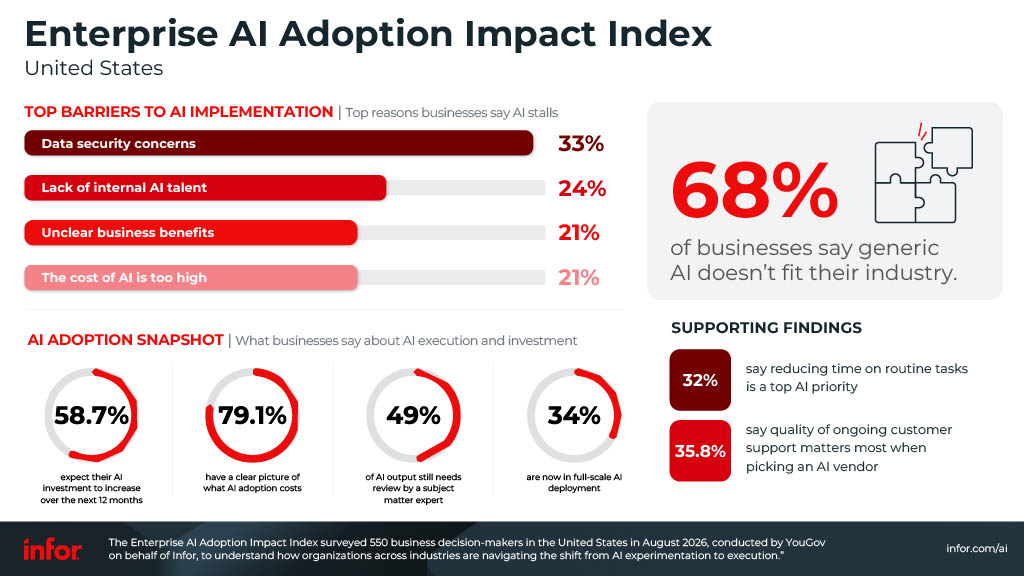
This next phase of Infor’s evolution responds to needs that generic ERP and AI cannot meet. Backed by the second edition of the Infor Enterprise AI Adoption Impact Index, new proprietary research surveying over 2,000 business decision-makers across seven markets finds that most businesses believe generic AI tooling can’t deliver on their AI ambitions.

Infor Industry AI reinforces Infor’s commitment to developing industry-specific solutions built for the specific complexities and operational realities of a defined set of industries. The platform architecture is built to help close the value void, the gap between what technology can promise and what companies achieve, and help businesses become agentic enterprises, where people and agents work as one coordinated team.

As AI deployment accelerates, businesses need expert agents they can trust to act, and trust only scales when those agents are coordinated across the enterprise rather than operating as isolated point solutions. Infor’s Industry AI agents are built with industry-specific context already in place, designed to reduce the errors and guesswork that come with generic AI, use tokens efficiently, and shorten the path from deployment to value.

Infor Industry AI is organized around four platform pillars:

PreciseOutcomes—An expanded suite of Industry AI agents with true micro-vertical AI expertise grounded in deep industry logic. Rather than reasoning from a generic, horizontal model, Infor’s Industry AI agents draw on Industry CloudSuites, Industry Process Catalogs, and industry-specific domain language models built from decades of in-house expertise. Customers using this layer are seeing shipments processed up to 60% faster. Paired with Industry AI Agents, the Infor GenAI Knowledge Hub provides customers with the depth of Infor’s application and industry knowledge to build custom AI Agents, now open to general availability.Open & Connected—An interoperable architecture that extends across the customer’s full ecosystem, not just Infor. Infor’s modular, open platform connects to non-Infor applications and existing orchestration and analytics tools, so customers are not required to standardize on a single vendor’s stack. Agents coordinate as one system through Infor IQ, the semantic layer that gives every agent a consistent understanding of the customer’s business, with a catalog of more than 350 value-driven use cases available out of the box.Easy to Use—Adaptive UX includes a personalized, AI-assembled experience that meets people in the tools they already work in. Infor’s Adaptive UX pulls what a decision requires, such as the bill of materials, quoted price, and delivery date, into a single role-aware view instead of ten screens across multiple applications, so users review and act in one step. Customers can work through the Infor GenAI Assistant or through the AI assistants they have already adopted, with no requirement to standardize on one. Customers are seeing up to 90% time savings across procurement, supply chain, manufacturing, and sales workflows.Governed—Enhanced Infor Governance, Risk, & Compliance capabilities bolster enterprise-grade security, governance, and auditability from the ground up. Human-approval workflows, agentic permission structures, and audit trails run throughout Infor’s orchestration layer, enabling customers to have critical benefits like accountability and traceability natively built into the architecture. Every agent action runs through a governance, risk, and compliance layer built into the core of the Infor Industry Cloud Platform with explainable AI logic and verifiable, immutable logging of every action taken. Customers are seeing up to a 90% reduction in auditing costs tied to access management.

Enterprise AI Adoption Impact Index: What Businesses Are Telling Us
Infor is also releasing the second edition of the Infor Enterprise AI Adoption Impact Index, surveying business decision-makers across seven markets. The data found that businesses’ investment in AI is outpacing efficiency gains, which Infor credits to the post-adoption gap often created by traditional AI and ERP solutions. Key findings include:

Finding 1: Businesses keep hitting the same wall: generic AI doesn’t speak their industry’s language.

When asking business leaders why their AI initiatives haven’t delivered the way they hoped, a familiar frustration emerges again and again: the tool wasn’t built for how their industry actually works. This was the majority view across six of the seven markets surveyed where two in three (68%) businesses said off-the-shelf AI doesn’t adequately address their industry’s needs.Finding 2: Some regions are pulling ahead on AI deployment while some regions are lagging, even as leaders grow comfortable handing critical decisions to autonomous agents.

Comparing the same questions from the first iteration of the Enterprise AI Adoption Index in April 2026, the markets surveyed both times, a clear divide opened up. Businesses in the US are accelerating deployment and seeing more efficiency gains than they were a few months ago. Germany held steady on both measures, favoring methodical pilot expansion over a rush to full scale. The UK’s picture is mixed: efficiency gains fell back while deployment edged forward. Overall, 59% of businesses globally expect AI investment to increase over the next 12 months. Now more than half (54%) of global leaders are comfortable with autonomous agents fully executing critical business processes without human input at every step. Just 11% of leaders prefer humans to make high-stakes decisions without any AI input.Finding 3: Almost nobody has figured out who’s actually accountable for AI, and that’s a problem hiding in plain sight.

Even as adoption accelerates, most businesses still haven’t answered a basic question: who’s responsible when AI gets something wrong? Across every market surveyed, accountability is scattered rather than centralized: 23% point to the CEO or executive leadership, 22% to the CIO or CTO, 15% to an AI committee or governance group, and 10% to individual department heads. Fifteen percent say no one person has primary responsibility, or it’s unclear who does. Chief AI Officer roles are still the exception rather than the rule everywhere, sitting at just 10% globally. That vacuum shows up in what leaders say they need most: 33% cite data security, sovereignty, or compliance as their single greatest barrier to advancing their AI strategy.Finding 4: Manufacturers feel the industry-fit problem more sharply than almost anyone else.

Pooled across all seven markets, 73% of manufacturing respondents said off-the-shelf AI doesn’t fit their needs, a sign that the complexity of real production environments, from shop-floor processes to supply-chain nuance, is exactly where generic AI tends to fall short. Distribution felt the gap even more acutely, at 76%, while retail trailed at 69%, together forming a consistent pattern: the more variable and hands-on the operating environment, the less generic AI delivers.

Quotes

“Everyone has the same AI models now. What matters is what those models know about your business,” said Kevin Samuelson, CEO, Infor. “Customers keep telling us that general-purpose AI doesn’t get the details of their world, like how a food manufacturer traces a bad lot back through its suppliers, or how a distributor has to reprice when freight costs jump. Our agents have access to our deep industry context to deliver precise and valuable outcomes.”

“AI only matters when it creates real value,” said Alicia Thompson, CTO, Team Air Distributing. “Infor has kept pace with our ambitions, pairing Infor Industry AI Agents with Forward Deployed Engineers who understand our industry and work as an extension of our team. Together, we’re reducing manual work and turning operational challenges into practical improvements, building trust one process at a time.”

“The next phase of enterprise AI will be defined not by access to models, but by how effectively organizations apply AI within the context of their industry and business processes,” said Shashi Bellamkonda, Principal Research Director at Info-Tech Research Group. “Infor’s focus on industry-specific intelligence, interoperability, and embedded governance addresses several of the practical barriers organizations face as they move from AI experimentation to trusted, measurable outcomes.”

Learn More:

Learn more about Infor Velocity SuiteRead the Enterprise AI Adoption Impact Index full reportRead the Enterprise AI Adoption Impact Index blogRegister for the virtual event: AI That Moves Your Industry ForwardFollow Infor on LinkedIn and Instagram

Frequently Asked Questions

What is Infor Velocity Suite?

Infor Velocity Suite is an all-inclusive AI package built for your industry. It includes industry-specific AI agents, GenAI, process mining, automation and a team of experts to implement it all for you. Infor Velocity Suite is designed to be the fastest path to real AI value and, ultimately, to becoming an agentic enterprise. Infor Velocity Suite is the single package through which customers access the capabilities announced today. It combines Infor Industry AI Agents, the Agentic Orchestrator, process mining, automation, prebuilt industry use cases, generative AI, and the implementation expertise to put them to work, all tied to a customer’s Industry Process Catalog. Rather than stitching together separate tools and consumption models from multiple vendors, customers adopt a single offer with unlimited access within fair business use, so adopting faster doesn’t mean a larger invoice.

What is the Infor Enterprise AI Adoption Impact Index?

It’s Infor’s proprietary research initiative tracking how enterprises are adopting, governing, and realizing value from AI over time. The October 2026 wave is the second in the series, surveying 2,111 business decision-makers across seven global markets, building on an initial April 2026 wave of 1,024 decision-makers across four markets.

What Was the Survey Methodology for the Infor Enterprise AI Adoption Impact Index Conducted?

The October 2026 wave was conducted in August 2026 and polled 2,111 business decision-makers across seven markets — the UK (254), US (550), Singapore (260), Japan (266), France (260), Australia (263), and Germany (258). Research was conducted by YouGov on behalf of Infor.

What does “off-the-shelf AI doesn’t fit our industry” actually mean?

In the survey, respondents were asked whether generic AI solutions adequately address their industry’s specific regulatory, workflow, and data requirements. Six of seven markets surveyed disagree by a clear majority — meaning most enterprises believe horizontal, one-size-fits-all AI tools fall short of what their industry actually requires, regardless of geography.

How does Infor’s architecture address the gaps this research identifies?

Infor’s architecture is built specifically around the two gaps the research surfaces most clearly. The industry-fit gap is addressed at the foundation: Infor’s CloudSuites and underlying data models are purpose-built for a defined set of industries, rather than generalized across every vertical, and a semantic/ontology layer gives agents industry-specific context rather than generic data to reason from. The governance-ownership gap is addressed through built-in auditability and human-approval workflows across the orchestration layer, so accountability and traceability are part of the architecture rather than something a customer has to bolt on separately.

What does “industry-specific context” actually mean at a technical level?

Infor’s agents draw on a shared semantic and knowledge layer — internally referred to during development as Infor IQ that gives every application in a CloudSuite a consistent understanding of core business concepts (what counts as a “location,” an “item,” a “customer”) along with the process- and industry-specific nuance underneath them. For example, an agent handling a raw-material order for a food manufacturer needs to understand an industry-specific spec like a sugar shipment’s Brix factor, while an agent handling an automotive parts order needs to understand a VIN number — two completely different kinds of precision that a generic, horizontal data model isn’t built to carry. Because Infor works across a defined, finite set of industries rather than attempting to serve every industry on the planet, it can build and maintain that depth of context in a way a horizontal platform serving dozens of unrelated industries structurally cannot.

Why does industry-specific context matter for things like accuracy and cost?

Enterprise AI agents typically need to call many technical, granular APIs to complete one piece of business work, which increases both the chance of errors and the compute cost of getting a task done. Infor’s architecture instead exposes business-level process APIs — the equivalent of “create a purchase order” rather than dozens of underlying technical calls — so agents can complete work in fewer steps. Combined with industry-specific context from the semantic layer, this is designed to reduce hallucination, improve reasoning accuracy, and lower the token cost of completing a given task relative to a generic AI approach working from generic data.

Does this replace a customer’s existing AI or orchestration tools?

No. Infor’s architecture is built to be open and composable — it’s designed to plug into a customer’s existing ecosystem, including third-party orchestration tools, rather than requiring a customer to replace what they already use. A single orchestration layer inside Infor coordinates work across Infor’s own applications regardless of which front-end experience or outside orchestrator a customer chooses to use.

About Infor
Infor is a global leader in business cloud software specialized by industry. We develop complete solutions for our focus industries. Infor’s mission-critical enterprise applications and services are designed to deliver sustainable operational advantages with security and faster time to value. Over 60,000 organizations in more than 175 countries rely on Infor’s 17,000 employees to help achieve their business goals. As a Koch company, our financial strength, ownership structure, and long-term view empower us to foster enduring, mutually beneficial relationships with our customers. Visit www.infor.com.

Media Contacts:
Infor Communications: inforpr@infor.com


View original content:https://www.prnewswire.com/news-releases/infor-unveils-its-expanded-infor-industry-ai-as-new-global-research-finds-off-the-shelf-ai-falls-short-for-two-out-of-three-businesses-302899181.html

SOURCE Infor

Continue Reading

Technology

ZINC SELENIDE (ZnSe) WINDOWS FOR HIGH-ENERGY AND LASER DEFENSE SYSTEMS

Published

on

By

PROVIDENCE, R.I., Oct. 6, 2026 /PRNewswire/ — Laser Research Optics has introduced new custom zinc selenide (ZnSe) windows manufactured to OEM specification for use in a wide range of high-energy laser (HEL) and directed-energy systems.

Laser Research ZnSe Windows can be manufactured in round, rectangle, and square shapes as plano-convex, plano-concave, and wedged-windows with coatings to achieve specific wavelengths from 7 to 11 µm. Designed for high-power laser systems where optical loss, thermal distortion, and beam quality are critical for performance, they can incorporate custom mounting features such as steps and holes.

Manufactured to ISO-10110 specifications, Laser Research ZnSe Windows are available in sizes from 0.5″ to 5″ O.D. with varying thicknesses, feature dimensional tolerances ranging from ±0.001″ to ±0.005″, depending upon configuration. Surface finishes from 10-5 to 80-50 scratch-dig and flatness of 10 waves to 1/20th wave are offered.

Laser Research ZnSe Windows are priced according to configuration and quantity.  Price quotations are available upon request.

For more information contact:

Laser Research Optics
A Division of Meller Optics, Inc.
Scott Rouillard, Sales Manager
120 Corliss St.
Providence, RI 02904
(888) 239-5545  FAX (401) 331-4004
e-mail: scott@laserresearch.net
www.laserresearchoptics.net

View original content to download multimedia:https://www.prnewswire.com/news-releases/zinc-selenide-znse-windows-for-high-energy-and-laser-defense-systems-302893580.html

SOURCE Laser Research Optics

Continue Reading

Technology

COBS Bread Partners with Deliverect to Simplify Digital Ordering Across North America

Published

on

By

Canada’s leading fresh-bread franchise chain deploys Deliverect to give every bakery a unified connection between third-party ordering and in-store operations

NEW YORK, Oct. 6, 2026 /PRNewswire/ — Deliverect, the global restaurant technology company powering digital ordering for restaurant brands worldwide, today announced a partnership with COBS Bread, one of the largest hand-crafted breads and treats bakery franchises in North America.

The partnership will create a more consistent ordering experience for customers while simplifying digital order management for COBS Bread bakery teams and franchisees across 200 stores. Every bakery will now have a standardized digital connection between third party ordering market places and its Boomi integration platform.

Through the partnership, orders placed on delivery marketplaces will be managed through the Deliverect Delivery Management App (DMA), with menu updates and pricing changes pushed across every location and every channel instantly. The result is a consistent digital ordering experience for customers and a materially simpler operational footprint for the franchisees running each bakery.

“Our bakery teams should be able to focus on baking fresh products and serving their customers, not managing disconnected ordering systems. Deliverect gives COBS Bread a consistent and scalable foundation for digital ordering across our bakery network,” said Ligia Costa, Senior Director of Technology at COBS Bread. “By bringing delivery and Click & Collect orders into one workflow, we are reducing manual effort and operational complexity while improving visibility and consistency. This allows our franchisees and bakery teams to spend less time managing multiple channels and more time focused on serving customers and growing their businesses”.

Built for an Independently Operated Bakery Network

COBS Bread bakeries are independently operated, making simplicity, reliability, and consistency critical to the successful adoption of new technology. Any new platform must reduce complexity at the bakery level and support a consistent experience without taking bakery teams away from serving customers and their communities.

Deliverect’s platform is designed for exactly that model. Third-party orders are processed in the same workflow as any other order, without separate tablets or manual re-keying. Menu updates, pricing adjustments, and item availability changes propagate instantly across every marketplace and every location, so franchisees can focus on baking and serving the community rather than on maintaining digital channels.

“COBS Bread is one of the most respected franchise brands in North America — a business built on quality, consistency, and community. Powering their digital ordering across 200 bakeries means giving every franchisee the same reliable connection to today’s ordering marketplaces, without adding operational overhead to their day-to-day. That’s exactly what our platform is built for,” said Noah Hayes, VP at Deliverect.

A Foundation for Continued Growth

COBS Bread is one of the fastest-growing bakery concepts in Canada, with a track record of opening more than 20 new bakeries per year. Standardizing digital ordering on Deliverect gives the brand a proven platform that new franchisees can plug into on day one, ensuring every new bakery joins the network with the same digital foundation as every existing location.

About COBS Bread
COBS Bread (BD Canada Ltd.) bakeries are a one-of-a-kind family-owned bakery franchise with a vision to be the favourite bakery in every community. Every morning at each of its +180 bakeries, all bread, treats, buns, scones (and more) are baked-from-scratch and hand-crafted. All leftover products are donated to local charities at the end of each day, allowing COBS Bread to donate over $50 million of retail products annually. 

About Deliverect
Deliverect is a global restaurant technology company that connects digital ordering channels directly to in-store operations, serving more than 80,000 restaurant locations worldwide. With an API-first platform and over 1,000 certified integrations, Deliverect streamlines digital ordering across carryout, delivery, catering, and in-store fulfillment. It is the only digital ordering platform to have earned DoorDash’s Excellent integration rating. By leveraging AI-driven innovation, Deliverect empowers restaurants to anticipate demand, recover lost revenue, and grow smarter at scale. The company processes 30 million API calls daily, has powered 1.5+ billion orders to date, and is trusted by many of the world’s largest and most innovative restaurant brands. To learn more, visit deliverect.com.

Media Contact:
Oier Fano Dadebat
Senior Content Marketing Manager, PR & Communications, Deliverect
oier.fano@deliverect.com

COBS Bread Media Contact:
Madison Rankine, Marketing Specialist, Social Media, Content, PR
madison.rankine@cobsbread.com

View original content to download multimedia:https://www.prnewswire.com/news-releases/cobs-bread-partners-with-deliverect-to-simplify-digital-ordering-across-north-america-302899479.html

SOURCE Deliverect

Continue Reading

Trending