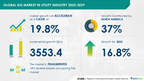
NEW YORK, Jan. 9, 2025 /PRNewswire/ — Report on how AI is driving market transformation – The global gis in utility industry market size is estimated to grow by USD 3.55 billion from 2025-2029, according to Technavio. The market is estimated to grow at a CAGR of over 19.8% during the forecast period. Increased adoption of GIS solutions in utility industry is driving market growth, with a trend towards increased use of GIS for water management. However, threat from open-source gis software poses a challenge. Key market players include AABSyS IT Pvt. Ltd., Autodesk Inc., Avineon Inc., Bentley Systems Inc., Blue Marble Geographics, Cadcorp Ltd., Caliper Corp., Environmental Systems Research Institute Inc., General Electric Co., Hexagon AB, Mapbox Inc., Maxar Technologies Inc., Mobile GIS Services Ltd., NV5 Global Inc., Orbital Insight Inc., Pitney Bowes Inc., Schneider Electric SE, SuperMap Software Co. Ltd., Trimble Inc., and VertiGIS Ltd..
Key insights into market evolution with AI-powered analysis. Explore trends, segmentation, and growth drivers- View Free Sample PDF
GIS In Utility Industry Market Scope
Report Coverage
Details
Base year
2024
Historic period
2019 – 2023
Forecast period
2025-2029
Growth momentum & CAGR
Accelerate at a CAGR of 19.8%
Market growth 2025-2029
USD 3553.4 million
Market structure
Fragmented
YoY growth 2022-2023 (%)
16.8
Regional analysis
North America, Europe, APAC, Middle East and Africa, and South America
Performing market contribution
North America at 37%
Key countries
US, China, Canada, Japan, Germany, Russia, India, Brazil, France, and UAE
Key companies profiled
AABSyS IT Pvt. Ltd., Autodesk Inc., Avineon Inc., Bentley Systems Inc., Blue Marble Geographics, Cadcorp Ltd., Caliper Corp., Environmental Systems Research Institute Inc., General Electric Co., Hexagon AB, Mapbox Inc., Maxar Technologies Inc., Mobile GIS Services Ltd., NV5 Global Inc., Orbital Insight Inc., Pitney Bowes Inc., Schneider Electric SE, SuperMap Software Co. Ltd., Trimble Inc., and VertiGIS Ltd.
Market Driver
The utility industry is embracing Geographic Information System (GIS) technology to enhance operations and improve customer experience. Trends like Spatial Context, Site Selection, and Land Acquisition are key areas where GIS solutions are making a difference. In Utility Planning and Designing, GIS enables better Visualization and Building of infrastructure. Smart Cities and Urban Planning rely on Geospatial Data from Satellite Imaging, Aerial Photography, and Remote Sensors for effective decision-making. GIS software and Digital Reality Solutions like Building Information Modeling, Augmented Reality (AR), and 4D GIS software are transforming Utility Industry projects. GIS solutions are essential for Grid Modernization, Water Management, and Transportation applications. Startups and Software Solutions are revolutionizing the Geospatial Industry with innovative hardware and enterprise solutions. Geospatial technology is crucial for Infrastructure Management, Public Safety, Natural Resources, and Defense Industries. GIS is vital for Agriculture, Mining, and Smart City projects. Modern GIS solutions offer licensing, permitting, and digital asset solutions to streamline business processes like Enterprise Resource Planning, Customer Relationship Management, and Business Process Management. Geospatial data barriers are being addressed with advanced GIS tools, making data accessible for Utilities, Water, Electric, and Gas customers.
GIS plays a significant role in the utility industry, particularly in water management and agriculture. For water management, GIS provides tools for assessing and managing water resources through simulation models. These models aid in making informed decisions regarding water flow rate, turbidity, pH, oxygen levels, and bacteria content. In agriculture, GIS enhances precision by offering detailed spatial data on soil moisture, crop health, and irrigation needs. This information enables farmers to optimize water usage effectively. Additionally, GIS facilitates groundwater management by mapping aquifer locations and monitoring recharge rates, which is essential in water-scarce regions. GIS solutions help identify leakages and manage pressure, ensuring efficient water usage in utility networks.
Request Sample of our comprehensive report now to stay ahead in the AI-driven market evolution!
Market Challenges
• The utility industry is embracing Geographic Information Systems (GIS) to tackle various challenges in Spatial Context, Site Selection, Land Acquisition, Planning, Designing, Visualizing, Building, Project Management, and more. GIS solutions are essential for Smart Cities and Urban Planning, enabling the use of Geospatial Data from Satellite Imaging, Aerial Photography, and Remote Sensors. AI, Sensors, and Digital Reality Solutions are transforming Utility Industry with Building Information Modeling, Augmented Reality (AR), and 4D GIS software. GIS plays a crucial role in Water Management, Mapping Systems, Grid Modernization, Transportation, and Infrastructure Management. Startups and Software Solutions are revolutionizing the Geospatial Industry with Enterprise Solutions, ERP, CRM, and BPM. Transport, Public Safety, Natural Resources, Defense Industries, Agriculture, and Mining are also benefiting from modern GIS solutions. However, Geospatial Data Barriers, Licensing, Permitting, and Infrastructure Management remain significant challenges. Investments in modern GIS solutions are essential to overcome these hurdles and provide Smart Utilities, Green Buildings, and Smart Urban Planning.
• Open-source GIS software has gained significant traction in the utility industry market, particularly in emerging economies like China and India. Small and medium-sized enterprises (SMEs) in these countries, which constitute a large portion of the market, are unable to afford the high cost of commercial GIS software. Consequently, they have turned to open-source alternatives. Even large companies are increasingly opting for open-source software as part of their cost-cutting measures. In the Asia Pacific region, where software products frequently change, open-source GIS software is a popular choice among companies. This shift towards open-source software poses a challenge to the sales and pricing strategies of commercial GIS software providers.
Discover how AI is revolutionizing market trends- Get your access now!
Segment Overview
This gis in utility industry market report extensively covers market segmentation by
Product 1.1 Software1.2 Data1.3 ServicesDeployment 2.1 On-premises2.2 CloudGeography 3.1 North America3.2 Europe3.3 APAC3.4 Middle East and Africa3.5 South America
1.1 Software- The global GIS market in the utility industry encompasses a range of software solutions designed to cater to the unique requirements of utility companies, including electricity, gas, water, and telecommunications providers. The software segment includes Geographic Information System (GIS) Software, Asset Management Software, Network Design and Planning Software, Field Service Management Software, and Mobile GIS Applications. GIS Software serves as the foundation for managing and analyzing geographical data, enabling utility firms to store, manipulate, analyze, and visualize maps, satellite imagery, and aerial photos. Asset Management Software helps track and manage physical assets, such as transformers, poles, pipes, and meters, by connecting to GIS platforms for a comprehensive view of asset data alongside geographic information. Network Design and Planning Software assists utility firms in organizing and planning their infrastructure, using GIS data to identify the most effective locations and routes for infrastructure components. Field Service Management Software streamlines field operations by managing service requests, dispatching technicians, and monitoring work orders, with real-time visibility of field activities based on location. Mobile GIS Applications provide utility personnel with access to geospatial data on smartphones or tablets, enabling them to view asset data, gather field data, and perform inspections locally. The software segment’s growth is driven by the increasing need for efficient infrastructure management, regulatory compliance, and the integration of advanced technologies like IoT and AI. The ongoing digital transformation in the utility sector and the adoption of smart grid and smart city concepts are expected to fuel the growth of the software segment in the global GIS market in utility industry during the forecast period.
Download a Sample of our comprehensive report today to discover how AI-driven innovations are reshaping competitive dynamics
Research Analysis
The utility industry is increasingly embracing Geospatial technology to enhance efficiency, improve decision-making, and promote sustainable development. Spatial context plays a crucial role in site selection and land acquisition for utility projects. Geospatial technology aids in planning and designing, allowing for visualization of projects in 3D using Building Information Modeling (BIM) and Augmented Reality (AR). In the utility industry, Geospatial technology is essential for water management, mapping systems, and grid modernization. Smart Cities are leveraging these technologies for transportation planning, green buildings, and smart urban planning. Geospatial industry solutions include software and hardware offerings from startups and established companies. Geospatial technology is revolutionizing utility infrastructure planning with smart city planning, land use management, and smart infrastructure planning. Geospatial technology is also transforming utility operations with smart utilities, enabling real-time monitoring and predictive maintenance. Overall, Geospatial technology is a game-changer for the utility industry, driving innovation and sustainability.
Market Research Overview
The utility industry is leveraging Geographic Information Systems (GIS) to enhance operational efficiency and improve customer service. GIS technology provides a spatial context for site selection, land acquisition, planning, designing, visualizing, building, and project management in the utility industry. Geospatial data from satellite imaging, aerial photography, remote sensors, and artificial intelligence (AI) are used for water management, mapping systems, grid modernization, and transportation applications. GIS solutions enable smart city planning, urban planning, green buildings, and smart urban planning. Startups and software solutions offer 4D GIS software, augmented reality (AR) platforms, and digital reality solutions for enterprise applications, including Enterprise Resource Planning, Customer Relationship Management, and Business Process Management. GIS technology is also used in surveying, construction, public safety, natural resources, transportation, defense industries, agriculture, mining, and smart city projects. Licensing and permitting processes are streamlined with modern GIS solutions, enabling infrastructure management and digital asset solutions for water, electric, and gas utility customers.
Table of Contents:
1 Executive Summary
2 Market Landscape
3 Market Sizing
4 Historic Market Size
5 Five Forces Analysis
6 Market Segmentation
ProductSoftwareDataServicesDeploymentOn-premisesCloudGeographyNorth AmericaEuropeAPACMiddle East And AfricaSouth America
7 Customer Landscape
8 Geographic Landscape
9 Drivers, Challenges, and Trends
10 Company Landscape
11 Company Analysis
12 Appendix
About Technavio
Technavio is a leading global technology research and advisory company. Their research and analysis focuses on emerging market trends and provides actionable insights to help businesses identify market opportunities and develop effective strategies to optimize their market positions.
With over 500 specialized analysts, Technavio’s report library consists of more than 17,000 reports and counting, covering 800 technologies, spanning across 50 countries. Their client base consists of enterprises of all sizes, including more than 100 Fortune 500 companies. This growing client base relies on Technavio’s comprehensive coverage, extensive research, and actionable market insights to identify opportunities in existing and potential markets and assess their competitive positions within changing market scenarios.
Contacts
Technavio Research
Jesse Maida
Media & Marketing Executive
US: +1 844 364 1100
UK: +44 203 893 3200
Email: media@technavio.com
Website: www.technavio.com/
View original content to download multimedia:https://www.prnewswire.com/news-releases/gis-in-utility-industry-market-to-grow-by-usd-3-55-billion-2025-2029-driven-by-increased-gis-adoption-in-utilities-ai-powered-market-insights—technavio-302345613.html
SOURCE Technavio










 Technology5 days ago
 Technology4 days ago
 Technology5 days ago
 Technology5 days ago
 Coin Market4 days ago
 Coin Market4 days ago
 Technology4 days ago