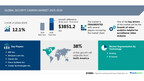
NEW YORK, Jan. 10, 2025 /PRNewswire/ — Report on how AI is driving market transformation – The global security camera market size is estimated to grow by USD 3.85 billion from 2025-2029, according to Technavio. The market is estimated to grow at a CAGR of 12.1% during the forecast period. Growth of video analytics helpful for surveillance video analyses is driving market growth, with a trend towards growing adoption of iot and smart homes. However, challenges regarding privacy and data loss poses a challenge. Key market players include ADT Inc., Amazon.com Inc., Canon Inc., Cisco Systems Inc., Costar Technologies Inc., Dahua Technology Co. Ltd., Hangzhou Hikvision Digital Technology Co. Ltd., Hanwha Techwin America, Honeywell International Inc., Johnson Controls International Plc, JVCKENWOOD Corp., Motorola Solutions Inc., Panasonic Holdings Corp., Robert Bosch GmbH, Schneider Electric SE, Simplisafe Inc., Sony Group Corp., Teledyne Technologies Inc., Vicon Industries Inc., and Xiaomi Inc..
Key insights into market evolution with AI-powered analysis. Explore trends, segmentation, and growth drivers- View Free Sample PDF
Security Camera Market Scope
Report Coverage
Details
Base year
2024
Historic period
2019 – 2023
Forecast period
2025-2029
Growth momentum & CAGR
Accelerate at a CAGR of 12.1%
Market growth 2025-2029
USD 3851.2 million
Market structure
Fragmented
YoY growth 2022-2023 (%)
9.9
Regional analysis
North America, APAC, Europe, South America, and Middle East and Africa
Performing market contribution
North America at 38%
Key countries
US, China, Germany, Canada, UK, France, Japan, India, South Korea, and Italy
Key companies profiled
ADT Inc., Amazon.com Inc., Canon Inc., Cisco Systems Inc., Costar Technologies Inc., Dahua Technology Co. Ltd., Hangzhou Hikvision Digital Technology Co. Ltd., Hanwha Techwin America, Honeywell International Inc., Johnson Controls International Plc, JVCKENWOOD Corp., Motorola Solutions Inc., Panasonic Holdings Corp., Robert Bosch GmbH, Schneider Electric SE, Simplisafe Inc., Sony Group Corp., Teledyne Technologies Inc., Vicon Industries Inc., and Xiaomi Inc.
Market Driver
The security camera market is experiencing significant growth due to increasing operational needs for safety and crime prevention. Traditional security cameras are being replaced by smart security solutions, including AI-powered appliances and IP cameras with high-definition and infrared capabilities. Innovations like facial recognition, motion detection, and anomaly detection are driving consumer interest. Cost-effective options, such as box cameras and dome cameras, offer ease of installation and scalability. Strategic partnerships and promotions are making advanced security solutions more accessible to homeowners and businesses. With the rise of the Internet of Things, cloud-based video surveillance and mobile surveillance systems are becoming essential for both home and commercial security. Despite investment costs, the benefits of AI-driven analytics, incident response times, and thermal imaging outweigh the risks of misuse and privacy concerns. Security camera systems are essential for crime prevention, border security, and critical infrastructure protection, making them a worthwhile investment for private properties and public spaces.
The Security Camera market is experiencing significant growth due to the increasing adoption of Internet of Things (IoT) devices, specifically smart cameras, for residential security. These advanced cameras come equipped with video analytics and recognition capabilities, enabling them to monitor and identify family members, pets, and objects. Consumers can record and view security events in real-time via their smartphones. Additionally, vendors offer smart doorbells and peepholes, replacing traditional models with cameras that detect people entering or exiting homes and monitor objects outside. Indoor smart cameras can also be used to monitor pets or babies from a distance.
Request Sample of our comprehensive report now to stay ahead in the AI-driven market evolution!
Market Challenges
• The security camera market is witnessing significant growth due to the increasing operational needs for safety and crime prevention in various sectors. Traditional security solutions like analog surveillance and dome cameras are being replaced by smart security cameras with advanced features like infrared, AI-powered appliances, and high-definition cameras. These innovations offer benefits such as anomaly detection, facial recognition, and two-way audio. However, challenges include investment costs, ease of installation, and privacy concerns. In high-risk areas like border security and critical infrastructure, scalable AI-driven analytics and thermal imaging are essential. Homeowners seek cost-effective, smart home technology solutions with long battery life and remote control. Strategic partnerships and promotions drive consumer interest. Despite these advancements, security risks and privacy protections remain crucial considerations. Incident response times and evidence collection are essential for investigations. Smart city development and mobile surveillance systems offer new opportunities. Overall, the market requires continuous innovation to address operational needs and consumer demands.
• IP-based security cameras offer valuable surveillance solutions for businesses, but they also present significant cybersecurity risks. Hackers can launch various attacks, such as DDoS, MiTM, data breaches, APTs, and ransomware, exploiting vulnerabilities in these devices. Weak passwords and mass-produced, identical cameras make them easy targets. Compromised security cameras can disrupt networks and potentially provide a gateway to larger IT infrastructure breaches. Businesses must prioritize securing their IP-based security cameras to mitigate these risks.
Discover how AI is revolutionizing market trends- Get your access now!
Segment Overview
This security camera market report extensively covers market segmentation by
Technology 1.1 Analog1.2 IP basedProduct Type2.1 HD and full-HD2.2 Non-HDGeography 3.1 North America3.2 APAC3.3 Europe3.4 South America3.5 Middle East and AfricaSystemApplicationFeatureCamera resolutionType
1.1 Analog- Analog cameras are a cost-effective solution for businesses seeking continuous surveillance through closed-circuit television (CCTV) systems. These cameras transmit video signals over cable to video cassette recorders (VCRs) and digital video recorders (DVRs), offering resolution ranges compliant with National Television Standards Committee (NTSC) and Phase Alternating Line (PAL) standards. Resolutions range from 420 to 1080 pixels, ensuring clear images. Analog cameras can connect via coax cables, twisted-pair cables, or wireless connections. Vendors provide advanced features such as infrared light-emitting diodes (IR LEDs) for night vision, 1080 pixels analog high definition (AHD), 1080 composite video interface (CVI), and complementary metal-oxide-semiconductor (CMOS) sensors with Infrared Cutfilter Removal (ICR) for accurate color reproduction. Cameras are built with Ingress Protection rated metal, safeguarding against dust, sand, rain, and snow. VCRs and DVRs are essential for video recording, with offerings up to 50 terabytes of storage, motion-detecting push notifications, remote viewing via smartphones, tablets, and computers, advanced recording and playback options, and scheduling recording 24/7 or by motion detection. Vendors also provide customer care services and a three-year warranty. Analog cameras are commonly used in city infrastructure surveillance, ATM banking outlets, construction sites, and indoor retail environments due to their affordability and advanced features. With a lower average selling price (ASP) and technological advancements like AHD and pan-tilt-zoom (PTZ), the analog segment will continue driving growth in the global security camera market.
Download a Sample of our comprehensive report today to discover how AI-driven innovations are reshaping competitive dynamics
Research Analysis
The Security Camera Market encompasses various segments, including video surveillance systems, CCTV, and smart home security. Accessories such as lenses, mounts, and cables enhance the functionality of these systems. Security camera technology continues to evolve, offering advanced features like analytics, remote monitoring, and cloud-based solutions. Organizations across industries rely on security cameras for benefits like deterrence, evidence collection, and improved safety. Installation and integration with business systems are crucial considerations. Security camera pricing varies based on factors like resolution, type, and advanced features. Privacy concerns and cybersecurity are essential aspects of the security camera market. Standards and regulations ensure data protection. Comparison of different security camera solutions based on their features, advantages, and ROI is vital for making informed decisions. The market’s growth is driven by increasing security concerns, technological advancements, and the integration of security systems with other business solutions. Security camera revenue is expected to continue growing as demand for advanced and cost-effective solutions increases. Innovations like AI and machine learning are transforming the market, offering improved monitoring, analytics, and cybersecurity. Maintenance and software updates are essential for ensuring optimal performance and security. Security camera manufacturers cater to various applications, from residential to industrial, providing customized solutions to meet diverse needs. The market’s trends reflect the shift towards more advanced, cost-effective, and user-friendly systems.
Market Research Overview
The security camera market is experiencing significant growth due to the increasing operational needs for safety and crime prevention in various sectors. Traditional security solutions, such as analog surveillance cameras, are being replaced by innovative smart security cameras with features like infrared technology, AI-powered appliances, and high-definition cameras. These advanced security solutions offer benefits like anomaly detection, facial recognition, and two-way audio. Investment costs for security camera systems have decreased with the advent of scalable IP cameras and the Internet of Things. Smart city development and border security are major drivers of growth, with AI-driven analytics and cloud-based video surveillance becoming essential components. Consumers, including homeowners, are showing increased interest in smart home devices and security solutions, leading to promotions and discounts. Expertise in security camera installation and maintenance is crucial for effective surveillance coverage. In high-risk areas, security cameras are used to prevent incidents like burglary, unauthorized access, and intruders. Thermal imaging and motion detection are effective surveillance tools for crime prevention. However, privacy concerns and data protection laws necessitate privacy protections and data redundancy. Security risks and misuse are potential challenges, requiring strategic partnerships and incident response times. Scalability and cost-effectiveness are essential considerations for commercial security and mobile surveillance systems. Overall, the market for security cameras is continuously evolving with innovations like machine learning and deep learning engines.
Table of Contents:
1 Executive Summary
2 Market Landscape
3 Market Sizing
4 Historic Market Size
5 Five Forces Analysis
6 Market Segmentation
TechnologyAnalogIP BasedProduct TypeHD And Full-HDNon-HDGeographyNorth AmericaAPACEuropeSouth AmericaMiddle East And AfricaSystemApplicationFeatureCamera resolutionType
7 Customer Landscape
8 Geographic Landscape
9 Drivers, Challenges, and Trends
10 Company Landscape
11 Company Analysis
12 Appendix
About Technavio
Technavio is a leading global technology research and advisory company. Their research and analysis focuses on emerging market trends and provides actionable insights to help businesses identify market opportunities and develop effective strategies to optimize their market positions.
With over 500 specialized analysts, Technavio’s report library consists of more than 17,000 reports and counting, covering 800 technologies, spanning across 50 countries. Their client base consists of enterprises of all sizes, including more than 100 Fortune 500 companies. This growing client base relies on Technavio’s comprehensive coverage, extensive research, and actionable market insights to identify opportunities in existing and potential markets and assess their competitive positions within changing market scenarios.
Contacts
Technavio Research
Jesse Maida
Media & Marketing Executive
US: +1 844 364 1100
UK: +44 203 893 3200
Email: media@technavio.com
Website: www.technavio.com/
View original content to download multimedia:https://www.prnewswire.com/news-releases/security-camera-market-to-grow-by-usd-3-85-billion-from-2025-2029–driven-by-video-analytics-for-surveillance-and-ai-powered-market-evolution—technavio-302346893.html
SOURCE Technavio








 Technology5 days ago
 Technology4 days ago
 Coin Market4 days ago
 Coin Market4 days ago
 Technology4 days ago
 Technology4 days ago