Technology
Corporate Training Market to grow by USD 43.86 Billion (2025-2029), driven by cost-effective e-learning, Report with market evolution powered by AI – Technavio
Published
1 year agoon
By
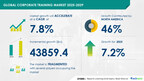
NEW YORK, Feb. 6, 2025 /PRNewswire/ — Report on how AI is driving market transformation – The global corporate training market size is estimated to grow by USD 43.86 billion from 2025-2029, according to Technavio. The market is estimated to grow at a CAGR of 7.8% during the forecast period. Emergence of cost-effective e-learning training modules is driving market growth, with a trend towards emergence of iot and wearable devices. However, technical constraints to implement corporate training poses a challenge. Key market players include Adobe Inc., Articulate Global Inc., Blanchard Training and Development Inc., BTS Group AB, Cegos Group, Cisco Systems Inc., City and Guilds Group, D2L Inc., DEMOS, Development Dimensions International Inc., Educomp Solutions Ltd., Franklin Covey Co., John Wiley and Sons Inc., Korn Ferry, Learning Technologies Group Plc, Mind Gym Plc, NIIT Ltd., Richardson Sales Performance, Simplilearn, and Skillsoft Corp..
Key insights into market evolution with AI-powered analysis. Explore trends, segmentation, and growth drivers- View Free Sample PDF
Corporate Training Market Scope
Report Coverage
Details
Base year
2024
Historic period
2019 – 2023
Forecast period
2025-2029
Growth momentum & CAGR
Accelerate at a CAGR of 7.8%
Market growth 2025-2029
USD 43859.4 million
Market structure
Fragmented
YoY growth 2022-2023 (%)
7.2
Regional analysis
North America, Europe, APAC, South America, and Middle East and Africa
Performing market contribution
North America at 46%
Key countries
US, UK, Germany, Canada, Japan, China, India, South Korea, France, and Italy
Key companies profiled
Adobe Inc., Articulate Global Inc., Blanchard Training and Development Inc., BTS Group AB, Cegos Group, Cisco Systems Inc., City and Guilds Group, D2L Inc., DEMOS, Development Dimensions International Inc., Educomp Solutions Ltd., Franklin Covey Co., John Wiley and Sons Inc., Korn Ferry, Learning Technologies Group Plc, Mind Gym Plc, NIIT Ltd., Richardson Sales Performance, Simplilearn, and Skillsoft Corp.
Market Driver
The corporate training market is thriving as businesses prioritize upskilling and reskilling their employees to meet the demands of a knowledge-based economy. Remote work and workplace learning are trending, with soft skills, diversity initiatives, and digital skills in high demand. Talent development is key to business goals like performance, retention, and competitiveness. Training methods include virtual, continuous, and specialized programs. Budget and time constraints, economic uncertainty, and organizational requirements shape training decisions. Technology implementations, such as digital tools, automation, and artificial intelligence, require digital literacy and skills. Training providers offer personalized learning activities through chatbots and virtual assistants, with continuous measurement and feedback ensuring quality. Employees’ productivity and efficiency depend on a continuous learning culture, employee engagement, and satisfaction. Industries like FMCG, Pharmaceutical and Healthcare, Financial Services, Professional Services, Public Enterprises, and Information Technology all benefit from technology-enabled training programs.
The corporate training market has seen a significant shift towards digital solutions, with the Internet of Things (IoT) and wearable devices playing a pivotal role. Wearable devices, such as smart glasses like Google Glass and smartwatches like the Apple Watch, offer convenience and time-saving benefits. These devices can be used for tracking trainee attendance and monitoring performance in real-time, making training sessions more efficient. In collaboration with educational technologies like augmented reality (AR) and virtual reality (VR), wearable devices have the potential to create accurate, multidimensional simulations for learning and development in modern organizations. This approach enhances the training experience and improves overall performance.
Request Sample of our comprehensive report now to stay ahead in the AI-driven market evolution!
The corporate training market is a vital aspect of upskilling and reskilling employees to meet business goals in today’s knowledge-based economy. With remote work becoming the new norm, workplace learning has shifted to various learning activities. Soft skills, diversity initiatives, and digital skills are essential for an adaptable workforce in a competitive and sustainable growth environment. However, challenges persist. Economic uncertainty and financial constraints impact budgets for training programs. Time constraints due to work schedules and employee engagement are crucial. Training providers offer virtual training methods for continuous learning and development, but personalization and continuous measurement are key to employee satisfaction and retention. Technological adoption, such as digital tools, automation, and artificial intelligence, necessitates specialized training programs for digital literacy and skills. Organizational requirements and employee performance are closely linked, making quality training essential for productivity and efficiency. Industries like FMCG, Pharmaceutical and Healthcare, Financial Services, Professional Services, Public Enterprises, and Information Technology have unique training needs due to rapid innovation and operational efficiency requirements. Learning Management Systems and mobile devices enable e-learning, making training more accessible. Continuous learning culture, employee morale, and turnover rates are crucial indicators of a successful training program.
Corporate training solutions face technical constraints in the form of customization and integration in the corporate sector. Customization is essential to cater to specific user requirements, reducing time and complexity. However, it increases operating costs, particularly for small-scale companies. Vendors must provide technical support to enhance product functionality, but may withdraw it due to cost reductions. This creates challenges for companies in implementing effective corporate training programs. Customization and documentation facilitate easy upgrades, yet come with added expenses. Companies must weigh these factors to optimize their training investments.
Discover how AI is revolutionizing market trends- Get your access now!
This corporate training market report extensively covers market segmentation by
ProductTechnical TrainingNon-technical TrainingTypeBlendedE-learningGeographyNorth AmericaEuropeAPACSouth AmericaMiddle East And AfricaIndustriesRetailPharmaceutical And HealthcareFinancial ServicesProfessional ServicesPublic EnterprisesInformation TechnologyOthers Industries
1.1 Technical training- The global corporate training market for non-technical skills is expected to experience significant growth during the forecast period. This growth is driven by the increasing importance of soft skills in enhancing employee productivity and driving business success. Non-technical training covers areas such as leadership development, team-building, problem-solving, and management techniques. These training programs are learner-centric and focus on outcomes that can be measured using behavioral objectives. Organizations are recognizing the value of investing in their employees’ personal and professional development, leading to increased productivity and business growth. Non-technical skills are essential for optimizing technical skills and are in high demand across industries and professions. Training programs are not limited to new employees but are also offered to mid-level and senior management to help them make effective decisions and facilitate business growth. With the increasing focus on people management and the skills gap, senior and HR managers are prioritizing soft skills training. The trend is expected to continue as service-based industries expand and soft skills become increasingly important in client-facing roles and marketing positions. Training providers are responding to this demand by offering mobile and online learning programs to cater to modern learners. For instance, Skillsoft offers a leadership skills development program featuring technology-enabled e-learning solutions, while Vital Smarts provides a leadership training program called Influencer Training. Collaborations between organizations and training vendors to enhance non-technical learning and development programs are expected to fuel the growth of the global corporate training market during the forecast period.
Download a Sample of our comprehensive report today to discover how AI-driven innovations are reshaping competitive dynamics
The Corporate Training Market is a dynamic and evolving industry focused on upskilling and reskilling employees to meet the demands of the knowledge-based economy. With remote work becoming increasingly common, workplace learning has taken on new meaning, incorporating virtual training methods and learning management systems. Soft skills, such as communication and problem-solving, are in high demand, as are diversity initiatives to foster inclusive workplaces. Business goals, employee performance, and retention are key drivers for corporate training. Technical training spans various industries, including Pharmaceutical and Healthcare, Financial Services, Professional Services, Public Enterprises, and Information Technology. Learning activities are delivered through various methods, including e-learning and mobile devices, and continuous development is essential for staying competitive.
The Corporate Training Market is a dynamic and evolving landscape that focuses on upskilling and reskilling employees to meet the demands of a knowledge-based economy. With remote work becoming increasingly prevalent, workplace learning has shifted to include various learning activities that prioritize soft skills, diversity initiatives, and continuous development. Business goals such as performance, retention, and competitiveness drive the need for talent development in various sectors, including FMCG, Pharmaceutical and Healthcare, Financial Services, Professional Services, Public Enterprises, and Information Technology. Training methods have evolved to include virtual training methods, continuous learning, and specialized programs tailored to organizational requirements. Digital transformation and technological adoption have led to the implementation of digital tools, automation, and artificial intelligence, necessitating the development of digital skills and literacy. Training providers offer personalized solutions to address budget constraints, time constraints, and employee engagement, utilizing chatbots, virtual assistants, data analytics, and continuous measurement for feedback and quality training. Employees’ productivity, efficiency, and morale are key indicators of a successful training program, contributing to sustainable growth and adaptation in a rapidly innovating business environment.
1 Executive Summary
2 Market Landscape
3 Market Sizing
4 Historic Market Size
5 Five Forces Analysis
6 Market Segmentation
ProductTechnical TrainingNon-technical TrainingTypeBlendedE-learningGeographyNorth AmericaEuropeAPACSouth AmericaMiddle East And AfricaIndustriesRetailPharmaceutical And HealthcareFinancial ServicesProfessional ServicesPublic EnterprisesInformation TechnologyOthers Industries
7 Customer Landscape
8 Geographic Landscape
9 Drivers, Challenges, and Trends
10 Company Landscape
11 Company Analysis
12 Appendix
Technavio is a leading global technology research and advisory company. Their research and analysis focuses on emerging market trends and provides actionable insights to help businesses identify market opportunities and develop effective strategies to optimize their market positions.
With over 500 specialized analysts, Technavio’s report library consists of more than 17,000 reports and counting, covering 800 technologies, spanning across 50 countries. Their client base consists of enterprises of all sizes, including more than 100 Fortune 500 companies. This growing client base relies on Technavio’s comprehensive coverage, extensive research, and actionable market insights to identify opportunities in existing and potential markets and assess their competitive positions within changing market scenarios.
Technavio Research
Jesse Maida
Media & Marketing Executive
US: +1 844 364 1100
UK: +44 203 893 3200
Email: media@technavio.com
Website: www.technavio.com/
View original content to download multimedia:https://www.prnewswire.com/news-releases/corporate-training-market-to-grow-by-usd-43-86-billion-2025-2029-driven-by-cost-effective-e-learning-report-with-market-evolution-powered-by-ai—technavio-302368583.html
SOURCE Technavio
You may like
Technology
MARIANA MINERALS RESTARTS UTAH COPPER MINE AS THE WORLD’S ONLY AUTONOMOUS-FIRST MINE AND REFINERY
Published
2 hours agoon
April 27, 2026By
Software-first minerals company integrates autonomous haulage, drilling, and robotic sensing across mining and refining under a single AI operating platform
SAN JUAN COUNTY, Utah, April 27, 2026 /PRNewswire/ — Mariana Minerals, the world’s only software-first, vertically integrated minerals company, today announced the restart of mining operations at Copper One in southeastern Utah. The restart marks a milestone in mining history: Copper One becomes the world’s first mine to deploy autonomous tools across all three operational domains (mining, refining, and capital project execution) unified under a single operating system.
Mariana acquired Lisbon Valley Mining Company in Q4 2025, gaining control of a roughly 10,000-acre permitted land package that has produced high-purity copper cathode since 2009. While refinery operations continued uninterrupted, mining was paused in late 2024. Mining operations resume this month with autonomous systems and autonomous orchestration active from day one.
“Copper One will be the first mine where delivering end-to-end autonomy is the priority, where it’s being rapidly deployed across mining and refining operations and coordinated by our internal software stack. That’s what MarianaOS makes possible. We chose to prove it here because the stakes are real: the U.S. has a structural copper deficit, and the window to close it is narrowing. We’re producing now and ramping output aggressively, with the primary goal of achieving fully-autonomous mining operations,” said Turner Caldwell, Co-Founder & CEO, Mariana Minerals.
MarianaOS: An Autonomy-First Mining Operating System
What makes Copper One unprecedented is not any single piece of autonomous equipment, but the intelligence layer coordinating them. MarianaOS integrates three core subsystems, MineOS, PlantOS, and CapitalProjectOS, into a unified platform spanning project execution through copper production.
On the mining side, Copper One will begin with integrating three best-in-class autonomous equipment platforms. Pronto’s turnkey Autonomous Haulage System (AHS) uses camera-based machine learning and Global Navigation Satellite Systems (GNSS) to enable fully driverless haul truck operation, with OEM-agnostic retrofit capability across mixed fleets. Sandvik’s AutoMine® platform enables autonomous production drilling, allowing operators to simultaneously monitor multiple surface machine operations from a remote-operations control center. And Boston Dynamics’ Spot quadruped robots autonomously patrol the open pit, heap leach pad, and solvent extraction-electrowinning (SX-EW) refinery infrastructure. All of these data feed directly into MineOS, enabling fleet-wide optimization and continuous improvement.
PlantOS extends autonomous operations into refining by integrating real-time sensor data across the entire refining process (solution chemistry, flow rates, temperature, and electrowinning cell performance) into a unified control system. Machine learning models predict process drift, automatically adjust reagent dosing, and flags maintenance needs before they impact output. The result is a continuously optimized refinery that operates with minimal human intervention.
CapitalProjectOS redefines how capital-intensive infrastructure projects are planned and executed. Traditional projects often take a decade or more and frequently suffer from chronic cost overruns. CapitalProjectOS integrates process development, engineering, procurement, construction, and commissioning data into a single platform that enables real-time progress tracking, predictive risk modeling, and automated schedule optimization. At Copper One, CapitalProjectOS is managing the expansion roadmap to scale output to 50,000 metric tons per year, coordinating heap leach pad expansions, refinery upgrades, and autonomous equipment deployment in parallel.
Built to Move Fast
While Mariana is actively constructing and developing greenfield projects – with the goal of compressing engineering, procurement, construction, and commissioning timelines leveraging CapitalProjectOS – Copper One is uniquely positioned to accelerate deployment of MarianaOS at scale. With an existing open pit mine, heap leach pad, and SX-EW refining infrastructure already in place, Mariana will rapidly ramp production that would take years to replicate elsewhere.
Mariana’s longer-term plan is to scale Copper One output to 50,000 metric tons per year of high-purity copper cathode by 2030, leveraging additional proven deposits on the property and integrating copper scrap recycling.
A Critical Supply Gap
The U.S. currently imports approximately 50% of its refined copper. With domestic demand projected to nearly double by 2035 — driven by AI data centers, defense systems, EVs, and grid modernization — the supply gap is a national security issue. The Trump Administration’s Section 232 investigation cited copper imports as a direct concern, and the Pentagon has identified critical minerals vulnerability as a threat to the defense industrial base.
Domestic operations like Copper One, and the step-change in productivity that autonomous operations deliver, have become strategically essential.
About Mariana Minerals
Mariana engineers, builds, and operates mines and refineries, using proprietary AI and machine learning tools to accelerate project execution and optimize production across critically needed metals. Copper One is Mariana’s second active project, alongside Lithium One, the world’s first GWh-scale lithium extraction facility from oil and gas produced water, currently under construction in East Texas. Mariana has raised $120 million in total capital, including a Series A led by Andreessen Horowitz with participation from Breakthrough Energy Ventures, Khosla Ventures, and strategic investors.
View original content to download multimedia:https://www.prnewswire.com/news-releases/mariana-minerals-restarts-utah-copper-mine-as-the-worlds-only-autonomous-first-mine-and-refinery-302753491.html
SOURCE Mariana Minerals
Technology
State CISOs Report Lower Confidence Across the Public Sector Cyber Ecosystem, 2026 NASCIO-Deloitte Survey Finds
Published
2 hours agoon
April 27, 2026By
The 2026 National Association of Chief Information Officers – Deloitte biennial cybersecurity study finds state officials face increasingly sophisticated threats, including new artificial intelligence-enabled tactics, and highlights steps CISOs are taking to better protect public data and critical digital services
NEW YORK, April 27, 2026 /PRNewswire/ —
Key takeaways
The survey of Chief Information Security Officers (CISOs) from all 50 states and two territories found that just 26% of state CISOs are “extremely” or “very” confident that their state’s information assets are protected from cyber threats, down from 48% in 2022.Implementing effectiveness metrics is now CISOs’ top priority: 49% named it a top cybersecurity initiative in 2026, up from 15% in 2022.Nearly all state CISOs (94%) said they are involved in developing Generative AI security policies and 84% are involved in Generative AI strategy development.Budget pressure is rising with 16% of CISOs reporting their budgets have been cut, up from none in 2024.The percentage of CISOs who described themselves as “not very confident” in the ability of local government and public higher education to secure public data rose significantly, from 35% in 2022 to 63% in 2026.
Why this decline in confidence matters
States share data and systems with counties, cities, and public colleges and universities, so a vulnerability in one network can cascade, exposing personal information, disrupting essential services and driving costly incident response. As attackers adopt AI-enabled tactics, the urgency is growing for faster coordination, clearer policy and stronger baseline defenses across the public sector. This may explain why roughly one-fifth of CISOs indicated that their states were moving toward a “whole-of-state” approach to cybersecurity.
Metrics reporting becomes CISOs’ top priority
Top priorities for CISOs have shifted since the 2024 survey. When asked to identify their states’ top cybersecurity initiatives for 2026, half of CISOs named implementing effectiveness metrics (49%, up from 25% in 2024 and 15% in 2022). Capturing the effectiveness of cyber spending can be difficult, but without metrics, it is challenging to show the benefits of investments. Tracking operational, compliance and risk-based key performance indicators, such as incident response time and phishing click rate, can help demonstrate the return on cyber investment.
AI both accelerates threats and becomes a frontline defense
AI is accelerating the scale and sophistication of attacks targeting public sector systems, making it easier and cheaper for adversaries to generate and automate cyberattacks. CISOs also point to an emerging threat toolkit, including deepfakes that can fool people and evade detection, AI agents that probe for weaknesses and adapt, and AI-driven ransomware-as-a-service operations.
At the same time, CISOs describe AI as a practical way to keep pace, using it to triage security alerts, summarize events, and explore faster report creation, threat identification and training. Several states are already utilizing Generative AI in core security operations, including security information and event management (SIEM) and security orchestration, automation and response (SOAR). The report also underscores how central CISOs have become to state AI efforts.
Key quotes
“We’re seeing more states move toward a ‘whole-of-state’ cybersecurity approach where the state helps extend protection beyond state agencies to local governments, public education and other critical entities that can become an entry point for attackers. At its core, it’s about scaling capabilities through shared services and better collaboration so a weakness in one part of the ecosystem doesn’t become a statewide incident. Many states are looking to scale capabilities through security operations centers and regional support, so counties, cities and schools can benefit from the same cyber-defense muscle as the enterprise.”
Mike Wyatt, Stale local and higher education cyber risk leader, Deloitte
“It’s an encouraging development that state CISOs are being placed at the center of Generative AI security. They are helping shape the strategy, establishing security policies and reviewing proposed use cases. By being involved from the beginning, CISOs are helping governments move faster without sacrificing safeguards because security and governance complement each other. We’re also seeing CISOs explore practical uses of AI to strengthen day-to-day defense, while putting clearer guardrails around responsible uses.”
Meredith Ward, deputy executive director, NASCIO
Additional data
To read the 2026 NASCIO-Deloitte report in its entirety, click here.
About NASCIO
The National Association of State Chief Information Officers is the premier network and resource for state CIOs and a leading advocate for technology policy at all levels of government. NASCIO represents state chief information officers and information technology executives from the states, territories, and the District of Columbia. For more information about NASCIO visit www.nascio.org.
As used in this document, “Deloitte” means Deloitte & Touche LLP, a subsidiary of Deloitte LLP. Please see www.deloitte.com/us/about for a detailed description of our legal structure. Certain services may not be available to attest clients under the rules and regulations of public accounting.
View original content to download multimedia:https://www.prnewswire.com/news-releases/state-cisos-report-lower-confidence-across-the-public-sector-cyber-ecosystem-2026-nascio-deloitte-survey-finds-302751899.html
SOURCE Deloitte
Technology
Duck Creek Kicks Off Formation ’26 as Strong Fiscal Momentum Signals Accelerating Demand for its Intelligent Core Insurance Platform
Published
2 hours agoon
April 27, 2026By
Company highlights double-digit SaaS growth, global expansion, and launch of its new agentic AI platform as industry leaders gather in Orlando
BOSTON, April 27, 2026 /CNW/ — Duck Creek Technologies, the intelligent core of insurance, today kicks off Formation ’26: Agents of Innovation, its flagship user conference, as the company builds strong momentum in the first half of fiscal 2026, marked by double-digit year-over-year SaaS ARR growth fueled by new logos and expansion across its global customer base.
Duck Creek’s strong start to fiscal 2026 reflects this demand, with double-digit new customer wins and existing customer expansions across its core, specialty, and AI-powered solutions. Adoption of Duck Creek’s intelligent cloud continues to scale globally. Insurers are selecting Duck Creek for its enterprise depth including policy, billing, claims, rating, loss control, reinsurance, distribution management, and payments solutions to operate faster, more accurately, and maintain regulatory compliance.
“We are expanding our leadership in insurance technology with more than 370 customers globally. Including 33 of the top 50 North American insurers,” said Hardeep Gulati, Chief Executive Officer of Duck Creek. “Insurers modernizing their core systems are looking for more from their technology. They need a trusted partner like Duck Creek with proven enterprise scale and speed-to-value to help them drive profitable impact and growth. At Formation, we are excited to announce our new agentic platform that will help further improve the combined ratios for insurers with more than $150B in premium flowing through Duck Creek annually.”
Formation ’26 will bring together more than 800 insurance professionals, ecosystem partners, and industry leaders to explore how technology is transforming the insurance lifecycle. The event underscores growing market demand for intelligent, cloud-native platforms that enable insurers to accelerate cloud migration, product development, and automate core insurance workflows to accelerate decision-making and improve operational agility. A highlight of the event will be Duck Creek unveiling its agentic AI platform and showcasing live demonstrations of agentic applications and agents.
Formation ’26 will feature a distinguished lineup of guest speakers joining Gulati during his keynote, including Stephen Lord, Global CIO of AXIS Capital, and Monti Saroya, Senior Managing Director and Co-Head of the Flagship Fund at Vista Equity Partners. Together, they will share perspectives on large-scale transformation, AI adoption, and the future of agentic insurance.
The conference will also include a customer panel moderated by Chief Operating Officer Chris McCloskey, featuring leaders from Core Specialty, Europ Assistance, and Arbella Insurance, who will discuss their transformation journeys and business outcomes achieved through modern core systems. An analyst panel moderated by SVP of Sales William Magowan will bring together experts from AM Best, Celent, and Datos Insights to provide an external view on market trends and innovation benchmarks.
Customer Momentum
Millers Mutual Insurance advanced its modernization strategy with Duck Creek OnDemand, implementing Policy, Billing, and Reinsurance Clarity to modernize its core systems and support continued growth in the multifamily housing insurance market.Anchor Group Management Inc. partnered with Duck Creek to modernize its insurance payments infrastructure, enabling more streamlined billing processes and improved digital payment experiences for policyholders.Frankenmuth Insurance adopted Duck Creek OnDemand Distribution Management to transform how it manages agencies and producers, increasing visibility, improving operational efficiency, and strengthening collaboration across its distribution network.Indigo Insurance turned to Duck Creek OnDemand to accelerate its modernization strategy and support rapid growth, gaining a scalable cloud-based core platform designed to bring new products to market faster.Encova Insurance went live on an upgraded Duck Creek OnDemand Distribution Management system, unifying agency operations across lines of business, streamlining onboarding, and improving the overall agent experience.New Zealand’s Medical Assurance Society (MAS) selected Duck Creek’s full suite of core solutions delivered via OnDemand to modernize its general insurance business, enhance member experiences, and support a broader digital and data-driven transformation.Country-Wide Insurance selected Duck Creek Clarity to strengthen its data and analytics capabilities, enabling real-time insights and preparing for its upcoming OnDemand go-live with Active Delivery.Fortegra selected Duck Creek Reinsurance and Duck Creek Clarity to modernize financial operations, improve portfolio transparency, and support continued growth across products, geographies, and distribution models.Duck Creek secured more than a dozen additional new customer engagements across commercial specialty and personal lines.
Industry Recognition
Named a Leader in the 2025 Gartner Magic Quadrant for SaaS P&C Insurance Core Platforms North America, marking the seventh consecutive year the company has been recognized as a Leader.Named a Leader in the Everest Group 2025 Underwriting Orchestration Products PEAK Matrix Assessment, recognizing Duck Creek’s strength in delivering AI-driven underwriting, integrated core workflows, and measurable value across global P&C carriers.Featured in Everest Group’s 2026 Voice of the Customer Report for Insurance CXOPs, outperforming both core system peers and the market average, with customers citing strengths in seamless implementation, deep core system integration, and enterprise scalability and more.Received the 2025 IDC FinTech Real Results Award for Insurance Transformation for measurable customer outcomes.
About Duck Creek
Duck Creek is the intelligent core that leading insurers choose to build on. Purpose-built for property and casualty (P&C) and general insurance, Duck Creek unifies the full insurance lifecycle on a single platform with one data foundation. As an agentic platform, it connects intelligence across underwriting, policy, billing, claims, and payments workflows where decisions are made and compliance is non-negotiable. Duck Creek enables carriers to launch products faster, adapt quickly to change, and grow with precision and confidence. Solutions are available individually or as a full suite via Duck Creek OnDemand. Visit www.duckcreek.com and follow Duck Creek on LinkedIn and X.
Media Contacts:
Marianne Dempsey / Tara Stred
duckcreek@threeringsinc.com
View original content to download multimedia:https://www.prnewswire.com/news-releases/duck-creek-kicks-off-formation-26-as-strong-fiscal-momentum-signals-accelerating-demand-for-its-intelligent-core-insurance-platform-302753478.html
SOURCE Duck Creek Technologies, Inc.
ETH price up 10% in April, so why is Ethereum Foundation selling?
First 21-week trend line reclaim since October 2025: Five things to know in Bitcoin this week
MARIANA MINERALS RESTARTS UTAH COPPER MINE AS THE WORLD’S ONLY AUTONOMOUS-FIRST MINE AND REFINERY
Send Rakhi to UK swiftly with UK Gifts Portal
Whiteboard Series with NEAR | Ep: 45 Joel Thorstensson from ceramic.network
New Gooseneck Omni Antennas Offer Enhanced Signals in a Durable Package
Why You Should Build on #NEAR – Co-founder Illia Polosukhin at CV Labs
Whiteboard Series with NEAR | Ep: 45 Joel Thorstensson from ceramic.network
NEAR End of Year Town Hall 2021: The Open Web World, MetaBUILD 2 Hackathon and 2021 recap
Trending
-
Coin Market5 days agoThailand regulator mulls crypto futures expansion in licensing overhaul
-
Coin Market5 days agoLazarus-linked macOS malware hits crypto and fintech firms
-
Technology4 days agoSBI Life Insurance registers New Business Premium of ₹42,551 crores for the year ended on 31st March, 2026
-
Technology4 days agoCGI renews global SAP S/4HANA operations and SAP BTP operations certifications, reinforcing its consistent, quality delivery at scale
-
Technology5 days agoMILLROCK TECHNOLOGY APPOINTS NEIL A. GOLDMAN AS CFO
-
Technology5 days agoRhythMedix Launches Next-Generation RhythmStar® SL Cardiac Monitor
-
Technology4 days agoGreenzie releases 2025 Annual Safety Report, documenting multi-year safety performance at commercial scale
-
Technology5 days agoNew Study Reveals Retail Security Measures Are Driving Customers Away