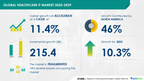
NEW YORK, Feb. 7, 2025 /PRNewswire/ — Report with market evolution powered by AI – The global healthcare IT market size is estimated to grow by USD 215.4 billion from 2025-2029, according to Technavio. The market is estimated to grow at a CAGR of almost 11.4% during the forecast period. Increasing focus on improving quality of services and efficiency is driving market growth, with a trend towards emergence of ai-enabled emotion recognition technologies. However, vulnerability of emrs toward cybercrime poses a challenge. Key market players include 3M Co., athenahealth Inc., Cognizant Technology Solutions Corp., Dassault Systemes SE, Datavant, Dell Technologies Inc., Epic Systems Corp., GE Healthcare Technologies Inc., International Business Machines Corp., Koninklijke Philips NV, McKesson Corp., Microsoft Corp., Oracle Corp., SAS Institute Inc., Siemens AG, Tata Consultancy Services Ltd., Tenet Healthcare Corp., Optum Inc., Veradigm LLC, and Wipro Ltd..
Key insights into market evolution with AI-powered analysis. Explore trends, segmentation, and growth drivers- View Free Sample PDF
Healthcare IT Market Scope
Report Coverage
Details
Base year
2024
Historic period
2019 – 2023
Forecast period
2025-2029
Growth momentum & CAGR
Accelerate at a CAGR of 11.4%
Market growth 2025-2029
USD 215.4 billion
Market structure
Fragmented
YoY growth 2022-2023 (%)
10.3
Regional analysis
North America, Europe, APAC, South America, and Middle East and Africa
Performing market contribution
North America at 46%
Key countries
US, Canada, Germany, UK, China, Japan, France, Italy, India, and South Korea
Key companies profiled
3M Co., athenahealth Inc., Cognizant Technology Solutions Corp., Dassault Systemes SE, Datavant, Dell Technologies Inc., Epic Systems Corp., GE Healthcare Technologies Inc., International Business Machines Corp., Koninklijke Philips NV, McKesson Corp., Microsoft Corp., Oracle Corp., SAS Institute Inc., Siemens AG, Tata Consultancy Services Ltd., Tenet Healthcare Corp., Optum Inc., Veradigm LLC, and Wipro Ltd.
Market Driver
The healthcare IT industry is experiencing significant growth, according to the latest research study. The industry trend analysis shows that e-prescribing, interoperability, and security concerns are top priorities for healthcare organizations. A single diagram and multiple tables highlight the highest revenue-generating segments: electronic health records, clinical devices, and capacity management solutions. Healthcare systems are investing in healthcare providers to monitor and manage disease progression, coordinate care, and ensure patient safety. The Worldometer reports that over 6 million hospital beds are in use, requiring IT systems for communication and data exchange. Healthcare management focuses on specialty medications, ePrescriptions, and virtual healthcare. Prescribers and controlled substances are under scrutiny, leading to the adoption of electronic prior authorizations and remote monitoring. Smaller healthcare organizations and outpatient settings face unique challenges, including basic infrastructure, usability, and integration. Federal bodies are pushing for web-based management and information systems to improve patient information access and decision-making for healthcare professionals. Security concerns persist, with exploitation and proliferation of medical apps and consumer technology companies posing risks. Healthcare IT solutions, including RCM, are essential for managing patient care quality and purchasing power. Cloud-based solutions, AI & IoT technologies, and data security are key investments for integrated healthcare systems. Virtual reality (VR) and augmented reality (AR) are transforming medical imaging and patient management. Value-based payment models, payer-provider mergers, and quality reporting solutions are shaping the eHealth market. Big data, IT investments, and healthcare analytics solutions are driving innovation in patient care and personalized medicine. The future of healthcare IT includes virtual hospitals, remote patient monitoring, telemedicine solutions, and accountable care solutions. Artificial Intelligence (AI) and Machine Learning (ML) are revolutionizing care delivery and patient data management. Geriatric population growth and workflow management are major considerations for healthcare IT architecture. Healthcare IT solutions must address the unique needs of hospitals, ambulatory care centers, and IT systems while ensuring patient safety and data security.
In the healthcare industry, doctors and caregivers are utilizing advanced medical technologies, including Artificial Intelligence (AI), for precise ailment diagnosis and effective patient treatment. AI is gaining significant traction in the healthcare IT sector. One noteworthy application of AI is emotion recognition, which enables the technology to identify, decipher, and react to human emotions and moods. Telemedicine vendors, particularly those focusing on telepsychiatry, have begun implementing emotion recognition technology to comprehend patients’ feelings. This technology is beneficial for patients who are not physically present and may not verbally express their emotions to psychiatrists. AI’s ability to recognize emotions enhances the quality of remote healthcare services.
Request Sample of our comprehensive report now to stay ahead in the AI-driven market evolution!
Market Challenges
• The healthcare IT industry is experiencing significant growth, with e-prescribing, virtual healthcare, and electronic health records leading the way. However, challenges persist, such as interoperability issues and security concerns. According to a recent research study, the industry is projected to reach USD735.6 billion by 2025. Key trends include the use of clinical devices for coordinated care, capacity management solutions for hospital beds, and RCM solutions for healthcare organizations. EPrescriptions, electronic prior authorizations, and remote monitoring are also gaining popularity. However, smaller healthcare organizations and outpatient settings face unique challenges, including basic infrastructure and communication issues. According to a survey by United Health, 75% of US hospitals use web-based management systems, but only 30% have fully integrated IT systems. Security concerns remain a major challenge, with exploitation and proliferation of medical apps and consumer technology companies a growing concern. Healthcare providers must invest in trained IT personnel and data security measures to ensure patient care quality. The highest revenue-generating segments include healthcare systems, hospitals, and ambulatory care centers. Key players include Change Healthcare, Mass Media Data, and Healthcare IT solutions. The eHealth market is also seeing significant growth, with hardware, software, and electronic information systems driving innovation. Cloud-based solutions, AI & IoT technologies, and data security are key areas of investment. Despite these challenges, the future of healthcare IT looks promising, with virtual hospitals, telemedicine solutions, and value-based payment models transforming care delivery. However, usability, integration, and IT architecture remain key areas for improvement. Worldometer reports that there are currently over 7.9 billion people in the world, with an aging population and increasing demand for personalized medicine and geriatric care. Healthcare organizations must adapt to these trends to provide quality care and manage disease progression effectively. In conclusion, the healthcare IT industry is undergoing significant change, with e-prescriptions, electronic health records, and virtual healthcare leading the way. However, challenges such as interoperability issues, security concerns, and communication challenges persist. Healthcare organizations must invest in IT systems, trained IT personnel, and data security measures to provide quality patient care and adapt to the changing healthcare landscape.
• The healthcare industry’s reliance on IT and electronic communications for managing large data volumes has significantly advanced. However, this progress comes with risks, particularly cybercrime. Hacking of computers, software, and intranet portals pose threats to sensitive data such as medical records, patient personal information, and insurance details. Ensuring data accuracy is crucial for healthcare providers to deliver appropriate patient insights. As technology advances, it’s essential to prioritize cybersecurity measures to protect this valuable information.
Discover how AI is revolutionizing market trends- Get your access now!
Segment Overview
This healthcare it market report extensively covers market segmentation by
End-userHealthcare ProvidersHealthcare PayersComponentServicesSoftwareHardwareGeographyNorth AmericaEuropeAPACSouth AmericaMiddle East And Africa
1.1 Healthcare providers- The healthcare providers segment, which includes hospitals, clinics, laboratories, pharmacies, and ambulatories, is the largest and continuing leader in the global healthcare IT market. In recent years, technological advancements have significantly transformed healthcare, with medical facilities adhering to regulatory changes and enhancing patient care quality. Hospitals and physician offices, regardless of size, have embraced new technologies. These modern medical facilities are high-tech operations that provide skilled personnel with advanced technology. Healthcare IT adoption offers numerous benefits, such as improved care quality, accuracy, reduced costs, and seamless collaboration. The HITECH Act of 2009 mandated medical facilities to upgrade their IT infrastructure, particularly regarding electronic health records (EHRs). EHR systems enable healthcare professionals to securely capture and exchange vital patient health information, fostering teamwork and critical decision-making. Pharmacies have also adopted IT to streamline operations and access essential patient and medical data. Digital messaging facilitates faster, more direct communication between doctors and pharmacists, resolving concerns before patients arrive. Laboratories, too, have implemented IT services for efficient information management through Laboratory Information Systems (LIS). The integration of IT in healthcare leads to enhanced patient care, with advantages such as improved quality, accuracy, reduced costs, and seamless collaboration. As healthcare providers continue to adopt and optimize these technologies, the healthcare IT market within this segment will thrive during the forecast period.
Download a Sample of our comprehensive report today to discover how AI-driven innovations are reshaping competitive dynamics
Research Analysis
Title: Healthcare IT Industry Trends and Financial Insights: A Comprehensive Analysis of E-Prescribing, Interoperability, and Digital Health Introduction: The healthcare IT industry is witnessing significant growth, driven by the adoption of e-prescribing, interoperability, and digital health solutions. This research study provides an industry trend analysis of the healthcare IT market, focusing on revenue-generating segments such as hardware, software, electronic information systems, and eHealth. Key Findings: – The e-prescribing market is expected to grow at a CAGR of 12.2% from 2021 to 2028. – Interoperability issues continue to challenge the industry, with Change Healthcare and Mass Media Data leading the charge towards standardization. – The highest revenue-generating segment in 2020 was software, accounting for 52.6% of the total market share. – Hardware and cloud-based solutions are gaining popularity due to their cost-effectiveness and scalability. – AI & IoT technologies are revolutionizing healthcare IT, with applications in data security, remote patient monitoring, and predictive analytics.
Market Research Overview
Title: Healthcare IT Industry Trends and Market Analysis: A Comprehensive Overview The healthcare IT industry is experiencing significant growth as digital transformation reshapes care delivery. According to the latest research study, the global eHealth market is projected to reach USD618.8 billion by 2026, growing at a CAGR of 15.5% from 2021. Key industry trends include the adoption of e-prescribing, interoperability, and security concerns. E-prescriptions and electronic prior authorizations are becoming standard in healthcare organizations, with over 80% of US hospitals using electronic health records (EHRs). Interoperability issues persist, with the need for standardized data communication protocols and IT architecture. Healthcare providers are investing in capacity management solutions, such as remote monitoring and virtual healthcare, to manage disease progression and improve patient care quality. The highest revenue-generating segments include clinical solutions, patient care, and healthcare management. The healthcare IT industry comprises various stakeholders, including healthcare organizations, clinical devices, and information systems. The Worldometer reports over 7.9 billion patient beds worldwide, and the US alone has over 60,000 hospitals and ambulatory care centers. The industry faces challenges such as security concerns, exploitation, and proliferation of medical apps and consumer technology companies. Trained IT personnel are in high demand to manage these systems and ensure patient data security. The financial information reveals that the largest players in the healthcare IT industry include Change Healthcare, Mass Media Data, Healthcare IT solutions, and United Health. Federal bodies and RCM solutions are also significant contributors to the industry. The healthcare IT industry is evolving rapidly, with trends such as cloud-based solutions, AI & IoT technologies, and value-based payment models. The future of healthcare IT includes virtual reality (VR), augmented reality (AR), genomics, personalized medicine, and virtual hospitals. The industry’s growth is driven by the increasing purchasing power of healthcare organizations, the need for usability and integration, and the shift towards accountable care solutions and healthcare analytics. The survey reveals that smaller healthcare organizations and outpatient settings are also adopting IT solutions to improve care delivery and patient management. In conclusion, the healthcare IT industry is experiencing significant growth and transformation, driven by trends such as e-prescribing, remote monitoring, and cloud-based solutions. The industry faces challenges such as interoperability, security concerns, and the need for trained IT personnel. The future of healthcare IT includes AI, machine learning, and virtual hospitals, among other trends.
Table of Contents:
1 Executive Summary
2 Market Landscape
3 Market Sizing
4 Historic Market Size
5 Five Forces Analysis
6 Market Segmentation
End-userHealthcare ProvidersHealthcare PayersComponentServicesSoftwareHardwareGeographyNorth AmericaEuropeAPACSouth AmericaMiddle East And Africa
7 Customer Landscape
8 Geographic Landscape
9 Drivers, Challenges, and Trends
10 Company Landscape
11 Company Analysis
12 Appendix
About Technavio
Technavio is a leading global technology research and advisory company. Their research and analysis focuses on emerging market trends and provides actionable insights to help businesses identify market opportunities and develop effective strategies to optimize their market positions.
With over 500 specialized analysts, Technavio’s report library consists of more than 17,000 reports and counting, covering 800 technologies, spanning across 50 countries. Their client base consists of enterprises of all sizes, including more than 100 Fortune 500 companies. This growing client base relies on Technavio’s comprehensive coverage, extensive research, and actionable market insights to identify opportunities in existing and potential markets and assess their competitive positions within changing market scenarios.
Contacts
Technavio Research
Jesse Maida
Media & Marketing Executive
US: +1 844 364 1100
UK: +44 203 893 3200
Email: media@technavio.com
Website: www.technavio.com/
View original content to download multimedia:https://www.prnewswire.com/news-releases/healthcare-it-market-to-grow-by-usd-215-4-billion-from-2025-2029–driven-by-service-quality-and-efficiency-focus-with-ai-impact-on-market-trends—technavio-302371183.html
SOURCE Technavio









 Coin Market5 days ago
 Technology4 days ago

 Near Videos4 days ago
 Technology4 days ago
 Technology5 days ago
 Technology5 days ago