Connect with us

Technology

Disrupting Academia: David Hatami’s Vision for Ethical AI in Higher Education

Published

on

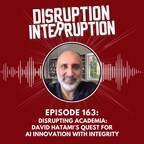
AI is rapidly reshaping higher education, creating a divide between those who embrace it and those who resist. On the Disruption Interruption podcast, David Hatami, Managing Director and Founder of EduPolicy.ai, explains how institutions can navigate the “Wild West” of AI adoption. He discusses the need for clear policies, ethical oversight, and data-driven governance to ensure AI enhances learning rather than undermines academic integrity.

TAMPA BAY, Fla., Feb. 19, 2025 /PRNewswire-PRWeb/ — With 60% of teachers now integrating AI into their daily teaching practices and 55% of educators reporting improved learning outcomes, the conversation around responsible AI adoption in education has never been more urgent. (1-2) In this week’s episode of Disruption Interruption, host Karla Jo Helms (KJ) sits down with David Hatami, Managing Director and Founder of EduPolicy.ai, to discuss how AI is reshaping academia. Hatami unpacks the challenges institutions face in the “Wild West” of AI adoption and shares insights on how data-driven decisions can enhance learning outcomes while mitigating risks. “We have a responsibility to teach AI literacy now,” highlights Hatami. “We are setting the bar for how the first generation of digital natives will teach subsequent generations to utilize technology.”

“We have a responsibility to teach AI literacy now. We are setting the bar for how the first generation of digital natives will teach subsequent generations to utilize technology” — David Hatami, Managing Director and Founder of EduPolicy.ai

The Wild West of AI in Higher Education: Adapt or Fall Behind
“Higher education is divided into two camps when it comes to AI adoption: ‘Camp GPT All Day’ and ‘Camp GPT No Way’,” explains Hatami. Some faculty members actively embrace AI, integrating it into their teaching by having students generate, refine, and critically assess AI-generated content. They see AI as a tool for engagement, deeper learning, and skill development. In contrast, others resist its use, fearing it undermines academic integrity or replaces essential critical thinking skills.

Bridging this AI divide is crucial to ensuring its responsible and effective use in education. “What we’re really looking at is a cultural paradigm shift,” says Hatami. “Technology is advancing faster than we are, and as a society, we must recalibrate to keep up.” But resistance alone will not stop AI’s influence. Without proper guidance, students will turn to AI anyway—without oversight, structure, or ethical considerations.

The Challenges of AI Without Clear Policies
Without clear policies, academic institutions are facing a growing backlog of AI-related integrity cases. Some faculty members reject AI outright, relying on detection tools to penalize students, while others offer second chances or escalate cases to the administration. “We’re creating an adversarial system where students claim they didn’t use AI, the software says they did, and administrators are left chasing their tails,” Hatami explains. “Every institution handles it differently, leading to inconsistency, frustration, and an overwhelmed administration.”

Meanwhile, students—who have grown up in a digital-first world—naturally turn to AI as a learning tool. Banning it doesn’t stop its use; it just drives it underground, leaving students without proper guidance. “The only ones benefiting from this cycle are the tech companies selling detection software,” Hatami notes. Institutions must decide whether to keep fighting a losing battle or implement structured, transparent policies that prepare students for the future.

EduPolicy.ai: A Data-Driven Approach to AI Governance
Many institutions are rushing to implement AI policies without first assessing how students, faculty, and administrators perceive and use AI. “Administrators have the authority to dictate policy, but it behooves them to acknowledge the challenge and recognize they’re not where they need to be,” Hatami emphasizes.

Without a grounded understanding of AI’s role in academia, policies risk being out of touch with reality. EduPolicy.ai works with institutions to gather data-driven insights, implement targeted training, and establish adaptive governance models that keep pace with AI’s rapid evolution. “We’ve developed a methodology that helps institutions assess their standing—gathering insights from students, faculty, administrators, and staff,” Hatami explains. “By integrating this information into customized training and governance programs, we ensure institutions aren’t just reacting to AI but actively shaping its responsible use in education.”

Links
Disrupting Academia: David Hatami’s Quest for AI Innovation with Integrity
https://omny.fm/shows/disruption-interruption/disrupting-academia-david-hatami-s-quest-for-ai-in
LinkedIn: https://www.linkedin.com/in/david-h-b288114/
Company Website: https://edupolicy.ai/

Disruption Interruption is the podcast where you will hear from today’s biggest Industry Disruptors. Learn what motivated them to bring about innovation and how they overcame opposition to adoption.
Disruption Interruption can be listened to in Apple’s App Store and Spotify.

About Disruption Interruption™
Disruption is happening on an unprecedented scale, impacting all manner of industries— MedTech, Finance, IT, eCommerce, shipping, logistics, and more—and COVID has moved their timelines up a full decade or more. But WHO are these disruptors and when did they say, “THAT’S IT! I’VE HAD IT!”? Time to Disrupt and Interrupt with host Karla Jo “KJ” Helms, veteran communications disruptor. KJ interviews badasses who are disrupting their industries and altering economic networks that have become antiquated with an establishment resistant to progress. She delves into uncovering secrets from industry rebels and quiet revolutionaries that uncover common traits—and not-so-common—that are changing our economic markets… and lives. Visit the world’s key pioneers that persist to success, despite arrows in their backs at http://www.disruption-interruption.com.

About David Hatami
David Hatami is a leading expert in AI ethics and policy, specializing in the responsible integration of artificial intelligence in higher education and industry. As the Founder and Managing Director of EduPolicy.ai, he develops frameworks and best practices that help institutions navigate the ethical and operational challenges of AI adoption.
With over 25 years of experience in higher education administration, curriculum development, and faculty training, David has worked across traditional universities, community colleges, and proprietary education programs. His expertise spans online pedagogy, student services, and academic operations, giving him a deep, systemic understanding of the education landscape.
Throughout his career, David has collaborated with institutions such as Career Education Corporation, St. Leo University, and Charter Universities, shaping policies and designing AI-driven educational solutions. In addition to his work in education, he holds an active Florida Health and Life insurance license and remains committed to lifelong learning and professional development.
A sought-after keynote speaker and thought leader, David is passionate about ensuring AI enhances, rather than compromises, the quality, accessibility, and ethics of education.

About Karla Jo Helms
Karla Jo Helms is the Chief Evangelist and Anti-PR® Strategist for JOTO PR Disruptors™. Karla Jo learned firsthand how unforgiving business can be when millions of dollars are on the line — and how the control of public opinion often determines whether one company is happily chosen, or another is brutally rejected. Being an alumnus of crisis management, Karla Jo has worked with litigation attorneys, private investigators, and the media to help restore companies of goodwill into the good graces of public opinion — Karla Jo operates on the ethic of getting it right the first time, not relying on second chances and doing what it takes to excel. Helms speaks globally on public relations, how the PR industry itself has lost its way, and how, in the right hands, corporations can harness the power of Anti-PR to drive markets and impact market perception.

References
1.    AIPRM. “AIPRM.” Aiprm.com, 11 July 2024, aiprm.com/ai-in-education-statistics/#overview-top-10-ai-in-education-statistics.
2.    Andre, Dave. “AI Statistics in Education: Market Size, Trends, and Future Impact.” All about AI, 14 May 2024, allaboutai.com/resources/ai-statistics/education/.

Media Inquiries:
Karla Jo Helms
JOTO PR™
727-777-4629

View original content to download multimedia:https://www.prweb.com/releases/disrupting-academia-david-hatamis-vision-for-ethical-ai-in-higher-education-302379916.html

SOURCE Disruption Interruption

Continue Reading
Click to comment

Leave a Reply

Your email address will not be published. Required fields are marked *

Technology

JAMS Launches AI for Enterprise Job Scheduling: JAX and JAMS MCP, on the Model You Choose

Published

on

By

A new AI agent and an open-standard connector let IT teams query, diagnose, and manage automation in plain language, on the model they choose, with operational data staying inside their own network

LONDON, July 24, 2026 /PRNewswire/ — JAMS Software, an orchestration solution for scheduled and event-driven automation, today announced the general availability of two AI capabilities for enterprise job scheduling: JAX, an AI agent built into the JAMS Web Client, and JAMS MCP, a connector built on the open Model Context Protocol standard that brings JAMS into external AI coding tools. Both capabilities ship at no additional cost as part of JAMS Web.

Automation environments grow faster than the teams that run them. Jobs multiply across SQL Server, Azure Data Factory, Airflow, SAP, JDE, and Banner, and when one fails, finding the root cause often means searching several consoles at once, frequently outside business hours. At the same time, IT leaders carry pressure to adopt AI while staying accountable for where operational data goes. JAX and JAMS MCP close both gaps together.

Full details on how JAX and JAMS MCP work, including the control model behind every action, are available at jamsscheduler.com/product/ai.

JAX is an AI agent that runs inside the JAMS Web Client. It finds jobs, troubleshoots failures, and answers how-to questions in plain language, with each response grounded in the JAMS user guide and checked against a built-in glossary. JAX acts only when a user asks it to. Reads flow freely, and every write action pauses for the user’s explicit approval before it runs. JAX does not learn between sessions, and conversations are not retained on the server.

JAMS MCP is a connector, built on the open Model Context Protocol standard, that brings JAMS into the AI tools engineering teams already use, including Cursor, VS Code with Copilot, Claude Code, Claude Desktop, and Codex. Users query jobs, investigate failures, and manage runs in plain language without leaving their tool.

Both capabilities run inside the customer’s own network and act as the signed-in user, with that user’s exact JAMS permissions. There is no elevated AI account: whatever a user cannot do in the JAMS interface, JAX and JAMS MCP cannot do on that user’s behalf. Every JAX and MCP operation is recorded in its own dedicated log, and changes made through the JAMS API land in the JAMS audit trail like any other change. Customers choose their own AI model, whether a commercial provider such as OpenAI or Anthropic or a model running entirely on their own hardware, and JAMS never trains on customer data. In the current release, neither feature edits or deletes a job, folder, schedule, or agent definition. For teams that must keep operational data within a defined boundary, JAX runs on a local model entirely inside the customer’s own network, so nothing leaves at all.

“Adopting AI usually means giving something up, most often visibility into where your data goes,” said Pete Hegland, Chief Executive Officer of JAMS Software. “We built JAX and JAMS MCP so that trade does not have to happen. Every action runs as the signed-in user, every change waits for approval, and the model itself can run entirely inside your own network.”

“IT teams across the United Kingdom and EMEA tell us the same thing: they want the benefit of AI without losing sight of where their data goes,” said Greg McLaughlin, Account Executive for EMEA at JAMS Software. “JAX and JAMS MCP let them keep operational data inside their own network and still get answers in plain language. That combination is what makes this practical for the teams I work with.”

JAX and JAMS MCP are available now to all JAMS Web customers across the United Kingdom and EMEA, with no separate licence, SKU, or additional cost. AI-assisted creation of new jobs and workflows from a plain-language description is on the roadmap for a future release, gated by the same approvals and permissions as every other action.

Learn how JAX and JAMS MCP work at https://jamsscheduler.com/product/ai.

Fast facts

JAX is an AI agent built into the JAMS Web Client for job scheduling and workflow automation.JAMS MCP is a connector built on the open Model Context Protocol standard, for Cursor, VS Code with Copilot, Claude Code, Claude Desktop, and Codex.Both act as the signed-in user, with that user’s exact JAMS permissions, and there is no elevated AI account.Customers choose the AI model, including a local model that runs entirely inside their own network.JAMS never trains on customer data.Both are available now at no additional cost as part of JAMS Web.

About JAMS Software

Founded in 1987, JAMS Software is an orchestration solution that helps IT teams centralize, automate, and manage scheduled and event-driven jobs across complex, hybrid environments. Over 850 customers rely on JAMS to run their automated workloads. JAMS Software, LLC is headquartered at 108 Patriot Drive, Suite A, Middletown, DE 19709.

Media Contact
Bobby Schmidt, Vice President of Marketing
press@jamssoftware.com
800.261.4267


Logo – https://mma.prnewswire.com/media/3007577/JAMS_logo.jpg
Photo – https://mma.prnewswire.com/media/3007578/jams_jax_ai_agent_job_scheduling_1.jpg
Photo – https://mma.prnewswire.com/media/3007579/jams_jax_mcp_ai_control_model.jpg
Photo – https://mma.prnewswire.com/media/3007580/jams_mcp_ai_connector_claude_cursor.jpg

View original content:https://www.prnewswire.co.uk/news-releases/jams-launches-ai-for-enterprise-job-scheduling-jax-and-jams-mcp-on-the-model-you-choose-302833908.html

Continue Reading

Technology

Video: CNPC offers green chemical answer

Published

on

By

BEIJING, July 24, 2026 /PRNewswire/ — A news report from chinadaily.com.cn:

Located on the edge of the Taklamakan Desert in Northwest China’s Xinjiang Uygur autonomous region, the Tarim 1.2 MTA Phase II Ethylene Project and its supporting green and low-carbon demonstration facility of PetroChina Dushanzi Petrochemical Company, a subsidiary of China National Petroleum Corporation, are offering a new example of China’s low-carbon industrial transformation.

Watch the video to discover how CNPC is exploring a cleaner and more circular future for the industry.

View original content to download multimedia:https://www.prnewswire.com/apac/news-releases/video-cnpc-offers-green-chemical-answer-302834036.html

SOURCE chinadaily.com.cn

Continue Reading

Technology

Shanghai Electric showcases embodied intelligence robot matrix and AI-native smart factory solutions at WAIC 2026

Published

on

By

Featuring humanoid robots with 41 degrees of freedom, pipe‑inspection robots with ±1mm positioning accuracy, and 51 industrial‑grade AI agents

SHANGHAI, July 24, 2026 /PRNewswire/ — Operations in high-end equipment manufacturing often involve confined spaces, complex objects, and fine manipulation tasks that demand sustained and stable precision. At the recent 2026 World Artificial Intelligence Conference and High-Level Meeting on Global AI Governance (WAIC 2026), Shanghai Electric (SEHK: 02727, SSE: 601727) showcased its comprehensive portfolio of embodied intelligence solutions tailored to a range of industrial scenarios.

Themed “AI for All: Smart Squad, Shining Without Limits,” Shanghai Electric highlighted its capabilities across embodied AI robots, robot core components, and AI-native smart factory solutions, demonstrating end-to-end capabilities spanning complete robot systems, critical parts, industrial software, and smart factory architecture.

“The true value of embodied intelligence lies in understanding real industrial tasks: combining the strength, precision, and stability of machines with human experience and judgment to drive a genuine paradigm of ‘machine-assisted, human-machine collaboration,'” said Wang Chunlei, deputy general manager of the Robotics Business Unit at Shanghai Electric Automation Group.

Shanghai Electric’s robotics portfolio covers five key industrial scenarios: connector insertion, electrical operations, flexible sorting, intelligent assembly, and pipe processing. Highlights include:

“SUYUAN” bipedal humanoid robot: With 41 degrees of freedom for enhanced mobility, it is equipped with a multimodal visual sensing system on the head and torso, along with a dual-battery hot-swap system. It is well-suited for inspection, material handling, and assembly tasks.”TUOYUAN” industrial wheeled humanoid robot: Powered by an embodied intelligence foundation model and force-position hybrid control, it is capable of multi-spec connector insertion, material sorting, and loading/unloading of automotive sheet metal parts.”Mermaid” bionic wheeled humanoid robot: Capable of autonomously identifying buttons, knobs, and air switches, it generates real-time operation paths.Autonomous pipe inner-wall chamfering robot: Designed for confined spaces, it can position and process thousands of hole edges with accuracy within 1 millimeter while transmitting data in real time.

Shanghai Electric also showcased its portfolio of core components ranging from power-output to end effectors. Among them, the planetary roller screw offers more than three times the load capacity of traditional ball screws, while the DexHand dexterous hand is designed to meet diverse gripping and manipulation requirements.

Shanghai Electric launched 51 AI models and agents under its “StarCloud Intelligent Manufacturing” series across three domains: R&D and design, production and manufacturing, and operations and maintenance—covering critical equipment processes such as process optimization and wind power facility maintenance.

These industrial agents are embedded in robotic decision-making systems and the operational logic of AI-native smart factories, transforming industrial expertise into digitized, reusable capabilities. They support production-line scheduling, quality inspection, and predictive maintenance, driving the evolution of manufacturing systems from experience-driven to data-driven operations.

Shanghai Electric also released the “AI-Native Smart Factory Technology White Paper,” proposing an active evolution architecture that enables real‑time, closed‑loop optimization of production data, giving the factory self‑perception, self‑decision, and self‑execution capabilities. Built on First Principles, the AI‑native smart factory vertically integrates process flows, industrial software, agents, and smart equipment to dismantle traditional hierarchies while horizontally bridging data silos. The architecture features three core layers: the AI factory brain as the “control center,” industrial agents and embodied robots as the “execution network,” and the physical twin as the “digital mirror.”

Leveraging its deep industrial expertise and comprehensive solution capabilities, Shanghai Electric will continue to drive the implementation of AI in industrial settings, tackle technical challenges facing embodied intelligence in complex scenarios, accelerate the large‑scale deployment of AI‑native smart factories, and deliver replicable solutions across diverse manufacturing environments.

SOURCE Shanghai Electric

Continue Reading

Trending