Technology
Automotive Event Data Recorder Market to Reach $3.2 Billion by 2032, Growing at a CAGR of 6.8% from 2025–Exclusive Report by Meticulous Research®
Published
1 year agoon
By
Market Growth Driven by Rising Regulatory Requirements, Insurance Premium Discount Demand, Fleet Safety Management, and Integration with Advanced Driver Assistance Systems
REDDING, Calif., May 15, 2025 /PRNewswire/ — According to a new market research report titled “Automotive Event Data Recorder Market by Component (Hardware, Software, Services), Vehicle Type (Passenger, Commercial), End User (Automotive OEMs, Commercial Fleet Operators, Insurance Industry), Distribution Channel, and Geography – Global Forecast to 2032”, the automotive event data recorder market is projected to reach $3.2 billion by 2032, up from an estimated $2.1 billion in 2025, growing at a CAGR of 6.8% during the forecast period. The growth of this market is mainly driven by rising regulatory requirements for vehicle safety systems, growing insurance premium discount demand, escalating emphasis on fleet safety management and operation efficiency, and integration of EDRs with Advanced Driver Assistance Systems (ADAS).
For more comprehensive insights, download the FREE report sample: https://www.meticulousresearch.com/download-sample-report/cp_id=6167
Key Market Drivers and Trends
The automotive event data recorder market is experiencing significant growth due to increasing accident investigation requirements and the evolution of conventional EDR designs to meet the growing need for accuracy and functionality in vehicle safety applications. Cloud-connected systems and high-end features such as video and audio recording capabilities are gaining traction, while the market is being powered by the transition from simple crash recording to full vehicle monitoring and AI-supported data analysis and event detection, especially in automotive OEMs, commercial fleet operations, and insurance sectors.
Latest trends in the automotive event data recorder market include integration with connected vehicle ecosystems and telematics, which is substantially enhancing data collection capabilities and real-time monitoring. The development of predictive analytics based on EDR data is creating new value propositions beyond traditional crash recording, while the advancement of EDR systems specifically geared to the development of autonomous vehicles is opening new applications by addressing the distinct monitoring and validation needs of autonomous technologies.
Growth Opportunities
The market presents substantial growth opportunities in integration with connected vehicle ecosystems and telematics, which is substantially enhancing data collection capabilities and real-time monitoring. Another major opportunity lies in the development of predictive analytics based on EDR data, creating new value propositions beyond traditional crash recording. Additionally, developing economies with enhanced road safety regulations are creating untapped regional markets for growth, making EDRs critical tools in overall safety efforts, while growing demand for value-added services through monetization of EDR data is generating recurring revenue streams for providers.
Get Insightful Data on Regions, Market Segments, Customer Landscape, and Top Companies (Charts, Tables, Figures and More) – https://www.meticulousresearch.com/product/automotive-event-data-recorder-market-6167
Market Challenges
Despite strong growth prospects, harmonizing data protection with security and analytics demands continues to be one of the bigger issues, especially in privacy-savvy economies. Protection against unauthorized use remains a continuing risk to deployability, even as systems become more integrated. Additionally, differing cross-border regulations and compliance levels complicate global deployment strategies, while standardization and interoperability problems with EDR data complicate platform integration. Technical limitations in the accuracy and completeness of crash data are limiting reliability in safety-critical applications, and integrating EDR technology into electric and autonomous vehicles introduces new engineering and compatibility challenges.
Segment Insights
The global automotive event data recorder market is segmented by component (Hardware, Software, Services), vehicle type (Passenger Vehicles, Commercial Vehicles), end user (Automotive OEMs, Commercial Fleet Operators, Insurance Industry, Public Sector & Government, Automotive Service Providers, Data Analytics Companies), distribution channel (Direct Channel, Aftermarket Retailers, Professional Installation Services), and geography (North America, Europe, Asia-Pacific, Latin America, and the Middle East & Africa).
Market by Component
The Hardware segment is expected to hold the largest share of the overall automotive EDR market in 2025, due to the essential role of EDR control units, sensors, storage systems, and connectivity modules in enabling core recording functionality. These components form the backbone of core recording capabilities, and their durable construction and dependable performance across diverse sensor types and storage formats make them suitable for use in passenger cars, commercial fleets, and specialized vehicles. However, the Software segment is projected to grow at the highest CAGR during the forecast period, driven by rising demand for advanced data analytics, crash detection algorithms, and driver behavior monitoring. This rapid expansion is fuelled by innovations in AI-powered analysis and a growing preference for cloud-integrated systems, particularly within fleet management, insurance evaluation, and next-generation safety solutions.
Market by Vehicle Type
The Passenger Vehicles segment is expected to dominate the overall automotive EDR market in 2025, primarily due to rising consumer demand for safety features, expanding regulatory requirements in developed economies, and the widespread adoption of EDRs in mid-size and luxury vehicles. These trends position passenger car applications as the key revenue driver, particularly in markets with sophisticated automotive safety regulations. However, the Electric Vehicles segment is expected to grow at the fastest CAGR through 2032, driven by the aggressive transition toward electric mobility, demand for specialized observation of EV powertrains, and higher use of sophisticated electronic systems. Specialized EDR systems to monitor EV-specific data points render this segment a key area of opportunity as the sector moves toward large-scale electrification.
Request a customized research analysis tailored to your specific requirements: https://www.meticulousresearch.com/request-customization/cp_id=6167
Market by End-User
The Automotive OEMs segment is expected to hold the largest share of the overall automotive EDR market in 2025, as it establishes foundational demand within the market with its growing trend of factory-installed EDR systems, increasing regulatory mandates, and the growing convergence of EDRs with more extensive in-vehicle systems. As the prime designers and manufacturers of vehicles, OEMs stand as the first implementers of EDR technology. However, the Insurance Industry segment is expected to experience the fastest growth rate during the forecast period, driven by the growing application of usage-based insurance programs, increased dependence on objective crash data for claim adjustment, and the industry’s migration toward data-based risk assessment.
Geographic Market Insights
In 2025, North America is expected to hold the largest share of the overall automotive EDR market, followed by Europe, Asia-Pacific, Latin America, and the Middle East & Africa.
However, the Asia-Pacific region, particularly China, Japan, and South Korea, is slated to record the highest growth rate during the forecast period. This rapid growth is primarily driven by rapidly evolving vehicle safety standards, increasing vehicle production volumes, growing consumer awareness about safety technologies, and substantial investments in smart transportation infrastructure. These factors collectively position Asia-Pacific as a pivotal market for EDR technology innovation and deployment across automotive, insurance, and fleet management sectors.
Immediate Delivery Available | Buy this Research Report (Insights, Charts, Tables, Figures and More)- https://www.meticulousresearch.com/view-pricing/1484
Competitive Landscape
The global automotive event data recorder market is characterized by technological innovation and strategic partnerships, driven by established automotive component manufacturers, specialized EDR developers, and technology companies expanding into the automotive safety space.
Market dynamics are increasingly influenced by key trends such as integration with vehicle telematics platforms, enhancement of data analytics capabilities, and development of comprehensive safety ecosystems that combine EDRs with other safety technologies. Leading companies are prioritizing improvements in data security, privacy compliance, and seamless connectivity to address evolving customer requirements and regulatory frameworks.
Key players operating in the global automotive event data recorder market include Robert Bosch GmbH, Continental AG, Aptiv PLC, Denso Corporation, ZF Friedrichshafen AG, Harman International Industries (Samsung Electronics), Veoneer Inc., BlackVue (Pittasoft Co., Ltd.), Nexar Ltd., Garmin Ltd., Digital Ally, Inc., THINKWARE Corporation, Waylens, Inc., Voyomotive, LLC, and Octo Telematics S.p.A., among others.
Related Reports:
Automotive Electronics Market by Component (ECU, Sensors, ICs), Material (Silicon, Germanium), Application (ADAS, Infotainment Systems), Vehicle Type (ICE, Hybrid, Electric Vehicles), Channel (OEMs, Aftermarket), and Geography – Global Forecast to 2032
https://www.meticulousresearch.com/product/automotive-electronics-market-5531
Automotive 3D Printing Market Size, Share, Forecast, & Trends Analysis by Offering (Hardware, Services), Technology (Fused Deposition Modeling, Stereo Lithography), Component (Interior, Exterior), Vehicle Types, Application, Geography – Global Forecast to 2032
https://www.meticulousresearch.com/product/automotive-3d-printing-market-6038
Automotive Transmission Market Size, Share, Forecast, & Trends Analysis by Type (Manual Transmission, Automated Manual Transmission, and Semi-automated Manual Transmission), Engine Type (Petrol Engine and Diesel Engine), Vehicle Type, Sales Channel – Global Forecast to 2032
https://www.meticulousresearch.com/product/automotive-transmission-market-5832
Automotive Powertrain Sensors Market by Type (Temperature, Position, Exhaust, Pressure, Speed, Knock), Powertrain Subsystems (Engine Management, Transmission Management, Power Steering), and Vehicle Type (ICE, HV, EV) – Global Forecast to 2031
http://meticulousresearch.com/product/automotive-powertrain-sensors-market-5155
About Meticulous Research
We are a trusted research partner for leading businesses worldwide, empowering Fortune 500 organizations and emerging enterprises with market intelligence designed to drive revenue transformation and strategic growth. Our insights reveal future growth opportunities, equipping clients with a competitive edge through a versatile suite of research solutions—including syndicated reports, custom research, and direct analyst engagement. Each year, we conduct over 300 syndicated studies and manage 60+ consulting engagements across eight major sectors and 20+ geographic markets, all to deliver targeted business insights that help our clients lead in a rapidly evolving global market.
With a strong focus on problem-solving for complex business challenges, our research enables organizations to navigate change with assertion, aligning it with strategic pathways for sustainable growth. By identifying innovative and effective solutions, we empower leaders to make impactful decisions that drive operational excellence and fuel innovation. We are committed to crafting insights that enhance business performance and help our clients unlock new revenue opportunities, positioning them for long-term success in the competitive global marketplace.
To find out more, visit www.meticulousresearch.com or follow us on LinkedIn
Contact:
Mr. Khushal Bombe
Meticulous Market Research Pvt. Ltd.
1267 Willis St, Ste 200 Redding,
California, 96001, U.S.
USA: +1-646-781-8004
Europe: +44-203-868-8738
APAC: +91 744-7780008
Email- sales@meticulousresearch.com
Visit Our Website: https://www.meticulousresearch.com/
Connect with us on LinkedIn- https://www.linkedin.com/company/meticulous-research
Content Source:https://www.meticulousresearch.com/product/automotive-event-data-recorder-market-6167
Logo – https://mma.prnewswire.com/media/1757980/5321466/Meticulous_Research_Logo_1.jpg
View original content to download multimedia:https://www.prnewswire.com/news-releases/automotive-event-data-recorder-market-to-reach-3-2-billion-by-2032–growing-at-a-cagr-of-6-8-from-2025exclusive-report-by-meticulous-research-302456913.html
SOURCE Meticulous Market Research Pvt Ltd.
You may like
Technology
Secretary of State Belanger announces expansion of high-speed Internet access in Saskatchewan
Published
9 minutes agoon
July 24, 2026By
Federal investment of over $141 million will help connect more than 30,000 homes to high–speed Internet
HUMBOLDT, SK, July 24, 2026 /CNW/ — Reliable and affordable high-speed Internet is essential for all Canadians. It enables access to important online resources, connects friends and families, and drives economic growth and innovation. This is why the Government of Canada is helping bring high-speed Internet access to underserved communities–including Indigenous communities–in Saskatchewan.
Today, the Honourable Buckley Belanger, Secretary of State for Rural Development, announced over $141 million in federal funding for six projects to bring high-speed Internet access to more than 30,000 households in over 500 rural and remote communities across Saskatchewan.
This funding is provided through the Universal Broadband Fund, a program designed to ensure that Canadians in rural, remote and Indigenous communities have access to reliable high-speed Internet.
The Government of Canada has committed to ensuring that every household in Canada has access to high-speed Internet by 2030, and it is on track to meet this connectivity target. These projects will build toward that goal, and the government will continue to invest in infrastructure that creates new opportunities and makes sure communities can benefit from all of Canada’s potential.
Quotes
“High-speed Internet is no longer just a luxury–it’s essential infrastructure, no matter where you live in Canada. It’s how people access health care virtually, start a business or just stay in touch with their loved ones. That’s why we made a historic commitment to provide 100% of Canadian households with access to high-speed Internet by 2030. The projects announced today are a major milestone for connectivity in Saskatchewan, providing reliable and affordable high-speed Internet to more than 30,000 underserved homes in over 500 rural and remote communities across the province.”
– The Honourable Buckley Belanger, Secretary of State for Rural Development
“In many rural and remote areas, connectivity projects like these face a number of financial and structural barriers. Federal tools like the Canada Infrastructure Bank help bridge that gap, ensuring critical infrastructure is built where it otherwise would not be. By supporting initiatives like this, we are advancing economic growth today and helping close the connectivity gap for underserved communities well into the future.”
– The Honourable Gregor Robertson, Minister of Housing and Infrastructure and Minister responsible for Pacific Economic Development Canada
“Access to dependable high-speed Internet should not be determined by where people live. Thanks to support from the Government of Canada through the Universal Broadband Fund, RFNOW is delivering the infrastructure needed to connect underserved rural and First Nations communities across Saskatchewan. Together, we are building a stronger digital future that will enhance economic development, support essential services and improve quality of life for thousands of Canadians.”
– Chris Kennedy, Chief Executive Officer, RFNOW Inc.
“Every community deserves the opportunity that comes with access to reliable high-speed Internet–and that’s exactly what this investment delivers. In partnership with the Government of Canada’s Universal Broadband Fund, Xplore is bringing high-speed Internet connectivity to nearly 20,000 homes and businesses in Saskatchewan. Better connectivity means more than faster downloads–it means students can learn without interruption, families can access health care from home, and local businesses can compete on a level playing field.”
– Brent Johnston, Chief Executive Officer, Xplore Inc.
“Since our establishment in 2007, we have been committed to providing dependable Internet service and strengthening connections in the communities we serve. With support from the Government of Canada’s Universal Broadband Fund, we’re excited to expand our network and introduce new 6 GHz fixed wireless technology capable of delivering speeds of up to 1 Gbps. This project will help more residents of rural and remote communities access the reliable high-speed connectivity they need for work, education, health care, business and everyday life.”
– Allen Stafford, President, Stafford Communications Inc.
“Beaver River Broadband has secured federal Universal Broadband Fund support to deliver fibre-to-the-home infrastructure directly to Peepeekisis Cree Nation. This critical investment guarantees gigabit-capable Internet access that will transform local opportunities in digital education, remote health care and community-led economic development. Crucially, the project underscores the importance of partnering with smaller, regional Internet providers that bring deep community roots, agile deployment and a dedicated focus on serving areas that larger national carriers often overlook. As an Indigenous-led regional provider working closely with First Nations, Beaver River Broadband understands the unique needs of the area and delivers tailored, reliable customer support on the ground. Empowering local providers through initiatives like the Universal Broadband Fund ensures that underserved First Nations are not just connected but also supported by partners invested in their long-term digital sovereignty.”
– John DeGraauw, CEO, Beaver River Broadband
“MCSnet’s fibre-to-the-tower expansion in Saskatchewan will deliver fast, highly reliable Internet access to underserved homes in rural Saskatchewan, courtesy of a dedicated, community-invested provider. As a family-owned company based in the Prairies, we have been serving rural communities with our innovative technology and exceptional customer service for over 30 years.”
– Jerome VanBrabant, Chief Projects Officer, MCSnet
Quick facts
Canada’s Connectivity Strategy aims to provide all Canadians with access to Internet speeds of at least 50 megabits per second (Mbps) download / 10 Mbps upload.The Universal Broadband Fund is a $3.225 billion investment by the Government of Canada designed to help provide high-speed Internet access to 98% of Canadian households by the end of 2026 and achieve the national target of 100% access by 2030.Today, 97.4% of Canadian households have access to high-speed Internet, compared to just 79% in 2014.In Saskatchewan, 89.2% of households currently have access to high-speed internet.Since 2015, the Government of Canada has invested $242 million in connectivity projects in Saskatchewan.The Canada Infrastructure Bank has committed more than $2 billion toward digital (broadband) infrastructure, closing last-mile connectivity gaps across Canada.Indigenous women, girls, Two-Spirit individuals and gender diverse people are more likely to go missing or be murdered than non-Indigenous women. Better connectivity means more tools in moments of danger, enabling victims of violence to access critical online resources and get help when they need it most.Building on the Building a Green Prairie Economy Act, the Government of Canada launched the Prairie Partnership Initiative to build a dynamic, sustainable and inclusive economy in the Prairie provinces.
Associated links
Rural economic developmentHigh-Speed Internet Access DashboardUniversal Broadband FundBackgrounder: Universal Broadband Fund and Telesat low Earth orbit capacity agreementCanada Infrastructure Bank: Digital Infrastructure and AIHigh-Speed Access for All: Canada’s Connectivity StrategyNational Broadband MapFederal Pathway to Address Missing and Murdered Indigenous Women, Girls and 2SLGBTQQIA+ PeoplePrairie Partnership Initiative
Stay connected
Follow Innovation, Science and Economic Development Canada on social media. X (Twitter): @ISED_CA | Facebook: Canadian Innovation | Instagram: @cdninnovation | LinkedIn: Innovation, Science and Economic Development Canada
For easy access to government programs for businesses, download the Canada Business app.
SOURCE Innovation, Science and Economic Development Canada
Technology
Fragmented Web Strategies Leave Organizations Exposed as Digital Expectations Rise, Warns Info-Tech Research Group
Published
9 minutes agoon
July 24, 2026By
Organizations are increasingly focused on modernizing their digital presence to meet rising user expectations, yet many still rely on decentralized content models, inconsistent governance, and legacy platforms. New findings from Info-Tech Research Group show that without a structured web experience management (WEM) strategy, web initiatives often fail to align with business goals and user needs. The firm’s blueprint Develop Your Web Experience Management Strategy provides a five-phase framework and tools to help IT leaders strengthen governance and align web priorities with organizational objectives.
ARLINGTON, Va., July 24, 2026 /CNW/ — Organizations continue to invest in digital platforms and web modernization efforts, but progress is often limited by unclear priorities, inconsistent ownership, and a lack of shared performance measures. New insights from Info-Tech Research Group indicate that without a clear understanding of web experience maturity and readiness, digital investments fail to translate into consistent and measurable outcomes. The global research and advisory firm’s recently published blueprint, Develop Your Web Experience Management Strategy, provides a structured five-phase methodology to assess current-state capabilities, define priority audiences and journeys, and build a practical roadmap for evolving the web ecosystem in alignment with organizational objectives.
“Web experience management has moved beyond basic websites to become a core driver of growth and engagement,” says Hriday Gulrajani, senior research analyst at Info-Tech Research Group. “CIOs and IT leaders need to align marketing, data, and technology teams under clear governance and a structured roadmap to deliver consistent, scalable digital experiences.”
Info-Tech’s blueprint shows that many organizations treat web modernization as a technology upgrade rather than a coordinated experience strategy. As a result, content operations remain decentralized, integration between core systems such as CMS, CRM, and analytics platforms is inconsistent, and governance responsibilities are not clearly defined. While capabilities such as personalization, automation, and advanced analytics offer opportunities to improve engagement and operational efficiency, organizations often lack a structured framework for prioritizing initiatives and measuring progress across the web ecosystem.
Key Challenges IT Leaders Face in Web Experience Management
Despite ongoing investment in digital platforms and experience initiatives, many organizations encounter structural and operational barriers that limit progress. Info-Tech’s research highlights several persistent challenges:
Content decisions are often made in silos, resulting in inconsistent messaging, fragmented governance, and unclear ownership across teams.Limited integration between CMS, CRM, analytics, and other core systems restricts visibility into user behavior and makes it difficult to measure and improve web experience performance.Legacy platforms and constrained architectures limit personalization, automation, accessibility, and multichannel delivery capabilities.Misalignment between marketing, IT, and data teams slows decision-making and weakens the organization’s ability to evolve its web ecosystem strategically.
Info-Tech’s Practical Framework for Web Experience Management
To address these challenges, Info-Tech recommends a structured five-phase approach that connects organizational strategy, customer experience priorities, and web execution. The Develop Your Web Experience Management Strategy blueprint outlines the following priorities for CIOs and IT leaders:
Phase 1: Define Vision & Success Criteria – Align WEM objectives to organizational strategy, define strategic outcomes, and establish experience KPIs to measure performance across digital touchpoints.
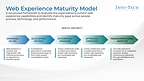
Phase 2: Assess Current State & Readiness – Use a web experience maturity model to evaluate capabilities across people, process, technology, and performance, and identify integration gaps and readiness risks.
Phase 3: Understand Audiences & Experience Priorities – Define priority personas, map end-to-end journeys, and translate organizational goals into structured web experience use cases prioritized by value and feasibility.
Phase 4: Architect & Govern the Ecosystem – Establish architecture principles, design the target-state WEM ecosystem, and define governance structures and operating models that clarify roles, ownership, and decision rights.
Phase 5: Launch, Communicate, & Measure – Develop a phased roadmap aligned to key value drivers, implement performance measurement frameworks, and enable continuous optimization across the web ecosystem.
Info-Tech’s Develop Your Web Experience Management Strategy blueprint is supported by a Web Experience Management Business Case Template and a Web Experience Initiatives Prioritization and Roadmap Planning Tool. These resources are designed to help CIOs and IT leaders build a clear case for modernization, prioritize initiatives based on value and feasibility, and develop phased roadmaps aligned to organizational objectives. By applying this framework and its supporting tools, organizations can strengthen governance, improve cross-functional alignment, and evolve their web ecosystem in a measurable and scalable way.
For exclusive and timely commentary from Info-Tech’s experts, including Hriday Gulrajani, and access to the complete Develop Your Web Experience Management Strategy blueprint, please contact pr@infotech.com.
About Info-Tech Research Group
Info-Tech Research Group is one of the world’s leading and fastest-growing research and advisory firms, serving over 30,000 IT, HR, and marketing professionals around the globe. As a trusted product and service leader, the company delivers unbiased, highly relevant research and industry-leading advisory support to help leaders make strategic, timely, and well-informed decisions. For nearly 30 years, Info-Tech has partnered closely with teams to provide everything they need, from actionable tools to expert guidance, ensuring they deliver measurable results for their organizations.
To learn more about Info-Tech’s HR research and advisory services, visit McLean & Company, and for data-driven software buying insights and vendor evaluations, visit the firm’s SoftwareReviews platform.
Media professionals can register for unrestricted access to research across IT, HR, and software, as well as hundreds of industry analysts through the firm’s Media Insiders program. To gain access, contact pr@infotech.com.
For information about Info-Tech Research Group or to access the latest research, visit infotech.com and connect via LinkedIn and X.
View original content to download multimedia:https://www.prnewswire.com/news-releases/fragmented-web-strategies-leave-organizations-exposed-as-digital-expectations-rise-warns-info-tech-research-group-302834308.html
SOURCE Info-Tech Research Group
Technology
In HelloNation, Custom Fabrication Expert Mark Coyle Explains What to Know Before Choosing an Aluminum Fabrication Partner
Published
9 minutes agoon
July 24, 2026By
The article explains how an integrated fabrication process supports better quality, efficiency, and long-term project success.
ROCHESTER, N.Y., July 24, 2026 /PRNewswire/ — What should someone look for before selecting an aluminum fabrication partner who can guide a project from the first design sketch through final delivery? That question is answered in a HelloNation article featuring insights from Custom Fabrication Expert Mark Coyle of American Custom Metals, Inc. in Rochester, New York, that explains how the full aluminum production workflow shapes accuracy, consistency, and long-term reliability. The article shows why a clear understanding of each stage in the process helps people make informed decisions before committing to a fabrication partner.
The article begins by explaining that aluminum fabrication involves far more than cutting or welding. It describes how every project moves through a connected chain of design support, extrusion, machining, finishing, and logistics. Each step affects the next, and the article notes that the best results come from choosing an aluminum fabrication partner who keeps these stages aligned. By showing how coordination prevents errors, the article gives readers a practical way to evaluate a potential shop.
Early design support is a major focus of the article. It states that many projects benefit when design engineering is handled in-house because small adjustments to a profile can influence strength, weight, and final performance. The HelloNation article explains that an aluminum fabrication partner with internal design capabilities can review shapes before tooling begins, reducing the risk of delays caused by unrealistic or difficult-to-extrude features. This design stage sets the direction for everything that follows, making it one of the most valuable parts of the process.
The article also examines extrusion, which it calls one of the most specialized stages in aluminum manufacturing. It notes that some shops do not extrude their own material, which forces them to rely on outside mills. That structure can lead to longer schedules and more points of communication. By contrast, an aluminum fabrication partner with direct access to extrusion equipment can control die design, schedule production runs, and manage metal flow more precisely. The article explains that this control reduces variation between batches, which supports stable timelines and more predictable quality.
Machining receives detailed attention as well. The article states that accuracy depends on how well each machine is calibrated for the specific alloy and geometry involved. It describes how a fabricator who machines their own extrusions becomes familiar with how those profiles respond to different tool paths and cutting forces. This familiarity supports tighter tolerances and more dependable results. The article explains that when machining is outsourced, the receiving shop may not know the conditions under which the material was extruded or aged, which can cause small adjustments that affect uniformity across long runs.
Finishing is another important stage explored in the article. It explains how anodizing, powder coating, polishing, or protective layers interact with thickness and alloy. The article notes that when finishing is spread across multiple vendors, the project moves more often, which increases the chance for delays or inconsistency. An aluminum fabrication partner with integrated finishing services can keep color and coating texture more uniform while maintaining a tighter schedule.
Logistics also plays a key role in the article’s guidance. It highlights that aluminum profiles, especially long or delicate ones, require thoughtful packaging, palletizing, and freight planning. A shop with its own logistics team can reduce damage risks and speed up the time between manufacturing and delivery. The article explains that when logistics is outsourced, communication slows down and the chances of errors increase, making it harder to keep a project on schedule.
Tolerance control is another subject the article describes. It explains that aluminum reacts to heat, pressure, and machining forces in predictable ways only when the team understands how the material was formed at every stage. The article notes that when extrusion, aging, machining, and inspection all occur within one operation, teams can maintain a closed loop of information. This reduces the risk of dimensional issues and strengthens consistency from batch to batch.
As the article moves toward its conclusion, it emphasizes that choosing the right aluminum fabrication partner comes down to understanding how many stages the shop directly manages. When a partner controls design, extrusion, machining, finishing, and logistics, communication becomes clearer, and the workflow becomes more predictable. The article explains that this unified structure allows teams to adjust quickly because they understand every step of the operation.
The article ends by stating that dependable performance in aluminum work depends on how well each stage connects to the next. A strong aluminum fabrication partner is defined not by one capability but by how the entire process fits together. This guidance gives readers a practical way to evaluate potential partners and make decisions that support long-term project success.
What to Know Before Choosing an Aluminum Fabrication Partner features insights from Mark Coyle, Custom Fabrication Expert of Rochester, NY, in HelloNation.
About HelloNation
HelloNation is America’s Good News Network, a premier media platform built on the idea that good news travels faster when real people tell real stories. Through its community-focused publications and innovative “edvertising” approach, HelloNation delivers content that informs, inspires, and spotlights the leaders making a meaningful impact in their communities.
View original content to download multimedia:https://www.prnewswire.com/news-releases/in-hellonation-custom-fabrication-expert-mark-coyle-explains-what-to-know-before-choosing-an-aluminum-fabrication-partner-302834344.html
SOURCE HelloNation
Secretary of State Belanger announces expansion of high-speed Internet access in Saskatchewan
Fragmented Web Strategies Leave Organizations Exposed as Digital Expectations Rise, Warns Info-Tech Research Group
In HelloNation, Custom Fabrication Expert Mark Coyle Explains What to Know Before Choosing an Aluminum Fabrication Partner
Send Rakhi to UK swiftly with UK Gifts Portal
Whiteboard Series with NEAR | Ep: 45 Joel Thorstensson from ceramic.network
New Gooseneck Omni Antennas Offer Enhanced Signals in a Durable Package
Why You Should Build on #NEAR – Co-founder Illia Polosukhin at CV Labs
Whiteboard Series with NEAR | Ep: 45 Joel Thorstensson from ceramic.network
NEAR End of Year Town Hall 2021: The Open Web World, MetaBUILD 2 Hackathon and 2021 recap
Trending
-
Coin Market5 days agoWill the US get CLARITY this week? Bitcoin’s new $80K target: Hodler’s Digest, July 19
-
Technology5 days ago“Every Day CO₂ Challenge”: More Than a Game, A New Way of Learning
-
Technology4 days agoTrakka Systems to Demonstrate Advanced ISR Capabilities at Farnborough International Airshow 2026
-
Technology5 days ago
China-Europe Youth Exchange Campaign: When Fashion Meets Football — A Green Pitch Appointment for Cross-Cultural Dialogue
-
Technology5 days agoPowering ASEAN’s Manufacturing Transformation: IME 2026 Connects Technology, Industry and Opportunity
-
Technology4 days agoSigneasy expands beyond eSignatures with Intelligent Contract Management for growing businesses
-
Technology5 days agoDBS named Asia’s Best Digital Bank by Euromoney, recognised for its AI leadership and responsible innovation
-
Technology4 days agoBOC Group Releases ADONIS 19.0 LTS to Bring Smarter Support into Everyday BPM Work