Connect with us

Technology

From Operators to Orchestrators: Deloitte’s 2026 Global Technology Leadership Study Reveals a New Mandate for Tech Leaders

Published

on

A new era of technology leadership is here, but most enterprises are not yet equipped to keep pace

NEW YORK, April 30, 2026 /PRNewswire/ —

Key takeaways | Explore Key Insights

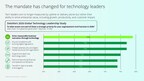
The mandate has fundamentally shifted: The majority of tech leaders (79%) cite driving business outcomes as their top priority, signaling a definitive move from running systems to creating enterprise value.There’s a new standard for tech leadership: As AI raises the stakes, success will likely require more than technical expertise. Tech leaders today should also be ready to lead people through change, build AI-ready teams, and turn technology ambition into business results.Ambitions are outpacing capabilities: While 81% of leaders are confident they can scale AI, 75% simultaneously state their operating model must fundamentally change to drive greater value.Leadership is now about orchestration over authority: As influence becomes distributed across an expanding tech C-suite—71% of organizations have five or more tech leaders —the role has evolved from control to coordination.

Why this matters

The role of the technology leader is undergoing a profound transformation. Today’s tech leaders are not only expected to run technology, but to shape strategy, lead change, build AI-ready teams, and drive enterprise-wide outcomes, according to Deloitte’s 2026 Global Technology Leadership Study. The research, which surveyed more than 660 senior technology executives, finds that while the mandate has changed, the enterprise has not. And leaders are caught between the bold ambition of an AI-driven world and the structural reality of legacy operating models, talent, and budget, creating a critical test of leadership.

The AI-era is challenging boards and leaders to rethink how they operate, compete, and create value, and the technology is no longer the only challenge, but there is structural lag within the enterprise. The gap between a tech leader’s expanded mandate and their organization’s ability to execute is where competitive advantage can be won or lost. The organizations that empower their leaders to close this gap — by redesigning how work gets done, how decisions are made, and how value is created — can define the next decade.

As AI raises the stakes, success will likely depend less on technical oversight alone and more on the ability to bring people, priorities, and decisions together across the enterprise. That means leading human-AI collaboration, building trust and talent, and translating technology ambition into action. In the orchestration era, leaders can stand out by combining technical depth with the judgment and influence to drive meaningful business outcomes.

Key quotes

“The era of the operational technologist is over. This shift has been building for over a decade, and AI is the catalyst bringing that into focus. Today’s CIO isn’t just leading technology; they are being asked to redesign the very fabric of how the business runs. As operating models and investments catch up to this new reality, success will be defined by judgment and trade-offs. This is the moment for tech leaders to redefine their mandate and their organization’s trajectory.”

Anjali Shaikh, Managing Director, Deloitte Consulting LLP, Leader of Deloitte Global CIO & US Tech Executive Programs

“For years, we’ve tracked the tech leader’s journey toward the center of the business. This year’s study shows they have arrived, but the enterprise wasn’t fully prepared for them. The challenge is significant, but the opportunity is immense. Today’s leaders are defined by their ability to orchestrate across the C-suite and translate technology into measurable outcomes. Those who remain focused solely on delivering underlying systems risk being sidelined, while those who embrace this moment can lead their organizations into the future.”

Steve Pratt, Principal, Deloitte Consulting LLP, US Tech Exec Programs Leader

The research revealed three shifts redefining technology leadership:

1. The Value Mandate: From Uptime to Outcomes
Technology’s role has evolved from enabling the business to shaping its strategy. Leaders are now expected to deliver measurable enterprise value across growth, productivity, and customer impact. The data shows this is not an emerging trend, but the new standard, as 79% of leaders report it is their top priority. However, 42% report low or no ROI on AI investments, demonstrating the difficulty of delivering on this new value mandate.

2. The Capability Gap: Ambition vs. Reality
A stark paradox has emerged between leaders’ confidence and their organizational reality. As expectations rise, many organizations are still catching up on the foundational data, talent, and operating models needed to translate AI investments into sustained outcomes. Challenges to scaling AI are not the technology itself, but internal constraints like poor data quality, security concerns, talent shortages, and legacy systems, creating a gap between ambition and execution.

3. The Resource Squeeze: More Mandate, Same Model
Balancing competing priorities is intensifying as tech leaders are now expected to run, change, protect, and grow the business simultaneously. However, they are operating within funding models and governance structures that have not kept pace. With tech spending projected to rise only modestly and 41% of tech leaders reporting the business sees them as unable to keep up with demand, leaders are being forced to make difficult trade-offs that can stifle transformational innovation.

The 2026 Global Technology Leadership Study unpacks the evolving priorities, ambitions, and challenges of the tech C-suite.

Learn more about our Tech Executive Programs and connect with us on LinkedIn.

Methodology
Deloitte conducted an online survey among more than 660 technology leaders across the globe from December 2025 to February 2026. Participants were screened based on title, company size, company revenue, and responsibility for setting the strategic direction of technology within their organization.

About Deloitte
Deloitte provides industry-leading audit, consulting, tax and advisory services to many of the world’s most admired brands, including nearly 90% of the Fortune 500® and more than 9,000 U.S.-based private companies. At Deloitte, we strive to live our purpose of making an impact that matters for our people, clients, and communities. We bring together distinct talents, technologies, disciplines, and an ecosystem of alliances to help tackle today’s most complex business challenges and drive long-term progress. Deloitte is proud to be part of the largest global professional services network serving our clients in the markets that are most important to them. Bringing more than 180 years of service, our network of member firms spans more than 150 countries and territories. Learn how Deloitte’s approximately 470,000 people worldwide connect for impact at www.deloitte.com.


View original content to download multimedia:https://www.prnewswire.com/news-releases/from-operators-to-orchestrators-deloittes-2026-global-technology-leadership-study-reveals-a-new-mandate-for-tech-leaders-302758075.html

SOURCE Deloitte LLP

Continue Reading
Click to comment

Leave a Reply

Your email address will not be published. Required fields are marked *

Technology

CGTN: China, Myanmar agree to deepen pragmatic cooperation across the board

Published

on

By

BEIJING, June 19, 2026 /PRNewswire/ — Marking a new milestone in bilateral ties, President of Myanmar Min Aung Hlaing completed his first state visit to China from June 15 to 19, opening a new chapter of in-depth, multi-field pragmatic cooperation between the two neighboring countries.

By visiting China Railway Construction Corporation Limited in Beijing and traveling from the Chinese capital to Shanghai aboard the Fuxing high-speed train, the Myanmar president experienced China’s development achievements firsthand, and voiced Myanmar’s strong willingness to further expand practical infrastructure cooperation with China.

Throughout the fruitful visit, the two countries signed a series of cooperation agreements, consolidating their time-honored “pauk-phaw” friendship.

During a meeting with Min Aung Hlaing on Tuesday, Chinese President Xi Jinping said China stands ready to share its development experience with Myanmar and jointly build a China-Myanmar community with a shared future, which is underpinned by political amity and mutual trust, win-win development, security coordination and people-to-people exchanges.

For years, China has remained Myanmar’s largest trading partner, largest source of imports and most important source of investment. Bilateral trade reached $19.4 billion in 2025, up 19.1% year on year.

Boasting prominent structural complementarity, the trade landscape sees China exporting electromechanical equipment and vehicles to Myanmar while importing high-quality agricultural products and mineral resources from Myanmar, forming a mutually beneficial and stable industrial and trade cycle.

As a key landmark of Belt and Road cooperation, the China-Myanmar Economic Corridor has entered a fast-track development phase. A cluster of flagship projects, including the New Yangon City, the Kyaukphyu Special Economic Zone and the China-Myanmar Railway, have gradually taken shape, forming a solid framework for the construction of the corridor.

These major connectivity projects have effectively driven Myanmar’s industrial upgrading, and improved local livelihoods, injecting strong impetus into cross-border economic integration.

During Tuesday’s talks, Xi reiterated that the China-Myanmar Economic Corridor is a flagship project of the Belt and Road cooperation.

The two sides need to steadily advance the construction of major projects on the basis of ensuring safety and security, and support Myanmar in growing its economy and improving livelihoods, he said.

China, Xi added, stands ready to implement more “small and beautiful” assistance programs, and jointly tell the stories of mutually beneficial cooperation between the two countries.

China and Myanmar on Tuesday issued a lengthy joint statement on accelerating the building of a community with a shared future between the two countries to better benefit the people of both countries.

In a demonstration of the depth and breadth of bilateral relations, the two sides signed a number of cooperative documents, covering transport, science and technology, intellectual property rights, human resources development, public health and media.

Bilateral and multilateral law-enforcement cooperation to combat cross-border criminal activities was also highlighted during the visit, with China and Myanmar expressing their support for the establishment of an international alliance against telecom cyber fraud.

Over recent months, through joint law enforcement coordination, China and Myanmar have cracked down the telecom fraud criminal operations in northern Myanmar, effectively upholding peace and stability along the border as well as the safety of lives and property of people of both countries.

During the talks, Xi said the two sides need to continue cracking down on criminal activities including online gambling, telecom fraud and drug trafficking, and fully safeguard the interests and security of the two peoples.

For his part, Min Aung Hlaing said Myanmar stands ready to work closely with China to resolutely combat online gambling and telecom fraud and safeguard security and stability in the border areas.

Qu Jianwen, chief of the Yunnan Province Association for Southeast Asian Studies, wrote that the China visit by Myanmar’s president vividly demonstrates the sound and growing momentum of bilateral cooperation.

https://news.cgtn.com/news/2026-06-19/China-Myanmar-agree-to-deepen-pragmatic-cooperation-across-the-board-1O64ed6YbYI/p.html

View original content:https://www.prnewswire.com/news-releases/cgtn-china-myanmar-agree-to-deepen-pragmatic-cooperation-across-the-board-302805303.html

SOURCE CGTN

Continue Reading

Technology

Protecting and Innovating Critical Infrastructure Through New Security Landscapes

Published

on

By

The following article is authored by Skyla Loomis, General Manager, IBM Z Software

ARMONK, N.Y., June 19, 2026 /PRNewswire/ — Over the last few years, we’ve seen seismic shift in enterprise computing. From the rise of machine learning to today’s agentic AI, computing systems have advanced beyond tools into active assistants, requiring new levels of secure, high-powered and efficient infrastructure.

One thing hasn’t changed though the decades. IBM Z has been the most resilient server platform in the market with its average yearly downtime as less than a third of a second.1

This reputation is because as technology has evolved, so has IBM Z. Today, clients have more workloads that may be considered highly sensitive and mission-critical given new sovereignty and regulation requirements, and continue to turn to IBM Z for their core applications.

IBM is continuing to innovate mainframes to address and combat the technological challenges of the future. As part of this mission, today we’re announcing the general availability of three new Z software tools designed to not only meet clients where they are, but to start addressing future challenges such as frontier model attacks. These complement our recent developments with Project Glasswing and our commitment to open-source security with Project Lightwell.

As a leading provider in hybrid cloud, AI and consulting expertise, IBM has developed decades of IBM Z Software to help clients protect themselves for what’s ahead. In cybersecurity, IBM developed IBM Concert for Z last year for enterprises to discover and address vulnerabilities across the entire landscape because we saw the siloed nature of infrastructure and application teams across an organization. Hybrid infrastructure is the reality and we are passionate about giving teams world-class software built to innovate and defend the full stack for the future – IBM Z included.

The following tools are now generally available:

IBM zSecure Detection – Evolving threats mean enterprises need better ways of monitoring and responding. IBM zSecure Detection monitors IBM Z activity for things like ransomware and suspicious behavior across the system. Enterprises now have a comprehensive tool to detect, investigate and respond on z/OS to strengthen their security posture.IBM zSecure Secret Manager – Certificate management can be a burden for infrastructure and security teams. As the lifespan of these certificates shortens, teams need a secure, continuous monitoring for z/OS environments in IBM Z and LinuxONE. Powered by IBM Vault Self-Managed for Z, IBM zSecure Secret Manager gives z/OS teams an automated and cohesive way of addressing certificate management with shortened certificate lifecycle deadlines and fragmented management strategies.IBM Z Database Assistant – IBM Z stands apart with its data integrity, but AI has shifted the need from access to intelligence. Now database teams can use agentic AI to optimize DBA performance, accelerate tasks and help ensure your trusted data is continuously available. IBM Z Database Assistant is proactive, autonomous and intelligent, designed for the future of data operations.

With security threats and new ways of working on IBM Z, we’re equipping the teams that work tirelessly on critical infrastructure to build and operate for the future. The bar for resiliency and 99.999999% uptime1remains the same for our clients, but IBM Z Software will continue to innovate so enterprises can manage and protect their core infrastructure and workloads.

Learn more about the latest Z Software solutions:

IBM zSecure DetectionIBM zSecure Secret ManagerIBM Z Database Assistant

1. ITIC 2025 Global Server Hardware, Server OS Reliability Report, February 2026

About IBM
IBM is a leading provider of global hybrid cloud and AI, and consulting expertise. We help clients in more than 175 countries capitalize on insights from their data, streamline business processes, reduce costs and gain the competitive edge in their industries. Thousands of government and corporate entities in critical infrastructure areas such as financial services, telecommunications and healthcare rely on IBM’s hybrid cloud platform and Red Hat OpenShift to affect their digital transformations quickly, efficiently and securely. IBM’s breakthrough innovations in AI, quantum computing, industry-specific cloud solutions and consulting deliver open and flexible options to our clients. All of this is backed by IBM’s long-standing commitment to trust, transparency, responsibility, inclusivity, and service.  Visit www.ibm.com for more information.

Media contact:

Marshall Hampson
IBM
marshall.hampson@ibm.com

View original content to download multimedia:https://www.prnewswire.com/news-releases/protecting-and-innovating-critical-infrastructure-through-new-security-landscapes-302804915.html

SOURCE IBM

Continue Reading

Technology

KCS Opens KuCoin’s Ninth Anniversary Chapter, Advancing Token Utility as a Value Participation Layer

Published

on

By

The upgraded KCS experience brings trading efficiency, rewards, payment benefits and ecosystem privileges into one unified user journey.

PROVIDENCIALES, Turks and Caicos Islands, June 19, 2026 /PRNewswire/ — KuCoin, a leading global crypto platform built on trust, today announced the upgraded KCS experience, marking the opening chapter of KuCoin’s ninth anniversary journey and a new step in the evolution of KCS from a platform utility token into a broader value participation layer across the KuCoin ecosystem.

Nine years ago, KCS was introduced to reward and empower KuCoin’s earliest users. Since then, both KuCoin and the broader digital asset industry have undergone profound transformation. What began as a token primarily associated with trading benefits has gradually evolved into a broader ecosystem asset connecting users with rewards, payments,  loyalty privileges and community participation.

As digital asset ecosystems mature,  the role of exchange-native tokens is changing as well. Exchange-native tokens are no longer defined only by isolated benefits or short-term incentives. They are increasingly becoming participation layers that connect users with value across an entire ecosystem. The upgraded KCS experience addresses this shift by bringing fragmented KCS-related benefits into a more connected and actionable journey. Through the upgraded experience, users can better discover and activate KCS benefits across trading fee reductions, rewards, loyalty privileges, KuCard-related incentives and broader ecosystem programs through one clearer pathway. This reflects KuCoin’s trust-first approach in practice: making platform value easier to understand, more transparent to access and more consistent across touchpoints.

“KCS has grown alongside our users and our ecosystem for nearly nine years,” said BC Wong, CEO of KuCoin. “As the industry evolves, we believe the next generation of exchange-native tokens will be defined not simply by utility, but by how effectively they connect users with ecosystem value. Our vision is for KCS to serve as a participation layer that brings together trading, rewards, payments, and future ecosystem experiences into one cohesive journey.”

KCS, the native token of the KuCoin ecosystem, has long served as a bridge between users and KuCoin’s platform value. With this upgrade, KCS’s long-term vision of moving blockchain “from geeks to mass adoption” and building a blockchain-based value self-circulation ecosystem is being translated into a clearer and more practical user experience, making KCS easier to understand, activate and use across KuCoin.

The milestone arrives at a symbolic moment for KuCoin, serving as the opening chapter of its ninth-anniversary journey. As KuCoin prepares to celebrate nine years of growth, the evolution of KCS reflects the broader transformation of KuCoin itself — from a crypto exchange into a global digital asset ecosystem spanning trading, payments, Web3 infrastructure, institutional services and emerging technologies such as AI. In this next chapter, KCS is designed to become a clearer user-facing gateway to KuCoin’s expanding ecosystem, helping users better discover, understand and participate in the value created across the platform. As KuCoin enters its ninth anniversary, the upgraded KCS experience sets the tone for a broader vision: making ecosystem value more accessible, connected and meaningful for users worldwide.

About KuCoin

Founded in 2017, KuCoin is a leading global crypto platform built on trust and security, serving over 40 million users across 200+ countries and regions. Known for its reliability and user-first approach, the platform combines advanced technology, deep liquidity, and strong security safeguards to deliver a seamless trading experience. KuCoin provides access to 1,500+ digital assets through a broad product suite and remains committed to building transparent, compliant, and user-centric digital asset infrastructure for the future of finance, backed by SOC 2 Type II, ISO/IEC 27001:2022, and ISO/IEC 27701:2019 Certifications. In recent years, we have built a strong global compliance foundation, marked by key milestones including AUSTRAC registration in Australia, a MiCA license in Europe, and regulatory progress in other markets.

Learn more at www.kucoin.com.

View original content to download multimedia:https://www.prnewswire.com/news-releases/kcs-opens-kucoins-ninth-anniversary-chapter-advancing-token-utility-as-a-value-participation-layer-302802551.html

SOURCE KuCoin

Continue Reading

Trending