Biohub and UC Berkeley show that the laser phase plate, a revolutionary device with a laser 100 million times brighter than the Sun, dramatically improves images obtained through cryo-electron microscopy, giving scientists a new window into the molecular underpinnings of disease
BERKELEY, Calif. and REDWOOD CITY, Calif., June 11, 2026 /PRNewswire/ — In a landmark achievement in biological imaging, researchers at Biohub and the University of California, Berkeley today announced the successful demonstration of the laser phase plate, a novel device that dramatically improves the contrast of images produced by cryo-electron microscopes, opening up an entirely new view of human biology.
Cryo-electron microscopy (cryo-EM) is itself a revolutionary, Nobel Prize–winning technology that has become the backbone of structural biology, having revealed the atomic-level architecture of many of the molecular machines that drive nearly every cellular process. But the technique has been hampered by the inability to generate enough contrast to clearly image small molecules — more than 90% of the proteins found inside human cells are too small for cryo-EM to capture clearly.
Building on earlier demonstrations, Biohub and UC Berkeley scientists have now built and integrated a laser phase plate, one of the brightest lasers of its type in the world, into a state-of-the-art cryo-electron microscope, as described in two new publications. The result is a device that will open up views of the cell like never before, allowing scientists to see the processes and interactions that are at the root of health and disease.
“The cell is just filled with everything that you could ever want to know — but we can’t see it, and we can’t find it,” said David Agard, Founding Scientific Director of Imaging at Biohub. “To see all those interactions has been the dream of structural cell biologists for decades, and we’re on the brink of being able to see that. In my view, the laser phase plate is integral to making this happen.”
Potential disease mechanisms and therapeutic targets come into view
The laser phase plate was first proposed more than 15 years ago by physicist Holger Müller and biophysicist Robert Glaeser, both of UC Berkeley, but it was long thought to be nearly impossible to build. After years of effort, they were able to achieve a working prototype and demonstrate its applicability in cryo-EM in an older generation electron microscope.
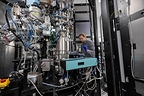
Now Biohub and UC Berkeley researchers have each built a laser phase plate, installed in custom versions of the Thermo Scientific Krios microscope, and demonstrated strong contrast improvements in imaging of small proteins, as reported in two scientific papers. The entire optical cavity housing the laser phase plate — the heart of the system — is less than four inches wide, tucked inside microscopes that stand 14 feet tall.
The UC Berkeley paper, published online today in Science, demonstrates that the laser phase plate provides higher resolution for six different biological samples of different sizes and different sample preparation. Further, they showed that the smaller the sample, the greater the improvement. Specifically, the authors show reconstructed images of a protein from muscle called aldolase, which is relatively easy to image with conventional cryo-EM machines, and of hemoglobin — a protein that carries oxygen in blood — which is at the lower limit for current machines.
“With the more challenging of the two particles, hemoglobin, we saw a strong improvement with the laser, but with the less challenging one, aldolase, the improvement is very small, as expected,” said Jessie Zhang, a postdoc in Müller’s lab who is the co-first author of the study with postdoc Petar Petrov.
Müller, professor of physics at UC Berkeley, said that now that the advantages of the laser phase plate have been clearly demonstrated, he is excited about its potential to solve even more challenging bioimaging problems.
“If you look at all the proteins in a human, they all have various sizes. And all of these proteins are potential disease mechanisms and drug targets,” said Müller, corresponding author of the paper and also a faculty scientist at Lawrence Berkeley National Laboratory. “The problem is, the average human protein is too small to be imaged by cryo-EM. The laser phase plate could fill an enormous gap in our knowledge of protein structures that can’t be processed with today’s cryo-EM.”
Müller spent more than 10 years building a working prototype of the laser phase plate. Then in 2021 Biohub decided to make a big bet on the technology and supported him with a grant, which allowed him to ramp up development, purchase a state-of-the-art cryo-electron microscope, and customize it for the laser phase plate.
In addition to supporting Müller’s efforts, Biohub made an even bigger bet, building a next-generation version of the laser phase plate with twice the complexity, featuring a dual laser system. That system is described in a new preprint on biorxiv.org.
Developed at Biohub’s imaging lab in Redwood City, in collaboration with UC Berkeley and industry partners, the device uses two laser beams oriented perpendicular to each other, each in its own cavity and operating at about half the power required by the single-cavity system used in Müller’s microscope. At lower power, components are less likely to burn and aberrations are reduced, making the system easier to operate.
The concept of a dual laser system was first proposed by Müller and UC Berkeley colleagues two years ago in a paper that was just published last week in Nature Communications.
An engineering feat — and a long time coming
More than a decade ago, Müller and Glaeser first proposed the idea of creating an intense laser to shift the phase of the electron beam in cryo-electron microscopes, but many in the field considered such an instrument far too difficult to build.
Making the laser phase plate a reality required an extraordinary combination of precision, advanced engineering, and complex laser optics to generate the most intense steady-state laser ever. Inside the cavity, a laser beam is bounced back and forth between two concave mirrors almost 10,000 times, building up to an intensity of approximately 350 to 400 gigawatts per square centimeter — an energy 100 million times more intense than the surface of the Sun, concentrated into a spot about 1/1000th the width of a human hair.
The mirrors that make this possible are themselves a remarkable feat of engineering. Each mirror must be polished to “atomic-level smoothness” — a surface roughness of less than one angstrom, approximately the diameter of a single atom.
“The mirrors must be extremely lossless to prevent them from melting, and in fact are so lossless that they barely warm up, despite being bombarded by a laser that could easily cut inches of steel,” Müller said.
The precision required to operate the instrument is equally demanding. The angle of the mirrors must be aligned to within 1/1000th of a degree for the lasers to bounce effectively. Additionally, the laser beam and electron beam must be aligned to within 50 nanometers — on a standing wave that is 500 nanometers across — to maximize contrast while acquiring data.
“It’s like a surfer trying to hold perfectly to the peak of a wave, not for seconds, but for half an hour at a stretch,” said Bridget Carragher, Founding Technical Director of Imaging at Biohub. She and Agard are co-leads of Biohub’s Dynamic Structural Cell Biology group and co-corresponding authors of the Biohub preprint, along with Biohub engineer Pavel Olshin.
The next frontier
While the papers demonstrate the device’s power for imaging individual small proteins, researchers at both institutions believe the next frontier is cryo-electron tomography (cryo-ET) — a powerful newer variant of cryo-EM that captures proteins not in isolation but in their natural cellular environment, revealing how molecular machines actually assemble, interact, and malfunction in disease.
“We believe tomography is where we’ll see the really huge wins for cell biology,” Carragher said. “There’s still work to be done in wrangling the microscope, but we’re optimistic we’ll be doing data collection by the end of the year.”
All of Biohub’s tomography data – including tens of thousands of annotated tomograms – is freely shared with the community at its CryoET Data Portal, which aims to accelerate the entire cryo-ET pipeline.
“Doing a cell biology experiment with cryo-ET today can take up a postdoc’s entire career,” Agard said. “We need to speed that up, and the laser phase plate, along with better processing, all working seamlessly with AI algorithms, will get us there.”
Müller hopes that microscopes fitted with laser phase plates will be commercially available in the coming years, and that labs around the world will have this powerful technology in regular use.
“This technology is a step function change for biology,” said Stephani Otte, Biohub’s Vice President of Imaging Science. “We are going to be able to see how molecular machines operate inside the living cell, in context, for the first time. What was once invisible will become visible — and that changes everything about how we understand disease.”
About Biohub
Biohub is a 501(c)(3) biomedical research organization building the first large-scale initiative to combine frontier AI and frontier biology to solve disease. With its compute capacity, AI research and engineering, and state-of-the-art technology for measuring, imaging, and programming biology, Biohub is enabling scientists worldwide to use AI-powered biology to study how cells operate and organize as systems — ultimately understanding why disease happens and how to cure or prevent it. Learn more at biohub.org.
About UC Berkeley
Founded in 1868, UC Berkeley is the world’s No. 1 public university, with 63 Nobel laureates and 50 graduate programs ranked in the nation’s top 10. Berkeley researchers advance fundamental science while addressing society’s greatest challenges — from artificial intelligence to climate change to human health. The university enrolls nearly 46,000 students, with 28% of undergraduates receiving federal Pell Grants, reflecting its commitment to access. Learn more at berkeley.edu.
View original content to download multimedia:https://www.prnewswire.com/news-releases/making-the-invisible-visible-microscope-breakthrough-will-open-unprecedented-view-into-our-cells-302798374.html
SOURCE Biohub








 Technology5 days ago
 Coin Market4 days ago
 Coin Market3 days ago
 Technology4 days ago
 Technology5 days ago
 Coin Market5 days ago
 Near Videos5 days ago