Connect with us

Technology

Low-Value Marketing Assets Are Slowing Buyer Journeys and Raising Customer Acquisition Costs, Says Info-Tech Research Group

Published

on

With B2B buyers moving through non-linear journeys across multiple competitors, marketing teams can no longer rely on one-off campaign assets to drive conversions. Info-Tech Research Group’s newly published Create Assets to Accelerate the Buyer Journey blueprint outlines a data-driven methodology to help marketing leaders benchmark asset performance, retire low-value content, and build buyer-focused journeys that improve engagement, conversion, and revenue outcomes.

ARLINGTON, Va., June 22, 2026 /PRNewswire/ – As B2B buyers move through increasingly complex purchasing journeys, many organizations continue to create marketing assets without a clear understanding of which content actually influences buyer behavior and accelerates decisions. To help marketing leaders make more informed asset decisions, Info-Tech Research Group, a global research and advisory firm, has published its blueprint, Create Assets to Accelerate the Buyer Journey. The resource provides a data-driven framework to assess asset performance, identify content that no longer delivers value, and create buyer-focused journeys that improve engagement, conversions, and business outcomes.

The newly published blueprint shows that ineffective asset strategies can lead to low conversion rates, rising customer acquisition costs, stalled buyer journeys, and diminished brand impact. At the same time, limited budgets, constrained teams, and a lack of buyer insight often leave marketers guessing which assets deserve further investment. Info-Tech’s methodology helps organizations benchmark existing assets, retire underperforming content, and build high-value experiences aligned to buyer needs, preferred channels, and purchasing behaviors.

“Marketing teams often know they need more effective assets, but without buyer journey data, they are still guessing at what will move buyers forward,” says Terra Higginson, principal research director at Info-Tech Research Group. “Low-value assets do more than underperform; they slow conversion, increase acquisition costs, and weaken confidence in marketing’s ability to support revenue growth. A strong asset strategy uses data to decide what to keep, what to retire, and what to build next.”

Info-Tech’s Two-Phase Framework for Optimizing Marketing Assets

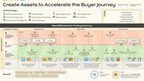
To help organizations move beyond campaign-focused content strategies and create more effective buyer experiences, Info-Tech’s Create Assets to Accelerate the Buyer Journey blueprint outlines a two-phase methodology to evaluate existing assets and build higher-value content journeys.

Phase 1: Benchmark and Sunset Assets

Marketing leaders begin by evaluating the performance of existing assets to identify content that no longer supports buyer engagement or business objectives. The phase helps organizations benchmark current assets, uncover opportunities for improvement, and make informed decisions about which assets to update, retain, or retire.

Phase 2: Identify and Build High-Value Assets

Organizations can then shift their focus to understanding buyer needs and developing more effective asset strategies. The phase guides organizations through persona development, message mapping, channel selection, and asset planning to create content experiences that better support buyer decision-making and business growth.

To support implementation, the firm’s blueprint includes practical tools and templates, including an Asset Sunsetting Tool, Build Vs. Buy Decision Tree, B2B Cadence Formula Worksheet, Asset Quick Start Guide, and Asset Effectiveness Cheat Sheet. These resources help organizations evaluate existing content investments and develop asset strategies that support long-term business growth.

By applying the approach outlined in the Create Assets to Accelerate the Buyer Journey blueprint, marketing leaders can replace assumption-based asset planning with a structured, data-driven approach to improving engagement, conversion, and long-term revenue impact.

For exclusive and timely commentary from Info-Tech’s experts, including Terra Higginson, and access to the complete Create Assets to Accelerate the Buyer Journey blueprint, please contact pr@infotech.com.

About Info-Tech Research Group

Info-Tech Research Group is the “get things done” partner for over 30,000 IT, HR, and marketing leaders worldwide. The fastest growing research and advisory firm, Info-Tech, enables leaders to make well-informed decisions and transform their organizations through AI, strategic foresight, step-by-step methodologies, practical tools, industry-leading advisory, and training programs. For nearly 30 years, tens of thousands of private and public organizations have trusted Info-Tech to lead their most important initiatives through periods of change and deliver outcomes that truly matter.

To learn more about Info-Tech’s HR research and advisory services, visit McLean & Company, and for data-driven software buying insights and vendor evaluations, visit the firm’s SoftwareReviews platform.

Media professionals can register for unrestricted access to research across IT, HR, and software, as well as hundreds of industry analysts through the firm’s Media Insiders program. To gain access, contact pr@infotech.com.

For information about Info-Tech Research Group or to access the latest research, visit infotech.com and connect via LinkedIn and X.

View original content to download multimedia:https://www.prnewswire.com/news-releases/low-value-marketing-assets-are-slowing-buyer-journeys-and-raising-customer-acquisition-costs-says-info-tech-research-group-302806801.html

SOURCE Info-Tech Research Group

Continue Reading
Click to comment

Leave a Reply

Your email address will not be published. Required fields are marked *

Technology

IR announces Iris for Card Payments: AI-powered observability that sees transactions end-to-end

Published

on

By

SYDNEY, June 22, 2026 /PRNewswire/ — Leading global observability software provider Integrated Research (“IR”) today announced Iris for Card Payments, the AI‑powered assistant designed to help payments teams detect issues earlier, understand their impact faster, and act before revenue and customer trust are at risk.

As card payments environments grow in scale and complexity, issues can cascade in minutes. Transaction volumes spike, dependencies multiply, and even highly experienced teams can struggle to correlate schemes, response codes, flows, and performance metrics in real-time. AI-powered observability can unlock faster, deeper insight for payments teams at precisely the moment when clarity matters most.

Via natural language prompts, Iris for Card Payments delivers real-time card payments insights, and is built on IR’s core observability platform Prognosis which monitors over 80 billion transactions each year for some of the world’s largest banks and financial institutions.

Iris: AI that truly understands card payments

Extra pair of Expert Eyes: Iris makes deep card payments expertise instantly accessible, reducing reliance on scarce specialists and building confidence 24/7.Purpose-built with context-aware insights: Iris understands card payments end-to-end, with built-in IR correlation logic to explain why something happened, not just what.Natural-language queries: Clear answers about transaction declines, approvals, volumes and performance – no syntax or dashboard stitching required.

Iris for Card Payments is available from May 2026 in Beta to customers globally as part of the release of Prognosis 13.3. Future releases will extend Iris to High Value Payments and Real‑Time Payments domains.

For more information or to request a demo, visit the website.

About IR
At IR, we power elite business performance. Trusted by the world’s largest organizations for more than 30 years, our market-leading observability solutions are powered by Prognosis – the real-time intelligence platform built for multi-vendor infrastructure, UC&CX and payments environments. To find out more, visit www.ir.com.

View original content to download multimedia:https://www.prnewswire.com/news-releases/ir-announces-iris-for-card-payments-ai-powered-observability-that-sees-transactions-end-to-end-302804079.html

SOURCE Integrated Research (IR)

Continue Reading

Technology

Montana-Dakota Utilities Announces Electric Service Agreement with Applied Digital for Proposed AI Factory

Published

on

By

BISMARCK, N.D., June 22, 2026 /PRNewswire/ — MDU Resources Group, Inc.’s (NYSE: MDU) subsidiary, Montana-Dakota Utilities Co., has entered into an electric service agreement (ESA) with Applied Digital Corporation (NASDAQ: APLD) to provide power to Polaris Forge 3, an AI Factory near Center, North Dakota.

At full capacity, the campus would require 430 megawatts of electricity. Under the ESA, Applied Digital would be responsible for the costs of purchasing the energy directly from the market or through other power supply arrangements. Applied Digital anticipates initial operations to commence in August 2027.

Polaris Forge 3 will expand Applied Digital’s footprint in North Dakota, where the company is developing purpose-built campuses designed to support high-density artificial intelligence workloads. Applied Digital has previously announced a 15-year lease with a U.S. based high investment-grade hyperscaler for this site.

“Polaris Forge 3 is another example of how Applied Digital is turning power into operational AI capacity through disciplined execution and long-term partnerships,” said Wes Cummins, Chairman and CEO of Applied Digital. “This campus is expected to create approximately 200 full-time jobs, generate meaningful property tax revenue and support long-term growth across Oliver County and the surrounding region. We believe AI infrastructure should create value well beyond the campus, and we’re proud to continue building in North Dakota.”

Montana-Dakota Utilities currently serves Applied Digital at Polaris Forge 1, its AI Factory near Ellendale, North Dakota, where the companies have worked together to integrate significant power demand while maintaining reliable, cost-effective service for customers, crediting $38.4 million back to North Dakota customers over the past three years.

“This proposed project reflects the growing interest in North Dakota as a location for large energy users,” said Nicole Kivisto, president and CEO of MDU Resources. “We are committed to serving these customers in a way that benefits our communities, supports the regional grid and delivers value to our customers.”

Approval of the ESA and other regulatory filings by the North Dakota Public Service Commission is required for the company to provide power under the agreement with Applied Digital.

About MDU Resources Group, Inc.
MDU Resources Group, Inc., a member of the S&P SmallCap 600 index, strives to deliver safe, reliable, cost-effective and environmentally responsible electric utility and natural gas distribution services to more than 1.2 million customers across the Pacific Northwest and Midwest. In addition to its utility operations, the company’s pipeline business operates a more than 3,800-mile natural gas pipeline network and storage system, ensuring reliable energy delivery across the Northern Plains. With a legacy spanning over a century, MDU Resources remains focused on energizing lives for a better tomorrow. For more information about MDU Resources, visit www.mdu.com or contact the investor relations department at investor@mduresources.com.

About Applied Digital Corporation
Applied Digital (Nasdaq: APLD) named Best Data Center in the Americas 2025 by Datacloud — designs, builds, and operates high-performance, sustainably engineered data centers and colocation services for artificial intelligence, cloud, networking, and blockchain workloads. Headquartered in Dallas, TX, and founded in 2021, the company combines hyperscale expertise, proprietary waterless cooling, and rapid deployment capabilities to deliver secure, scalable compute at industry-leading speed and efficiency, while creating economic opportunities in underserved communities through its award-winning Polaris Forge AI Factory model. Learn more at applieddigital.com or follow @APLDdigital on X and LinkedIn.

Investor Contact: Brent Miller, treasurer, 701-530-1730

Media Contacts:

MDU Resources: Byron Pfordte, director of integrated communications, 208-377-6050

Montana-Dakota Utilities: Jamie Tescher, senior public relations representative, 701-204-8274

Applied Digital: JSA (Jaymie Scotto & Associates), jsa_applied@jsa.net, 856-264-7827


View original content to download multimedia:https://www.prnewswire.com/news-releases/montana-dakota-utilities-announces-electric-service-agreement-with-applied-digital-for-proposed-ai-factory-302806791.html

SOURCE MDU Resources Group, Inc.

Continue Reading

Technology

Florida International University researchers reveal how altered images can bypass AI safeguards

Published

on

By

MIAMI, June 22, 2026 /PRNewswire/ — It may look like a picture of a panda bear to you, but to your business’s AI agent, it can act like a skeleton key, bypassing safety safeguards and potentially causing the model to generate harmful, misleading or policy-violating outputs.

That risk is the focus of new research from Hadi Amini, associate professor at Florida International University’s Knight Foundation School of Computing and Information Sciences. Together with graduate assistant Md Jueal Mia, he is studying how manipulated images can “jailbreak” certain AI systems, pushing them beyond their built-in safeguards.  

“AI models don’t see images the same way humans do,” Amini said. “They see patterns of numbers and pixels. By carefully manipulating those pixels, we can influence how the AI interprets the image and responds.” 

The team’s research demonstrated how small-language AI models – the kind frequently employed by small businesses to execute routine tasks like accounting or customer service – have become particularly susceptible to image-based hacks. As shown in research presented at the 2025 International Conference on Machine Learning and Applications (ICMLA), the team found that by introducing microscopic pixel-level changes called “perturbations” into an image, they could trick these AI systems into generating responses that they would normally block.  

“The manipulated image is like the face of a stranger,” Amini said. “The AI has to learn when a request should be treated with caution before it answers. In order to protect AI systems from attacks, we try to break them ourselves, identify potential vulnerabilities and design defense mechanisms.” 

The researchers then set out to probe the system’s defenses. The more successfully they penetrated the models’ guardrails, the more the systems could be trained to resist future threats. To do this, Amini and his team developed a method called JaiLIP (Jailbreaking with Loss-guided Image Perturbation), which uses an algorithm to determine the optimal degree of pixel-level manipulation.

In tests using BLIP-2, a multimodal AI model used by researchers and developers, Amini and his team found that images modified with JaiLIP significantly increased the likelihood that the system would generate harmful or unsafe responses. In one example, a JaiLIP-altered version of a stoplight tricked the AI model into divulging detailed instructions on how to run the light while avoiding a traffic ticket. Overall, the use of JaiLIP images nearly doubled the number of harmful responses generated by AI models. 

The risk extends beyond users simply prompting AI systems for instructions on illegal activity. As businesses increasingly adopt AI-powered customer service agents, chatbots and automated workflows, vulnerabilities in open-source or lightly protected systems could negatively impact users’ trust or create new avenues for cyberattacks.

“Small businesses and companies can benefit from AI to enhance their efficiency, but they have to be aware of the potential vulnerabilities,” Amini said. “They must make sure they’re deploying sufficient guardrails to maintain the safety and integrity of their AI tools.” 

Amini said there are some basic precautions that everyone should use before integrating AI into their business or workplace, including limiting the sensitive information they provide to AI systems (especially images), restricting who can access those systems and carefully evaluating the security measures built into AI tools before deployment.  

Because safety is paramount, Amini and his team are working to stay one step ahead of potential bad actors in the AI sphere. The more vulnerabilities he and his team can find, the quicker the AI will learn to repair them. The challenge, he said, is ensuring that AI can recognize threats hidden in plain sight — even when humans cannot. 

Photos and videos of Amini’s AI research, including interviews and b-roll, are available for media use via Dropbox

Media Contact:
Brian Zimmerman
305-348-8448
bzimmerm@fiu.edu 
news.fiu.edu
@FIU

View original content to download multimedia:https://www.prnewswire.com/news-releases/florida-international-university-researchers-reveal-how-altered-images-can-bypass-ai-safeguards-302806851.html

SOURCE Florida International University

Continue Reading

Trending