Connect with us

Technology

CIOs Need Clearer Enterprise Architect Role Definition to Strengthen EA Value, Advises Info-Tech Research Group

Published

on

With technology and business priorities evolving at a rapid pace, many organizations still lack a clear definition of what success looks like for the enterprise architect role. New insights from Info-Tech Research Group indicate that developing architects against generic expectations can erode credibility, stall momentum, and weaken business alignment. The firm’s newly published blueprint, Build a Better Enterprise Architect, gives CIOs, EA leaders, and enterprise architects a structured way to define the role, prioritize the skills that matter, and map development milestones to real stakeholder value.

ARLINGTON, Va., July 6, 2026 /CNW/ – Many organizations still treat enterprise architect maturity as a competency of technical depth alone. However, newly published findings from Info-Tech Research Group show that effective enterprise architects also need strong analytical thinking, relationship-building, communication, and storytelling skills to influence decisions and deliver value. The global research and advisory firm’s recent blueprint, Build a Better Enterprise Architect, provides a structured path to help organizations move beyond generic job descriptions and create an enterprise architect role aligned to stakeholder outcomes.

Despite continued investment in enterprise architecture (EA) practices, many organizations face challenges in showing measurable results. Budget pressure has increased scrutiny on ROI, yet EA functions often lack an effective role to deliver and lead the EA practice. Without a role anchored to specific outcomes, and without a way to track progress, EA initiatives can lose momentum before they demonstrate value. Info-Tech’s blueprint addresses this directly, helping organizations translate broad expectations into focused development plans for an enterprise architect that builds credibility and strengthens business alignment.

“Enterprise architects often become difficult to justify and resource because many organizations expect architects to do too much at once,” says Andrew Kum-Seun, research director at Info-Tech Research Group. “Info-Tech’s framework helps leaders focus the role around the outcomes that matter most. Once the mandate is clear, the skills and development priorities become much easier to define and plan.”

Key Challenges EA Leaders Face in Defining and Developing Enterprise Architects

Despite growing recognition of the EA practice’s and enterprise architect’s strategic importance, Info-Tech’s research highlights several systemic barriers that organizations consistently encounter:

Role ambiguity undermines credibility. Without a context-specific definition of the enterprise architect’s purpose, scope, and reporting structure, architects take on misaligned expectations and struggle to build organizational trust.Generic skillsets create false confidence. Industry frameworks and job descriptions may not capture what an organization needs from its enterprise architects. Evaluating every possible skill at once produces unfocused development plans that fail to deliver results.Orientation mismatches limit delivery. Enterprise architects can embody several distinct orientations. Choosing the wrong orientation constrains the value the role can deliver.Stakeholder buy-in falters without measurable objectives. If progress takes too long to materialize, early enthusiasm fades, and the role loses organizational support before it matures.

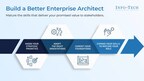
Info-Tech’s Three-Phase Framework for Building a Better Enterprise Architect
To address these challenges, Info-Tech recommends a structured approach. The firm’s Build a Better Enterprise Architect research framework outlines the following priorities for EA leaders and their teams:

Phase 1: Craft Your Enterprise Architect Role.
Establish a clear, context-specific role definition, select the orientation(s) that align with stakeholder value, and document the scope and reporting structure, anchoring the role to specific outcomes rather than broad expectations.

Phase 2: Prioritize and Assess Your EA Skills.
Use the Enterprise Architect Skills Assessment tool to identify the gaps for the chosen orientation, covering mandatory foundation skills and supplementary skills to expand the architect’s breadth and depth.

Phase 3: Roadmap Your Development Milestones.
EA leaders and architects define SMART objectives and corresponding metrics, then sequence skill-development activities across periods, capturing outputs in the Enterprise Architect Role Profile template. This document communicates the architect’s purpose, value, and development plan for stakeholder buy-in.

“The role of the enterprise architect is so complex that to deliver long-term value, they need to determine what skills to develop and what orientation to adopt to best serve the enterprise,” says Caleb Pittman, research specialist at Info-Tech Research Group. “When architects stop chasing the desire to please everyone and focus on a narrow, high-impact mandate, their credibility deepens and their influence scales.”

The firm’s research, Build a Better Enterprise Architect, includes a comprehensive EA skills framework covering various architect orientations, an Enterprise Architect Skills Assessment tool, and an Enterprise Architect Role Profile template. By applying Info-Tech’s research, CIOs and EA leaders can move from a loosely defined EA function to a focused practice that earns stakeholder trust, tracks measurable progress, and builds the organizational credibility that enterprise architecture requires.

For exclusive and timely commentary from Info-Tech’s experts, including Andrew Kum-Seun and Caleb Pittman, and access to the complete Build a Better Enterprise Architect blueprint, please contact pr@infotech.com.

About Info-Tech Research Group
Info-Tech Research Group is the “get things done” partner for over 30,000 IT, HR, and marketing leaders worldwide. The fastest growing research and advisory firm, Info-Tech enables leaders to make well-informed decisions and transform their organizations through AI, strategic foresight, step-by-step methodologies, practical tools, industry-leading advisory, and training programs. For nearly 30 years, tens of thousands of private and public organizations have trusted Info-Tech to lead their most important initiatives through periods of change and deliver outcomes that truly matter.

To learn more about Info-Tech’s HR research and advisory services, visit McLean & Company, and for data-driven software buying insights and vendor evaluations, visit the firm’s SoftwareReviews platform.

Media professionals can register for unrestricted access to research across IT, HR, and software, and hundreds of industry analysts through the firm’s Media Insiders program. To gain access, contact pr@infotech.com.

For information about Info-Tech Research Group or to access the latest research, visit infotech.com and connect via LinkedIn and X.

View original content to download multimedia:https://www.prnewswire.com/news-releases/cios-need-clearer-enterprise-architect-role-definition-to-strengthen-ea-value-advises-info-tech-research-group-302818157.html

SOURCE Info-Tech Research Group

Continue Reading
Click to comment

Leave a Reply

Your email address will not be published. Required fields are marked *

Technology

Fractal establishes India Business Unit to meet increasing demand from large Indian enterprises

Published

on

By

Will leverage its products portfolio led by Cogentiq

MUMBAI, India, Aug. 25, 2026 /PRNewswire/ — Fractal Analytics Ltd. (BSE: 544700) (NSE: FRACTAL), a global enterprise AI company serving Fortune 500® organizations, today announced the launch of its dedicated India Business Unit (India BU), to help India’s large enterprises accelerate business transformation through its enterprise agentic AI platform, Cogentiq, and other products.

Fractal’s expanded focus on India builds on nearly two decades of AI innovation and leadership in the country’s AI ecosystem. Fractal has partnered with multiple Global Capability Centers (GCCs) in India, serving enterprise transformation needs across the region. Fractal’s Cogentiq suite has seen strong traction with institutions in India. In addition to driving enterprise impact, Fractal has been working on driving societal impact through AI. It was selected under the IndiaAI Mission to develop a Large Reasoning Model (LRM) for India and has recently signed a partnership with the Brihanmumbai Municipal Corporation (BMC) to deploy AI-powered citizen health services leveraging Vaidya.ai, India’s first healthcare multimodal reasoning platform.

“We’ve seen a significant increase in interest from Indian enterprises looking to move beyond AI pilots and scale AI-driven transformation across their businesses. This growing demand, combined with India’s rapidly evolving AI ecosystem, makes this the right time for us to establish a dedicated India Business Unit. With a strong portfolio of products and platforms, and deep experience partnering with leading enterprises, we are uniquely positioned to help India’s largest organizations unlock meaningful business value from AI at scale,” said Srikanth Velamakanni, Co-founder, Group CEO and Vice Chairman, Fractal.

To capitalize on India’s growing enterprise AI opportunity, Fractal has appointed Rishi Seth, a seasoned industry leader, as Head of the India Business Unit. The India Business Unit will be part of Fractal’s APAC practice, led by Sandeep Dutta, Chief Practice Officer & Head APAC.

“Indian enterprises are at an inflection point in their AI journey. Organizations are looking for trusted partners who can deliver business outcomes at scale. Fractal brings together globally proven AI capabilities, innovative products/platforms and strong domain expertise to help Indian enterprises accelerate their business transformation. We look forward to co-creating India’s transformation journey together with Indian Enterprises and partner ecosystem,” said Sandeep Dutta, Chief Practice Officer & Head APAC, Fractal.

About Fractal 

Fractal Analytics Ltd (BSE: 544700) (NSE: FRACTAL) is a globally recognized pure-play enterprise AI company trusted by Fortune 500®-sized enterprises to power decision-making through AI services, solutions, and products. Fractal’s strategy is focused on three pillars: AI-led Transformation (AIT), which reimagines business workflows and decision-making through AI; AI Foundations (AIF), which enables scalable, trusted, and governed enterprise AI through robust data and technology foundations; and AI Work & Workforce (AIW), which helps organizations redesign work, develop AI-ready talent, and build the capabilities needed for the AI-native enterprise. All three pillars are powered by Cogentiq, Fractal’s flagship agentic AI platform.

With over 6,000 professionals across North America, EMEA, and Asia-Pacific, Fractal partners with business leaders to drive competitive differentiation for their organizations by embedding AI into critical decisions across business functions and industry verticals.

Fractal invests more than 6% of its revenue in AI R&D, supporting foundational AI research, product development, and IP creation that address both immediate client needs and long-term technological advancement. Fractal’s track record includes developing proprietary models and products such as Vaidya.ai and PiEvolve, as well as incubating and spinning out Qure.ai, a global healthcare AI leader focused on the rapid identification and management of tuberculosis, lung cancer, and stroke (or critical health conditions). Fractal’s suite of businesses consists of Asper.ai (a Revenue Growth Management product for CPG companies) and Analytics Vidhya (an Ed-tech platform).


View original content to download multimedia:https://www.prnewswire.com/in/news-releases/fractal-establishes-india-business-unit-to-meet-increasing-demand-from-large-indian-enterprises-302859109.html

Continue Reading

Technology

ZINZINO AB (PUBL.): INTERIM REPORT Q2 2026

Published

on

By

GOTHENBURG, Sweden, Aug. 25, 2026 /PRNewswire/ —

STRONG GROWTH AND SIGNIFICANTLY INCREASED PROFITABILITY

Revenue for the second quarter of 2026 amounted to SEK 936.8 (794.4) million, representing 18% (57%) growth compared with the same period last year. In local currencies, revenue for the second quarter increased by 23% (62%) compared with the same period last year. EBITDA rose to SEK 153.1 (79.7) million after the EBITDA margin increased to 16.3% (10.0%). The improvement in EBITDA compared with the corresponding period last year was primarily driven by a higher gross margin, good cost control, and increased economies of scale in the business. During the quarter, work continued on realizing synergies from the acquisition of ITWorks as well as several initiatives were implemented to drive continued growth and increased efficiency. Colombia was opened as the next official market in South America, and a new AI-driven customer support tool was launched to increase internal efficiency through automation.

April – June

Total revenue amounted to SEK 936.8 (794.4) million, representing growth of 18% (57%). In local currency, revenue increased by 23% (62%)Gross profit amounted to SEK 351.3 (247.9) million, and the gross profit margin was 37.5% (31.2%)EBITDA amounted to SEK 153.1 (79.7) million, and the EBITDA margin was 16.3% (10.0%)Net income amounted to SEK 105.8 (55.4) millionNet income per share after tax before dilution amounted to SEK 2.72 (1.56)Cash flow from operating activities amounted to SEK 175.8 (112.6) million

January – June

Total revenue amounted to SEK 1,858.9 (1,518.1) million, representing growth of 22% (58%). In local currency, revenue increased by 28% (63%)Gross profit amounted to SEK 692.8 (471.5) million, and the gross profit margin was 37.3% (31.1%)EBITDA amounted to SEK 295.3 (158.4) million, and the EBITDA margin was 15.9% (10.4%)Net income amounted to SEK 210.4 (111.4) millionNet income per share after tax before dilution amounted to SEK 5.51 (3.17)Cash flow from operating activities amounted to SEK 280.0 (133.7) millionCash and cash equivalents as of the balance sheet date amounted to SEK 842.0 (408.5) million

Link to the report: https://www.zinzino.com/site/se/en-gb/about/investor-relations/

For more information:
Dag Bergheim Pettersen CEO Zinzino +47 (0) 932 25 700, dag@zinzino.com
Fredrik Nielsen CFO Zinzino +46 (0) 707 900 174, fredrik.nielsen@zinzino.com

Pictures for publication free of charge: marketing@zinzino.com

Certified Adviser: Tapper Partners AB

Zinzino AB (publ.) is obliged to publish this information in compliance with current EU regulations governing market abuse. The information was provided by the above contact person for publication at 08:00 CET on 25 August 2026.

This information was brought to you by Cision http://news.cision.com

https://news.cision.com/zinzino/r/zinzino-ab–publ–interim-report-q2-2026,c4387203

The following files are available for download:


View original content:https://www.prnewswire.co.uk/news-releases/zinzino-ab-publ-interim-report-q2-2026-302859115.html

Continue Reading

Technology

Southeast Asia Data Center Investment to Reach USD 35.08 Billion by 2031 | Malaysia, Indonesia, Thailand & Singapore – Arizton

Published

on

By

CHICAGO, Aug. 25, 2026 /PRNewswire/ — Arizton’s latest report highlights the continued expansion of Southeast Asia’s data center market, with investments projected to grow from $15.72 billion in 2025 to $35.08 billion by 2031, at a CAGR of 14.32%. The region currently has 306 operational data centers across nine key countries, with another 173 facilities in the pipeline. Upcoming data center capacity is nearly four times the region’s current operational capacity, with Malaysia leading the upcoming IT load pipeline at over 6 GW and Thailand emerging as another major growth market with around 3.5 GW of future capacity. This significant capacity expansion reflects the growing infrastructure requirements for cloud computing, AI, big data, edge computing, and IoT.

To Know More, Click: https://www.arizton.com/market-reports/southeast-asia-data-center-market

Browse in-depth TOC on the Southeast Asia Data Center Market

Pages-:296 
Region:1
Countries:7
Company: 244
Segment:10

Southeast Asia Data Center Market Snapshot

Market Size – Investment (2031)

USD 35.08 Billion

Market Size – Investment (2025)

USD 15.72 Billion

CAGR – Investment (2025-2031)

14.32 %

Market Size – Area (2031)

5.83 Million Square feet

Power Capacity (2031)

1,435 MW

Historic Year

2022-2024

Base Year

2025

Forecast Year

2026-2031

Segments Covered

Facility Type, Infrastructure, IT Infrastructure, Electrical Infrastructure, Mechanical Infrastructure, Cooling Systems, Cooling Techniques, General Construction, Tier Standard, Geography

Geographic Analysis

Singapore, Indonesia, Malaysia, Thailand, Philippines, Vietnam, and Rest of Southeast Asia Countries

Southeast Asia Data Centers: The Next Phase of Capacity Growth

Southeast Asia has around 306 existing data centers, with Singapore, Malaysia, and Indonesia having a strong presence in the region.

Malaysia is a major hyperscale growth market, particularly through Johor, and currently leads the region in upcoming IT load pipeline with over 6 GW planned.

Southeast Asia’s upcoming data center capacity is nearly four times its current operational capacity, indicating the scale of planned development across the region.

Indonesia remains one of the largest operational data center markets in Southeast Asia, with Jakarta and surrounding regions accounting for a strong concentration of facilities.

Thailand’s future data center pipeline is estimated at around 3.5 GW, with Bangkok serving as the country’s major data center hub.

View Insights On 479 Data Center Facilities Across 9 Key Countries in Southeast Asia Data Center Market

Malaysia Continues to Emerge as a Prime Destination for Data Center Investments

Malaysia continues to attract data center investments due to its strategic location between major Southeast Asian markets, robust digital infrastructure, and competitive land and energy costs compared with neighboring Singapore.

In September 2025, ZDATA Technologies, a Chinese data center operator, sought a $500 million loan to finance its upcoming data center project in Gelang Patah, Johor Bahru, near the Singapore border.

The Malaysian government is actively introducing initiatives and strategic programs to strengthen the country’s AI ecosystem. AI growth is supported by strong FDI in digital infrastructure and government strategies to position Malaysia as a regional hub for AI development. Johor is a major data center hub, driven by its proximity to Singapore, land availability, and strong power connectivity.

Malaysia is also expanding its renewable energy capacity to support the growing demand from energy-intensive sectors such as data centers. The government aims to achieve 70% renewable energy in its power mix by 2050, driven by solar, hydropower, and green hydrogen initiatives.

More Insights: https://www.arizton.com/market-reports/malaysia-data-center-market-size-analysis

Singapore Remains a Leading Data Center Investment Destination in Asia

Singapore remains a leading business and investment destination in Asia, supported by its strategic location, strong financial ecosystem, political stability, and global connectivity. Its strong position in ease of doing business, foreign investment, and digital readiness makes it a natural gateway for regional and international enterprises.

The establishment of the Johor-Singapore Special Economic Zone (JS-SEZ) is expected to benefit the data center sector, as supply constraints in Singapore are encouraging operators to establish a presence in Johor.

As of December 2025, Singapore has 45 operational data centers with 5,101.4 thousand sq ft of white floor space, along with 6 upcoming facilities covering around 652.5 thousand sq ft. However, Singapore remains one of the world’s most expensive markets for data center development, with very limited land availability.

Looking ahead, Singapore’s data center market is expected to expand steadily, supported by AI computing, cloud adoption, submarine cable connectivity, and regional digital services. Future development is likely to focus on high-efficiency, high-density, and sustainable facilities, rather than a significant increase in the number of data centers.

More Insights: https://www.arizton.com/market-reports/singapore-data-center-market-size-analysis

Indonesia Remains One of the Largest Operational Markets in Southeast Asia

Indonesia emerges as a key player in the Southeast Asia data center market, showcasing substantial growth potential.  Government-led digital transformation, rising AI adoption, and expanding submarine connectivity are driving continued investment in the country’s data center infrastructure.

In May 2025, Microsoft launched its first data center in Indonesia, which is expected to contribute around $2.5 billion to the economy and create 60,000 jobs by 2028. The initiative will also support digital training for one million people, with 840,000 already participating in AI capability-building.

Indonesia is also advancing its renewable energy transition to support its net-zero carbon emissions target by 2060. The country aims to generate more than 48% of its electricity from renewable sources by 2030, supporting the growing energy requirements of data centers.

The country is also advancing its “100 Smart Cities Movement” to address rapid urbanization through technology-enabled public services. Jakarta and Nusantara are key examples, with initiatives including IoT-based flood management in Jakarta and the development of Nusantara as a sustainable “forest city” supported by renewable energy.

More Insights: https://www.arizton.com/market-reports/indonesia-data-center-market-analysis-2026

Thailand Emerges as a Key Player in the Southeast Asia Data Center Market,

Thailand’s upcoming data center projects are expected to address growing demand for data storage and cloud services across Thailand and the wider ASEAN region. Once developed, these projects are expected to enhance the country’s cloud computing and AI capabilities while creating new employment opportunities.

The Thai government has set ambitious goals, including the development of 100 smart cities by 2040. Policies such as the Smart City Development Plan and Thailand 4.0 are designed to support urban transformation.

Thailand’s cloud-first policy, part of the broader Thailand 4.0 initiative, requires government agencies to prioritize cloud services for their IT infrastructure needs. The policy aims to improve efficiency, reduce costs, enhance cybersecurity, and create a more agile public sector.

Thailand offers foreign ownership flexibility, access to pre-approved energy and fiber infrastructure, and various incentives through the EEC, making it an attractive location for data center investment in Southeast Asia. Bangkok is the preferred location, with major investments from colocation providers such as ST Telemedia Global Data Centres, AIS Business (CSL), OneAsia Network, True IDC, Internet Thailand, Telehouse, and SUPERNAP Thailand

More Insights: https://www.arizton.com/market-reports/thailand-data-center-market-size

Why the Philippines Is Becoming an Attractive Alternative to More Expensive Regional Markets

The Philippines is gaining attention as a cost-competitive data center market in Southeast Asia, supported by its strategic location, expanding subsea connectivity, government incentives, and growing energy infrastructure. Its position within the APAC network corridor further strengthens its appeal to data center investors.

Data center construction costs in the Philippines average around $6–$7 million per MW, lower than in several regional markets, including Thailand, Singapore, and Indonesia. This cost advantage makes the country attractive for investors seeking greater value from regional expansion.

Land costs also remain competitive. As of 2025, land purchase prices ranged from around $120–$200 per sq m, among the lowest in the APAC region, further supporting the Philippines’ position as an emerging alternative for data center development.

More Insights: https://www.arizton.com/market-reports/philippines-data-center-colocation-market

What Key Findings Will Our Research Analysis Reveal?

How big is the Southeast Asia data center market?What is the growth rate of the Southeast Asia data center market?What is the estimated market size in terms of area in the Southeast Asia data center market by 2030?What are the key trends in the Southeast Asia data center market?How much MW of power capacity is expected to reach the Southeast Asia data center market by 2030?What is the estimated market size in terms of area in the Southeast Asia data center market by 2030?

Get Access to complete Southeast Asia data center report – Regional Outlook, Growth Potential, Price Trends, Competitive Market Share & Forecast 2026–2030.

Major Companies in the Southeast Asia Data Center Market

The Southeast Asia data center market has the presence of key investors such as Bridge Data Centres, Digital Realty, Equinix, AirTrunk, NTT DATA, Princeton Digital Group, DayOne, ST Telemedia Global Data Centres, Vantage Data Centers, and others.New Entrants include A-FLOW, Aslan Energy Capital, Beeinfotech PH, BRIGHT RAY, BW Digital, CloudHQ, CtrlS Datacenters, DAMAC Digital, NEXTDC, ZDATA Technologies, STACK Infrastructure and several others.

What Key Findings Will Our Research Analysis Reveal?

How big is the Southeast Asia data center market?What is the growth rate of the Southeast Asia data center market?What is the estimated market size in terms of area in the Southeast Asia data center market by 2030?What are the key trends in the Southeast Asia data center market?How much MW of power capacity is expected to reach the Southeast Asia data center market by 2030?What is the estimated market size in terms of area in the Southeast Asia data center market by 2030?

About Arizton Advisory & Intelligence:                                                                                   
Founded in 2017, Arizton Advisory & Intelligence delivers data-driven market research and strategic consulting that empowers clients to make informed decisions and drive growth. Combining quantitative and qualitative insights, we provide in-depth analysis across industries including Agriculture, Consumer Goods, Technology, Automotive, Healthcare, Data Centers, and Logistics. Recognized by top-tier media, our expert team transforms complex market data into actionable strategies, helping clients anticipate trends, seize opportunities, and stay ahead of the competition.

Contact Us                                   
Mail: enquiry@arizton.com
Contact Us: https://www.arizton.com/contact-us
Website: https://www.arizton.com/
 Call: +1 312-680-2940
Source: Arizton Advisory & Intelligence


View original content to download multimedia:https://www.prnewswire.co.uk/news-releases/southeast-asia-data-center-investment-to-reach-usd-35-08-billion-by-2031–malaysia-indonesia-thailand–singapore–arizton-302859140.html

Continue Reading

Trending