Connect with us

Technology

VoicePing releases VoicePing 3.0 for enterprise multilingual communication

Published

on

The latest version brings together real-time translation, AI meeting minutes, voice output, terminology dictionaries, MCP/API access, QR-based event translation, file transcription, subtitles, AI dubbing, virtual office collaboration, enterprise administration, and new VoicePing ASR and MT models.

TOKYO, July 12, 2026 /PRNewswire/ — VoicePing Inc. today announced the availability of VoicePing 3.0, the latest version of its multilingual AI communication platform for in-person and web meetings, exhibitions and events, audio and video files, recordings, and virtual offices.

VoicePing 3.0 is designed for organizations that need to communicate, document and reuse spoken information across multilingual workplaces. The platform captures audio from meetings, seminars, webinars, external web conferences, recorded audio and video files, and hybrid office environments, then converts that communication into real-time transcription and translation, AI meeting minutes, meeting summaries, action items and searchable meeting logs.

The latest version also supports translated voice playback, AI dubbing, terminology dictionaries, MCP/API access for approved AI workflows, and event QR translation. These capabilities help multilingual teams reduce information gaps, improve meeting follow-up and manage communication knowledge across the organization. Experience VoicePing 3.0 for free or request a demo to learn more.

“Global teams no longer communicate in one place,” said Akinori Nakajima, CEO of VoicePing. “Important conversations happen across meetings, events, recorded files, external web conferences and hybrid offices. With VoicePing 3.0, we rebuilt the platform so enterprises can translate multilingual communication in real time, preserve it as searchable knowledge, manage terminology, and connect meeting records to governed AI workflows through MCP and APIs.”

Multilingual Communication Is Becoming Enterprise Infrastructure

As global companies and organizations with international talent expand across distributed teams, events, training content and hybrid work, communication increasingly happens across many different channels. Language barriers, scattered meeting records, slow follow-up and enterprise security requirements make it difficult to turn those conversations into shared knowledge.

Single-purpose transcription or translation tools can support individual meetings or files, but they are often not enough for enterprises that need to manage multilingual communication continuously. VoicePing 3.0 addresses this need by combining real-time translation, voice output and AI dubbing, AI meeting minutes, event translation, web meeting capture, file transcription, terminology dictionaries, MCP/API access, virtual office collaboration, analytics, security and administration in one platform.

Key Updates in VoicePing 3.0

VoicePing 3.0 includes product, model, performance and security updates across desktop, mobile and enterprise administration.

Key enhancements include:

A redesigned user experience for clearer multilingual meeting workflows.

Improved real-time translation responsiveness across display, sharing, playback and summarization.

Performance improvements for stable use during live meetings.

Enhanced workspace security, including permission management, IP restriction, audit logs and sharing controls.

Improved mobile offline models for more reliable transcription and translation in unstable network environments.

New VoicePing ASR V0.1 and VoicePing MT V0.1 models for speech recognition and multilingual translation.

Core Platform Capabilities

VoicePing 3.0 supports multilingual communication across the full enterprise workflow:

Real-time translation, transcription and voice output:Translate microphone audio, PC system audio, other app audio, presentation audio and mobile conversations in real time, with bilingual display, translated voice playback, topic summaries, searchable logs and QR-based listener mode.

AI meeting minutes and searchable meeting logs:Store recorded meetings with playback, speaker segments, original transcripts, translations, summaries, topics, action items, AI prompts, tags, participants and sharing permissions.

Terminology dictionary management:Manage personal and workspace dictionaries, special-word recognition, translation dictionaries, vocabulary, pronunciation, phrase replacement, CSV import/export and AI suggestions to improve consistency for names, product terms and industry vocabulary.

Web Meeting Bot: Join Zoom, Google Meet and Microsoft Teams meetings to record, transcribe, translate, summarize, extract topics and generate action items, with Google Calendar, Outlook Calendar and Slack integration.

File transcription, subtitles and AI dubbing:Upload audio and video files to generate transcripts, translations, subtitle files, subtitled videos and dubbed audio or video for training, webinars, demos, YouTube content and archived recordings.

MCP/API access for AI workflows:Connect meeting logs, transcripts, summaries and action items to external systems and approved AI workflows. In organizations using Claude or ChatGPT with MCP-enabled environments, meeting knowledge can support follow-up drafting, task organization, CRM updates, enterprise knowledge search and internal Q&A.

Expo Mode for events:Let attendees at exhibitions, seminars, conferences, booths and international meetings scan a QR code and view real-time translation on their own smartphones without creating an account. VoicePing 3.0 supports individual translation sessions from a single URL and gives organizers visibility into access, usage and language activity.

Virtual office for multilingual teams:Provide presence, meeting rooms, audio and video, screen sharing, chat, reactions, collaborative notes, whiteboards and GPT support inside a virtual office environment, with real-time transcription and translation available during meetings.

Enterprise administration and security:Manage users, roles, groups, floors, projects, feature access, IP restrictions, API/MCP access, usage, quotas, billing, event logs, debug logs and workspace analytics.

VoicePing ASR and MT Models

VoicePing also introduced VoicePing ASR V0.1, a speech recognition model, and VoicePing MT V0.1, a multilingual translation model. These models support core functions across transcription, translation, subtitles, meeting summaries and search, with a focus on practical multilingual business communication, especially across Asian languages.

In the company’s benchmark testing across 5,000 business conversation clips in English, Japanese, Korean, Chinese and Vietnamese, totaling approximately 41 hours, VoicePing ASR V0.1 recorded an average word error rate of 19.3%. Lower WER indicates higher speech recognition accuracy.

For English-Japanese translation, VoicePing MT V0.1 recorded an overall score of 87.2 in the company’s evaluation, indicating performance comparable with major translation models in the evaluated setting. Higher scores indicate higher translation quality. VoicePing is continuing development and evaluation of the next model version, VoicePing V0.2.

These model updates are expected to improve transcription accuracy, English-Japanese translation quality, live subtitle stability, and the quality of meeting summaries and search.

Built for Enterprise Deployment

VoicePing 3.0 includes governance and security capabilities required for enterprise use, including role and permission management, feature access controls, IP restriction, allowed-network control, event logs, debug logs, API/MCP access management and workspace usage visibility.

The platform is supported by ISO/IEC 27001 / ISMS certification, TLS 1.2+ encrypted communication, a policy that customer data is not used for AI training, and an option designed for deployments where data should not be stored on the cloud side.

Adoption and Scale

VoicePing is used by more than 1,000 organizations and more than 100,000 users across manufacturers, universities, public institutions, event operators and global companies. The platform supports 48 languages and has processed more than 550 million seconds of translated audio and more than 1 million meeting records.

Availability

VoicePing 3.0 is available now. Organizations can learn more, request a demo or start for free at:

Product website: https://voiceping.net/

Demo request: https://forms.gle/beGbg8tkHUL2dNZJ6

Start free: https://app.voiceping.io/user/signup

About VoicePing

VoicePing provides a multilingual communication platform for companies and teams working across languages. The platform combines real-time translation, AI meeting minutes, meeting logs, event translation, external meeting bots, virtual office collaboration, remote work management and enterprise administration. VoicePing helps organizations record, translate, summarize and reuse communication from meetings, events, files, recordings and hybrid offices as searchable knowledge.

Company name: VoicePing Inc.

Head office: 3F Nihonbashi Otomi Building, 13-7 Nihonbashi Odenmacho, Chuo-ku, Tokyo 103-0011, Japan

Representative: Akinori Nakajima, CEO

Founded: July 2019

Capital: JPY 209,900,096, including capital reserve

Business: Development and provision of the multilingual communication platform VoicePing

Media Contact

VoicePing Inc. Public Relations Email: support@voice-ping.com Tel: 050-3117-0204, weekdays 11:00-17:00 JST

View original content:https://www.prnewswire.com/news-releases/voiceping-releases-voiceping-3-0-for-enterprise-multilingual-communication-302823495.html

SOURCE VoicePing Inc.

Continue Reading
Click to comment

Leave a Reply

Your email address will not be published. Required fields are marked *

Technology

YFORE Debuts ODMS In-Cabin Sensing System to Enhance Cockpit Safety

Published

on

By

SUWANEE, Ga., Aug. 29, 2026 /PRNewswire/ — Marking the official opening of its North American manufacturing facility in Georgia, global Tier-1 supplier YFORE Technology debuted its Occupant & Driver Monitoring System (ODMS)—an integrated in-cabin full-coverage sensing solution.

As in-cabin monitoring systems become standard, conventional vision-only setups often struggle with seatback occlusion, footwell blind spots, and covered occupants, while distributed sensors complicate vehicle wiring and roof tooling. To solve this, YFORE’s ODMS combines a DMS/OMS-integrated smart mirror with automotive-grade cabin radar, delivering an integrated multimodal architecture for robust cabin protection.

Multimodal Fusion Eliminates Blind Spots
Integrating the smart mirror with in-cabin radar overcomes optical limitations through RF signal penetration. The smart mirror’s high-definition camera tracks driver fatigue, distraction, and unresponsive states from a prime forward angle. Simultaneously, the roof radar penetrates blankets, clothing, and tall seatbacks to capture micro-breathing in rear rows and footwells, achieving comprehensive 3D spatial coverage.

Full-Scenario Sensing Aligned with Safety Standards
The ODMS architecture covers seven core functions: driver fatigue, distraction, unresponsive driver, and phone use detection, alongside seatbelt status, occupant classification, and full-cabin life presence detection. This integrated approach provides automakers with a reliable, full-scenario sensing foundation to help vehicles achieve five-star safety ratings under Euro NCAP.

Streamlined Architecture and Cabin Space
By embedding optical components into the smart mirror and pairing them with a compact radar module, ODMS eliminates multiple headliner cutouts and complex roof wiring. This preserves clean interior aesthetics while simplifying platform adaptation across multiple vehicle models.

Moving from localized monitoring to full-cabin protection, YFORE delivers a comprehensive, integrated, and scalable safety solution for global automakers.

About YFORE

YFORE is a global Tier 1 automotive electronics supplier dedicated to driving the future of intelligent mobility. Partnering with more than 30 leading automotive OEMs worldwide, YFORE delivers high-performance, automotive-grade solutions across Intelligent Access, Intelligent Mirror and Sensing systems. With operational footprint spanning North America, Europe, and Asia, YFORE combines global engineering depth with local execution to empower the next era of connected vehicles.
For more information, please visit www.yftech.com/en or follow YFORE on LinkedIn.

View original content to download multimedia:https://www.prnewswire.com/news-releases/yfore-debuts-odms-in-cabin-sensing-system-to-enhance-cockpit-safety-302863286.html

SOURCE YFORE

Continue Reading

Technology

Niutech Signs Agreement with Global Energy Major for Waste Plastic Pyrolysis Line to Produce SAF

Published

on

By

JINAN, China, Aug. 29, 2026 /PRNewswire/ — Niutech Technology Group Co., Ltd (abbreviated as “Niutech”), a STAR Market-listed Chinese company specialized in industrial continuous pyrolysis technology, today announced it has signed a sales agreement with a global energy major for an Industrial Continuous Waste Plastic Pyrolysis Production Line. The line runs on Niutech’s proprietary patented pyrolysis technology and delivers safe, environmentally sound operation with a single-unit processing capacity of 10,000 to 50,000 tons per year (tpy). The agreement marks Niutech’s first entry into the customer’s equipment supply chain and the start of a long-term partnership.

As part of its sustainability commitments, the customer has steadily expanded investment in renewable energy in recent years and made Sustainable Aviation Fuel (SAF) a strategic priority. Under the agreement, Niutech’s technology and equipment will be deployed to upgrade a large refinery owned by the customer. Once complete, the refinery will have an integrated capability from pyrolysis oil to hydrotreated SAF.

SAF is widely regarded as a key pathway for aviation decarbonization. Under the EU’s ReFuelEU Aviation regulation, SAF blending in jet fuel is mandatory at 2% from 2025, rising to 6% by 2030 and 70% by 2050, while the UK and Singapore have enacted their own blending mandates. Used cooking oil (UCO) is currently the dominant feedstock for SAF production, but limited UCO supply has left the market in urgent need of alternatives. Through Niutech’s patented technology, waste plastics can be converted into pyrolysis oil suitable for SAF production, making the feedstock route a promising second option.

Niutech’s industrial continuous waste plastic line is highly tolerant of feedstock quality: it requires no complex washing, sorting, drying or fine shredding, and directly pyrolyzes low-value waste plastics — including PP, PE, PS, ABS and nylon, single or mixed — with high efficiency and long-cycle, safe, stable continuous operation at large throughput. Niutech’s waste plastic pyrolysis solutions have been commercialized in the UK, South Korea, Denmark, Thailand, Vietnam, China and other markets, supporting multiple 10,000-tonne-scale continuous projects, including the European Waste Plastic Pyrolysis Chemical Recycling Demonstration Project, the Southeast Asian Waste Plastic Pyrolysis Chemical Recycling Demonstration Project, and China’s first large-scale continuous pyrolysis project for medical waste plastics.

Waste plastic pyrolysis oil, once an alternative energy source, is now becoming a key upstream feedstock for aviation decarbonization. “Large-scale pyrolysis projects place demanding requirements on the continuous operation capability of the equipment,” said a market executive at Niutech. “Niutech has focused on pyrolysis technology for nearly 40 years and brings mature equipment and extensive project experience. This partnership is another validation of the strength of our industrial continuous technology.”

About Niutech

Niutech Technology Group Co., Ltd (Stock Code: 688309) is a pyrolysis solutions provider with fully proprietary, globally leading pyrolysis technology, integrating R&D and application, high-end equipment manufacturing and sales, and its own industrial project construction and operation. Its independently developed industrial continuous pyrolysis equipment, with a single-unit processing capacity of 10,000 to 50,000 tpy, has been applied to the disposal of more than 30 waste types, including scrap tires, waste plastics, oily sludge, tar residue, medical waste and biomass. Niutech has helped customers complete 10,000-tonne-scale continuous pyrolysis projects across dozens of countries, including Germany, the UK, South Korea, Denmark and Brazil.

Website: www.niutechpyrolysis.com
Email: contact@niutech.com
YouTube: www.youtube.com/@niutechpyrolysis
Facebook: www.facebook.com/pyrolysistooil

View original content to download multimedia:https://www.prnewswire.com/news-releases/niutech-signs-agreement-with-global-energy-major-for-waste-plastic-pyrolysis-line-to-produce-saf-302863280.html

SOURCE Niutech Technology Group Co., Ltd

Continue Reading

Technology

Amid Growing Water Crisis, Chandigarh University Biotechnology Researchers Get Patent for Innovative Device to Kitchen Wastewater Reuse, Save Potable Water

Published

on

By

CU Researchers’ Patent Two-Stage Filtering Device to Address Water Scarcity
with Recycling of Kitchen Wastewater for Gardening, Cleaning and Other Uses

CHANDIGARH, India, Aug. 29, 2026 /PRNewswire/ — At a time when 80% of water supplied to households in India is released as wastewater even as over 60 crore people in the country are facing severe water crisis due to extreme groundwater over-extraction, erratic monsoons and rapid urbanisation, a team of Chandigarh University (CU) researchers has conceived and patented an innovative wastewater filtering device designed to provide a two-stage treatment for kitchen wastewater before it enters the drainage system, while also enabling collection of the filtered water for suitable domestic uses including gardening, irrigation and outdoor-area cleaning, thus  reducing the demand for fresh potable water.

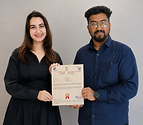
Chandigarh University researchers including Prof (Dr) Anu Kumar, Associate Professor, Department of Biotechnology, CU along with two students of Biotechnology, Bhanu Krishan and Shivani have been granted a patent for this invention titled ‘Waste Water Filtering Device’ by the Patent Office, Government of India in April 2026.

Sharing details, Prof Kumar said, “The idea for this Device came from the water scarcity experienced in Shimla in 2018. This water crisis made me think that while water is an essential and limited resource, yet much water gets wasted in household activities which don’t require potable water. According to Economic Survey 2025-26, India is among the top generators of wastewater in the world, with almost 112 billion litres of urban wastewater being generated daily but only 8% of wastewater generated was being recycled and reused. So there is a need to reuse wastewater wherever possible rather than allowing it to directly go into the drainage system as over 60 Crore people in India are experiencing high to extreme water stress in India. The device was therefore designed as a simple, affordable solution to treat commonly generated household wastewater, particularly kitchen wastewater and collect it for suitable reuse. The broader aim was to make the best possible use of available water, reduce wastage and contribute to water conservation,”.

Explaining the working of this Device, Prof Kumar said, “When wastewater get generated during washing of utensils, it enters the modified strainer, the main housing of the filtering device. From there, the wastewater passes through two successive treatment sections. The first section contains multiple polyurethane sheets coated with silica along the inner walls of the strainer. These sheets serve as the primary filtering and absorbing material and are intended to absorb oily constituents and soap micelles present in kitchen wastewater. The wastewater then passes through a second section containing activated charcoal which provides second adsorption stage for contaminants in the wastewater,”.

 “Thus, the two sections work sequentially, with the first stage primarily addressing oil- and soap-containing constituents while the activated charcoal providing further adsorption of contaminants. The filtered water is then conveyed through a tail pipe connected to the strainer and directed into an attached storage tank where the treated water is collected for further suitable non-potable domestic uses,” he added.

Prof Kumar said this treated wastewater collected in the storage tank can be used for watering household plants, lawns and other vegetation. It could also potentially be used for toilet flushing, floor and outdoor-area cleaning, washing of courtyards or other utility areas, thereby reducing the demand for potable water. The basic idea is to divert relatively less-contaminated household wastewater from the drainage system, remove major constituents such as oil, grease and soap micelles through the polyurethane and activated-charcoal stages and collect filtered water for appropriate non-drinking applications, he said.

 “The ‘Waste Water Filtering Device’ is designed specifically for wastewater generated during routine washing activities in a kitchen. It integrates filtration and water collection into a single device and uses a sequential treatment concept combining silica-coated polyurethane sheets and activated charcoal. Overall, this device offers a potential preliminary treatment and water-reuse approach for domestic settings, especially for works which don’t require potable water,” Prof Kumar added.

Congratulating Chandigarh University researchers for getting the patent for the ‘Waste Water Filtering Device’, Deepinder Singh Sandhu, Senior Managing Director, Chandigarh University said, “This achievement reflects the strong research and innovation eco-system at Chandigarh University to support research excellence and intellectual property generation for advancement of technology. Chandigarh University’s students and faculty members have filed more than 6,100 patents out of which 5800 patents have been published and 260 patents have been granted. Chandigarh University has been ranked number one as a single institution in India for filing highest number of patents. CU’s 44 faculty members featured in Stanford University–Elsevier list of the world’s top 2% scientists,”.

“The range of research activities at Chandigarh University is both wide-ranging and profound. CU scholars conduct research in practically every domain, and pursue to develop human knowledge through investigation, invention, and understanding. Chandigarh University is recognized as Scientific and Industrial Research Organization (SIRO) by the Union Ministry of Science and Technology’s Department of Scientific and Industrial Research (DSIR) for promoting and advancing the research,” he said.

Sandhu further said to further strengthen its research eco-system, Chandigarh University has dedicated an annual budget of Rs 15 Crore for research and has also 60 Research Centres and 15 Centres of Excellence. CU’s research initiatives are further strengthened by 67 projects funded by the corporate sector and government bodies with Rs 90 Crore.

“Making research a core pillar of education, Chandigarh University nurtures next-generation leaders in emerging domains with its research-intensive, innovation-driven and unique experiential learning model. CU has established a strong presence in global academic databases by producing over 25,000+ scholarly documents in key areas including engineering, computer science, life sciences, physical sciences, social sciences and management, according to Scopus. These research publications have received more than 1.53 lakh Scopus citations which reflect the growing impact of CU’s diverse research output,” he added.

Chandigarh University

Chandigarh University is a NAAC A+ Grade University and QS World Ranked University. This autonomous educational institution is approved by UGC and is located near Chandigarh in the state of Punjab. It is the youngest university in India and the only private university in Punjab to be honoured with A+ Grade by NAAC (National Assessment and Accreditation Council). CU offers more than 109 UG and PG programs in the field of engineering, management, pharmacy, law, architecture, journalism, animation, hotel management, commerce, and others. It has been awarded as The University with Best Placements by WCRC.

Website address: https://www.cuchd.in/

Photo: https://mmx.prnewswire.com/media/MS1977927/PRESS-PIC-001-CU-STUDENTS.jpg?id=OA2918975&token=eyJhbGciOiJkaXIiLCJlbmMiOiJBMjU2R0NNIn0..aE6gItATRRYXmGQZ.7pVOgUCJzjiZGn8mSlpak0iGQ4xcdeyDuTBUkKt-BMPXL3kkVbmIx-dX_mgayhdNxWV_WXZc9G9m3VZ7Zc7tgq4KDlx2jQKdRT7VBCJoUagzvgDswMQa12bEOGSOugKNZk8.HzkA6WIu4AyOnND9gqcM9A

View original content to download multimedia:https://www.prnewswire.com/in/news-releases/amid-growing-water-crisis-chandigarh-university-biotechnology-researchers-get-patent-for-innovative-device-to-kitchen-wastewater-reuse-save-potable-water-302863271.html

Continue Reading

Trending