Connect with us

Technology

Interview With Bifu CEO: From Exchange to Trading Network, With Financial Equality at Its Core

Published

on

HONG KONG, Aug. 13, 2026 /PRNewswire/ — In an industry where exchanges compete on derivatives depth, listing speed and platform tokens, Bifu has chosen a different path. With financial equality as its foundation, the platform is upgrading from a single exchange into a trading network that connects multiple markets, asset classes and communities. In a recent interview, the CEO of Bifu explained the beliefs behind the move, the dual-engine architecture powering it, the brand renewal now underway, and the trustless endgame the company is building toward.

Financial Equality as the Starting Point

According to the CEO, financial equality is the basis of the company’s decisions rather than a marketing phrase. “Quality assets, strategies and trading infrastructure should not belong only to institutions and high-net-worth individuals,” he said. “Ordinary users deserve an equal path to reach them.”

In practice, this translates into a clear direction: the company packages market return opportunities that were previously available mainly to professional institutions into products for ordinary users, so that quality strategies are no longer reserved for the few.

The CEO also connected this principle to what he sees as the industry’s main structural problem: Web2 and Web3 exchanges have not truly converged. On-chain markets offer diversity and transparency but remain fragmented and difficult to use, while traditional platforms are efficient but concentrate authority in the platform’s hands. He considers starting from Web2 the practical choice at this stage, while maintaining that platforms will ultimately need to share authority with users. This is the reasoning behind Bifu’s stated positioning as a bridge from Web2 to Web3.

A Dual Asset Engine Behind One Network

Bifu’s asset expansion runs on two tracks. The first is a brokerage engine that connects to external liquidity in markets with mature pricing, such as CFDs and prediction markets. For these markets, the company’s approach is to integrate existing liquidity rather than build its own. The second is a self-built liquidity engine covering primary assets without established pricing, along with futures and spot. This in-house pricing and matching capability is what the CEO identifies as the company’s long-term moat.

The two engines together form BiNet, the global asset trading network behind the platform. Under this architecture, crypto, forex, commodities, stock CFDs, RWA and prediction markets connect to a single account and funding system: one verification, one pool of funds, access to every market. Bifu is the platform users interact with, while BiNet is the network layer underneath.

Between traditional finance and blockchain finance, the company says it is working on the flow of funds in both directions. For the next six to twelve months, its stated priority is a trader incubation program that combines livestreaming, IM and AI agents to produce trading-related content, with content and community intended to serve as the platform’s growth channel.

From Exchange to Trading Network

On the timing of the repositioning, the CEO’s explanation is that the product has moved ahead of brand perception. In his view, the dual-engine architecture, multi-asset coverage, trader incubation and the Web2-to-Web3 bridge already constitute a trading network rather than an isolated exchange, and the brand is catching up to that fact.

BiNet, the carrier of the new positioning, is aimed at a long-standing structural problem. Each asset class operates in its own market, with separate accounts, verification and funding channels. When an opportunity appears in one market, a trader’s capital is often in another, and moving it can take hours or days. The CEO described the fragmentation as running across four levels, identity, funds, risk control and compliance, and framed it as an infrastructure problem: between the markets, there is no network.

BiNet’s proposed answer is a single shared entrance for all assets, allowing capital to move between markets rather than sitting in silos. The CEO compared it to global roaming, where one phone number works in every country, and summarised the goal in one sentence: “Wherever the opportunity is, you are already there.”

He also drew a structural distinction between a trading network and an exchange. In a traditional venue, users trade one class of assets, and each new market requires rebuilding an entire system. In a network, each new market reuses the same account, routing, matching and clearing capabilities, so markets keep being added while the entrance stays one. Beyond the technical difference, he characterised an exchange as a closed venue where users come, trade and leave, and a trading network as an open ecosystem in which the platform provides infrastructure and asset access while traders, retail users and communities operate on top of it.

This positioning also shapes how the company communicates. While competitors centre their messaging on futures, spot and platform tokens, Bifu frames its message around helping users earn from the market, with the aim that each type of trader can find a solution that fits them on Bifu, provided collectively by the community. On its relationship with partners, the CEO put it this way: “The platform is an amplifier, not a harvester.”

As for its target users, the company’s long-term position is that financial equality should carry no entry barriers. At the current stage, it serves users who want steady returns while allocating part of their capital to market opportunities. The CEO described them as financially literate, open to new things, and unwilling to stay in their comfort zone. Most discover Bifu through communities, and their feedback, according to the company, centres on the actual returns its strategies deliver.

Compliance and Trust: From Trustable to Trustless

On the question of trust, the CEO pointed to two horizons. In the short term, the company relies on its group background: the group behind Bifu has operated for years with substantial revenue, which, in his argument, means harming users would cost it far more than it would cost a new entrant. In the long term, the company says it selects jurisdictions with stable regulatory policies and plans to obtain top-tier licenses, positioning itself as a compliant bridge between Web2 and Web3.

Asked about the low level of user trust in centralised platforms after multiple industry collapses, the CEO said the company does not use competitors’ failures for attention, and instead focuses on asset segregation and custody. Beyond licenses, he emphasised segregation at the code and asset level, designed to remove the possibility of internal misconduct, so that engineering constraints rather than promises become the basis of user trust.

The stated endgame goes a step further. Today, choosing a platform means choosing to believe in a brand, and the company describes its current work as making Bifu more trustworthy. The long-term goal, however, is a protocol-based exchange with trustless mechanisms, where rules are written into the protocol and asset ownership is guaranteed by mechanisms rather than by any team’s conduct. In the CEO’s framing, trust then becomes a default property of the system, which he called the completed form of financial equality.

One Account, Trade the World

Asked to introduce Bifu in one sentence to users who do not yet know it, the CEO answered that Bifu is building a multi-market, multi-asset trading network for retail users, so that wherever the opportunity is, they are already there. However, when users first encounter the platform, he said, the intent is that they stay for a trading solution that fits them and a community that grows with them.

From trustable to trustless, and from an exchange to a trading network, Bifu’s repositioning is still in its early stages.

CONTACT:
Stan Li
stan.l@bifu.co

View original content to download multimedia:https://www.prnewswire.com/apac/news-releases/interview-with-bifu-ceo-from-exchange-to-trading-network-with-financial-equality-at-its-core-302850616.html

SOURCE Bifu

Continue Reading
Click to comment

Leave a Reply

Your email address will not be published. Required fields are marked *

Technology

Labuan IBFC Inc., ASAS and STEP Malaysia strengthen Islamic wealth planning practices

Published

on

By

Joint initiative highlights integrated approaches to wealth planning, succession and cross-border solutions

KUALA LUMPUR, Malaysia, Aug. 13, 2026 /PRNewswire/ — Labuan IBFC Incorporated Sdn Bhd (Labuan IBFC Inc.), the official marketing agency for Labuan International Business and Financial Centre (Labuan IBFC), together with the Association of Shariah Advisors in Islamic Finance Malaysia (ASAS) and the Society of Trust and Estate Practitioners (STEP) Malaysia  brought together industry practitioners and experts to explore the intersection of Islamic wealth planning, estate administration and Shariah governance, with a focus on cross-border wealth management and family governance.

The forum brought together Islamic estate planning professionals, Shariah advisers, trust and estate practitioners, wealth managers as well as legal experts to explore effective approaches to preserving, managing and transferring wealth. Discussions encompassed estate administration beyond faraid, Shariah estate administration governance, succession planning and the use of trusts, takaful and other wealth structures.

In her welcome address, Mdm. Farah Deba, Branch Chair of STEP Malaysia, said, “Beyond Faraid means faraid is only one part of estate planning. However, this does not mean planning beyond Islamic principles. We come from three different perspectives – where STEP speaks as advisors to families across generations while Labuan IBFC brings the international family wealth and structuring dimension, whereas ASAS brings the core Shariah perspective.”

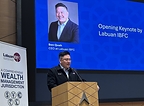
Delivering the keynote address, Mr. Ben Quah, CEO of Labuan IBFC Inc., highlighted Labuan IBFC’s role as a platform for Islamic private wealth planning and cross-border wealth solutions. “As wealth becomes increasingly global, families need flexible solutions that offer asset protection and long-term continuity. Labuan IBFC is well positioned to meet these needs while complementing Malaysia’s leadership in Islamic private wealth through strong ecosystem collaboration,” he said.

The programme opened with “Beyond Faraid – The Real Challenges in Muslim Estate Administration,” examining practical challenges in estate administration, while exploring solutions to translate succession intentions into effective estate planning. This was followed by a dialogue which explored how effective governance and proper documentation can help ensure wealth planning arrangements are implemented consistently with Shariah requirements.

Labuan IBFC was then featured in “Labuan IBFC as a Platform for Islamic Wealth and Family Governance,” showcasing its flexible legal structures and solutions for cross-border wealth management, succession planning and asset structuring.

The afternoon session focused on the practical implementation of wealth plans, covering liquidity, takaful, trusts and other structures. Panellists outlined how these can support wealth preservation, risk management and intergenerational wealth transfer.

The event concluded with a panel discussion on strengthening the Islamic wealth planning ecosystem, bringing together perspectives from wealth management, financial planning, estate administration and Shariah practice. The discussion underscored the importance of collaboration in advancing holistic Islamic wealth planning solutions.

In her closing remarks, Mdm. Yusaini Yusof, EXCO member of ASAS, emphasised, “Shariah governance ensures that the legacy is properly structured, successfully implemented and ultimately serves Maqasid Shariah. ASAS shall continue to support this journey for greater engagements and increased professionalism of the wider Shariah fraternity and practitioners.”

The session builds on the strategic partnership established through the Memorandum of Understanding between Labuan IBFC Inc. and ASAS, while further strengthening engagement with STEP Malaysia and the wider professional community.

For more information on Labuan IBFC and its Islamic finance and wealth management solutions, visit www.labuanibfc.com.

View original content to download multimedia:https://www.prnewswire.com/apac/news-releases/labuan-ibfc-inc-asas-and-step-malaysia-strengthen-islamic-wealth-planning-practices-302850684.html

SOURCE Labuan IBFC Inc.

Continue Reading

Technology

iQIYI Expands Suspense Slate with New Horizontal-Screen Short-Form Drama Brand Undercurrent Theater, Debut Title “Dead of Winter” Tops Charts

Published

on

By

BEIJING, Aug. 13, 2026 /PRNewswire/ — Recently, iQIYI, China’s leading online entertainment platform, has launched Undercurrent Theater, a horizontal-screen short-form suspense brand making a strong debut with its inaugural title “Dead of Winter”. The title has gained rapid audience traction and delivered solid commercial returns, signaling strong market appetite for the format. The launch sets a strong foundation for Undercurrent Theater as iQIYI deepens its leadership in premium suspense content.

Since its August 4 premiere, “Dead of Winter” has reached a peak iQIYI content popularity index, a measure of audience engagement on the platform, of 6,638, the highest for an iQIYI revenue-sharing, a model where production partners share earnings with iQIYI based on viewership, short-form drama since 2024. It has also topped multiple industry rankings across leading Chinese entertainment data providers Enlightent, Maoyan and DataWin. Enlightent data shows its daily market share peaked at 60.9%, making it the second horizontal short-form drama this year to surpass 60%, following iQIYI’s “The Ferry Man 10th Anniversary”, a 10th-anniversary return of the classic IP “The Ferry Man”.

Strong viewership has also translated into commercial momentum. Within five days of release, “Dead of Winter” generated over RMB5 million (approximately US$740,000) in revenue-sharing earnings, with iQIYI projecting total revenue-sharing earnings to exceed RMB10 million (approximately US$1,480,000) within nine days of release.

Set in a small northeastern Chinese city in the late 1990s, “Dead of Winter” is a gritty crime suspense drama rooted in social realism. The series follows two former friends – a community police officer and a criminal investigator – who reunite to solve a series of major cases, unraveling an eight-year family tragedy. Its fast-paced storytelling, strong performances, and distinctive wintry setting have driven significant social buzz. More than 20 derivative short videos have each surpassed 100,000 likes, with audience calls for a second season.

The debut validates both the premium content model and the revenue-sharing approach underpinning Undercurrent Theater, with more titles already in the pipeline. “The VI Group of Fatal Case” (the Chinese title translates as Sixth Criminal Investigation Unit), a prequel to the beloved 2001 crime procedural. “The Murder Truth”, adapted from a highly rated original work, weaves intricate deduction with interconnected serial crimes for a layered viewing experience. Together, the upcoming slate builds on the momentum of “Dead of Winter” as iQIYI continues to deepen its short-form suspense offering and cement its position as the home of premium Chinese suspense storytelling for global audiences.

Contact: 
iQIYI Press
press@qiyi.com 

View original content to download multimedia:https://www.prnewswire.com/apac/news-releases/iqiyi-expands-suspense-slate-with-new-horizontal-screen-short-form-drama-brand-undercurrent-theater-debut-title-dead-of-winter-tops-charts-302850700.html

SOURCE iQIYI Inc.

Continue Reading

Technology

From Chinese AI to Global ETFs: STARTRADER Launches 45 New 24/7 Stock and ETF CFDs Spanning Seven Market Themes

Published

on

By

Available from August 13, 2026, the launch covers seven distinct market themes with no trading-hour restrictions.

DUBAI, UAE, Aug. 13, 2026 /PRNewswire/ — STARTRADER today announced the launch of 45 new 24/7 Stock and ETF CFDs, available from Monday through Sunday, 00:00–24:00 (GMT+3 platform time).

Where previous 24/7 expansions were anchored around specific themes, this one is defined by its breadth. The new instruments span seven areas: Chinese AI, AI infrastructure, technology, crypto and digital assets, energy, other equities, and ETFs.

Among the new additions are Zhipu and MiniMax, two Hong Kong-listed Chinese AI companies that debuted on HKEX in January 2026. Zhipu develops large language models for enterprise and developer markets. MiniMax is an AI company focused on artificial general intelligence (AGI), with investors including Alibaba, Tencent, and Hillhouse Capital, and has attracted sustained market attention since its listing.

STARTRADER builds its product offering around where eligible clients are directing their attention. When significant market narratives emerge in new geographies, ensuring access to them is a core part of that responsibility.

“This launch reflects a deliberate choice to keep pace with how global market interest actually moves, across regions, sectors, and timeframes simultaneously. For eligible clients, the launch provides access to a broader range of instruments across regions, sectors, and market themes.” 
– Peter Karsten, Chief Executive Officer, STARTRADER

As STARTRADER’s 24/7 product range continues to grow, the focus remains consistent: building access that reflects the global market as it is today.

Out-of-hours trading may involve wider spreads, reduced liquidity and price gaps, particularly when underlying markets are closed.

Risk Warning: Trading CFDs involves a significant risk of loss and may not be suitable for all investors. Please ensure you fully understand the risks before trading.

About STARTRADER

STARTRADER is a global multi-asset broker empowering retail and institutional partners to access global markets through a range of platforms, including MetaTrader, STARTRADER APP, and STAR Copy. STARTRADER operates through entities licensed and regulated by authorities including CMA, ASIC, FSCA, FSA and FSC, combining strong governance with a client-first approach, serving both retail clients and partners with a commitment to transparency, reliability, and long-term growth.


View original content to download multimedia:https://www.prnewswire.co.uk/news-releases/from-chinese-ai-to-global-etfs-startrader-launches-45-new-247-stock-and-etf-cfds-spanning-seven-market-themes-302850701.html

Continue Reading

Trending