Connect with us

Technology

Smart Railway Systems Market size is set to grow by USD 29.78 billion from 2024-2028, Expansion of railways to address efficiency and environmental concerns to boost the market growth, Technavio

Published

on

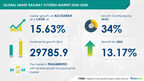
NEW YORK, July 2, 2024 /PRNewswire/ — The global smart railway systems market  size is estimated to grow by USD 29.78 billion from 2024-2028, according to Technavio. The market is estimated to grow at a CAGR of almost 15.63%  during the forecast period.  Expansion of railways to address efficiency and environmental concerns is driving market growth, with a trend towards adoption of iot and big data driving efficiency. However, investments in initial infrastructure  poses a challenge. Key market players include ABB Ltd., ALSTOM SA, Atos SE, Capgemini Service SAS, Cisco Systems Inc., Digi International Inc., General Electric Co., Hitachi Ltd., Huawei Technologies Co. Ltd., Indra Sistemas SA, International Business Machines Corp., Mitsubishi Electric Corp., Nokia Corp., Robert Bosch GmbH, Schneider Electric SE, Siemens AG, Teleste Corp., Thales Group, Trimble Inc., and ZTE Corp..

Get a detailed analysis on regions, market segments, customer landscape, and companies – Click for the snapshot of this report

Forecast period

2024-2028

Base Year

2023

Historic Data

2018 – 2022

Segment Covered

Product (Solutions, Components, and Services), Type (Passenger information system, Rail and freight operations management system, Smart ticketing system, Rail analytics system, and Others), and Geography (Europe, North America, APAC, Middle East and Africa, and South America)

Region Covered

Europe, North America, APAC, Middle East and Africa, and South America

Key companies profiled

ABB Ltd., ALSTOM SA, Atos SE, Capgemini Service SAS, Cisco Systems Inc., Digi International Inc., General Electric Co., Hitachi Ltd., Huawei Technologies Co. Ltd., Indra Sistemas SA, International Business Machines Corp., Mitsubishi Electric Corp., Nokia Corp., Robert Bosch GmbH, Schneider Electric SE, Siemens AG, Teleste Corp., Thales Group, Trimble Inc., and ZTE Corp.

Key Market Trends Fueling Growth

Smart Railway Systems Market: The integration of IoT and big data in railway operations is revolutionizing the industry. Onboard control systems and sensors generate valuable data, which can improve efficiency, reduce downtime, and enhance safety. IoT and big data enable real-time monitoring, predictive maintenance, and energy savings. Cost savings have been reported, with Trenitalia achieving an 8%-10% reduction in maintenance costs. The future of railways lies in leveraging data to optimize operations and enhance passenger experience. 

The Smart Railway Systems market is experiencing significant growth, driven by advancements in technology. Real-time monitoring and ticketing systems are becoming increasingly common. These systems enable passengers to check train schedules, purchase tickets, and receive real-time updates on their devices. Additionally, safety features such as automatic train protection and collision avoidance systems are being implemented to enhance passenger safety. Schdule-based train control and traffic management systems are also being adopted to improve efficiency and reduce delays. The use of biometric technology for passenger identification and security is also on the rise. Overall, the Smart Railway Systems market is transforming the railway industry with its innovative solutions. 

Research report provides comprehensive data on impact of trend. For more details- Download a Sample Report

Market Challenges

The adoption of smart railway systems faces challenges due to the substantial initial investment needed for infrastructure development. This is attributed to the use of advanced technologies and the long payback period for such projects. Government-funded railway projects, particularly those with significant investments, undergo rigorous evaluation. Smaller carriers have found it costly to implement Positive Train Control (PTC) due to high installation and maintenance costs. Technical errors or integration issues can lead to severe consequences, including loss of life and replacement costs, as well as downtime and revenue declines. These factors are expected to hinder the growth of the global smart railway systems market.The Smart Railway Systems Market faces several challenges in implementation and operation. One major challenge is the integration of various technologies such as sensors, communication systems, and software applications. Another challenge is ensuring the reliability and interoperability of these systems in harsh railway environments. Additionally, the high cost of implementation and maintenance is a significant barrier for many railways. Furthermore, the need for standardization and regulation to ensure safety and security is a pressing issue. Lastly, the lack of skilled personnel to design, install, and maintain these systems is a significant challenge for the market. Addressing these challenges will require collaboration between industry players, governments, and academia to develop cost-effective, reliable, and interoperable solutions.

For more insights on driver and challenges – Download a Sample Report

Segment Overview 

This smart railway systems market report extensively covers market segmentation by

Product 1.1 Solutions1.2 Components1.3 ServicesType 2.1 Passenger information system2.2 Rail and freight operations management system2.3 Smart ticketing system2.4 Rail analytics system2.5 OthersGeography 3.1 Europe3.2 North America3.3 APAC3.4 Middle East and Africa3.5 South America

1.1 Solutions-  Smart Railway Systems Market: The components segment is essential for ensuring security and network connectivity in railway systems. Sensors monitor trains and infrastructure, video surveillance cameras ensure security, multimedia displays offer real-time information, and networking devices facilitate smooth data transmission. These devices enhance safety, improve service quality, and drive market growth during the forecast period. Railway operators increasingly use sensors for cost-effective monitoring and safety. Video surveillance cameras ensure public security and employee safety. Multimedia displays provide real-time alerts and entertainment. Networking devices enable machine-to-machine communication and interoperability. Overall, these components are vital for the proper functioning of smart railway systems.

For more information on market segmentation with geographical analysis including forecast (2024-2028) and historic data (2018 – 2022)  – Download a Sample Report

Research Analysis

The Smart Railway Systems Market encompasses advanced Technology-based Solutions for Rail Analytics, Freight Information, Passenger Information, and Smart Ticketing Systems. These systems facilitate Real-time Data monitoring and analysis, ensuring optimal Passenger capacity and addressing Commuting requirements in the context of Urbanization and Societal changes. Railway technology plays a pivotal role in enhancing Scheduling, Maintenance, and Manual diagnostics through Digitalization and Real-time monitoring. Smart railway components, including High-speed sensors, are integral to Logistical activities and Railway projects, ensuring efficient Train Services and Railway Systems operation.

Learn and explore more about Technavio’s in-depth research reports

The global Facilities Management Market is experiencing significant growth due to the increasing demand for integrated services across various sectors. The market’s expansion is driven by the need for efficient management of facilities and the adoption of advanced technologies. Similarly, the global Industrial HVAC Market is also on an upward trajectory, propelled by rising industrialization and stringent environmental regulations. Innovations in energy-efficient systems are further enhancing market prospects. Both markets are benefiting from the trend towards automation and the emphasis on sustainability, reflecting a broader shift towards more efficient and eco-friendly industrial practices.

Market Research Overview

The Smart Railway Systems Market encompasses advanced technologies and solutions that aim to enhance the efficiency, safety, and passenger experience in railway transportation. These systems leverage technologies such as IoT, RFID, AI, and machine learning to optimize train operations, improve infrastructure management, and provide real-time information to passengers. The market is driven by factors such as increasing urbanization, growing demand for efficient and reliable transportation, and government initiatives to modernize railway infrastructure. Smart railway systems offer benefits like reduced operational costs, improved safety, and enhanced passenger comfort. The market is expected to witness significant growth in the coming years due to these factors and the continuous advancements in technology.

Table of Contents:

1 Executive Summary
2 Market Landscape
3 Market Sizing
4 Historic Market Size
5 Five Forces Analysis
6 Market Segmentation

ProductSolutionsComponentsServicesTypePassenger Information SystemRail And Freight Operations Management SystemSmart Ticketing SystemRail Analytics SystemOthersGeographyEuropeNorth AmericaAPACMiddle East And AfricaSouth America

7 Customer Landscape
8 Geographic Landscape
9 Drivers, Challenges, and Trends
10 Company Landscape
11 Company Analysis
12 Appendix

About Technavio

Technavio is a leading global technology research and advisory company. Their research and analysis focuses on emerging market trends and provides actionable insights to help businesses identify market opportunities and develop effective strategies to optimize their market positions.

With over 500 specialized analysts, Technavio’s report library consists of more than 17,000 reports and counting, covering 800 technologies, spanning across 50 countries. Their client base consists of enterprises of all sizes, including more than 100 Fortune 500 companies. This growing client base relies on Technavio’s comprehensive coverage, extensive research, and actionable market insights to identify opportunities in existing and potential markets and assess their competitive positions within changing market scenarios.

Contacts

Technavio Research
Jesse Maida
Media & Marketing Executive
US: +1 844 364 1100
UK: +44 203 893 3200
Email: media@technavio.com
Website: www.technavio.com/

View original content to download multimedia:https://www.prnewswire.com/news-releases/smart-railway-systems-market-size-is-set-to-grow-by-usd-29-78-billion-from-2024-2028–expansion-of-railways-to-address-efficiency-and-environmental-concerns-to-boost-the-market-growth-technavio-302187548.html

SOURCE Technavio

Continue Reading
Click to comment

Leave a Reply

Your email address will not be published. Required fields are marked *

Technology

IR announces Iris for Card Payments: AI-powered observability that sees transactions end-to-end

Published

on

By

SYDNEY, June 22, 2026 /PRNewswire/ — Leading global observability software provider Integrated Research (“IR”) today announced Iris for Card Payments, the AI‑powered assistant designed to help payments teams detect issues earlier, understand their impact faster, and act before revenue and customer trust are at risk.

As card payments environments grow in scale and complexity, issues can cascade in minutes. Transaction volumes spike, dependencies multiply, and even highly experienced teams can struggle to correlate schemes, response codes, flows, and performance metrics in real-time. AI-powered observability can unlock faster, deeper insight for payments teams at precisely the moment when clarity matters most.

Via natural language prompts, Iris for Card Payments delivers real-time card payments insights, and is built on IR’s core observability platform Prognosis which monitors over 80 billion transactions each year for some of the world’s largest banks and financial institutions.

Iris: AI that truly understands card payments

Extra pair of Expert Eyes: Iris makes deep card payments expertise instantly accessible, reducing reliance on scarce specialists and building confidence 24/7.Purpose-built with context-aware insights: Iris understands card payments end-to-end, with built-in IR correlation logic to explain why something happened, not just what.Natural-language queries: Clear answers about transaction declines, approvals, volumes and performance – no syntax or dashboard stitching required.

Iris for Card Payments is available from May 2026 in Beta to customers globally as part of the release of Prognosis 13.3. Future releases will extend Iris to High Value Payments and Real‑Time Payments domains.

For more information or to request a demo, visit the website.

About IR
At IR, we power elite business performance. Trusted by the world’s largest organizations for more than 30 years, our market-leading observability solutions are powered by Prognosis – the real-time intelligence platform built for multi-vendor infrastructure, UC&CX and payments environments. To find out more, visit www.ir.com.

View original content to download multimedia:https://www.prnewswire.com/news-releases/ir-announces-iris-for-card-payments-ai-powered-observability-that-sees-transactions-end-to-end-302804079.html

SOURCE Integrated Research (IR)

Continue Reading

Technology

Montana-Dakota Utilities Announces Electric Service Agreement with Applied Digital for Proposed AI Factory

Published

on

By

BISMARCK, N.D., June 22, 2026 /PRNewswire/ — MDU Resources Group, Inc.’s (NYSE: MDU) subsidiary, Montana-Dakota Utilities Co., has entered into an electric service agreement (ESA) with Applied Digital Corporation (NASDAQ: APLD) to provide power to Polaris Forge 3, an AI Factory near Center, North Dakota.

At full capacity, the campus would require 430 megawatts of electricity. Under the ESA, Applied Digital would be responsible for the costs of purchasing the energy directly from the market or through other power supply arrangements. Applied Digital anticipates initial operations to commence in August 2027.

Polaris Forge 3 will expand Applied Digital’s footprint in North Dakota, where the company is developing purpose-built campuses designed to support high-density artificial intelligence workloads. Applied Digital has previously announced a 15-year lease with a U.S. based high investment-grade hyperscaler for this site.

“Polaris Forge 3 is another example of how Applied Digital is turning power into operational AI capacity through disciplined execution and long-term partnerships,” said Wes Cummins, Chairman and CEO of Applied Digital. “This campus is expected to create approximately 200 full-time jobs, generate meaningful property tax revenue and support long-term growth across Oliver County and the surrounding region. We believe AI infrastructure should create value well beyond the campus, and we’re proud to continue building in North Dakota.”

Montana-Dakota Utilities currently serves Applied Digital at Polaris Forge 1, its AI Factory near Ellendale, North Dakota, where the companies have worked together to integrate significant power demand while maintaining reliable, cost-effective service for customers, crediting $38.4 million back to North Dakota customers over the past three years.

“This proposed project reflects the growing interest in North Dakota as a location for large energy users,” said Nicole Kivisto, president and CEO of MDU Resources. “We are committed to serving these customers in a way that benefits our communities, supports the regional grid and delivers value to our customers.”

Approval of the ESA and other regulatory filings by the North Dakota Public Service Commission is required for the company to provide power under the agreement with Applied Digital.

About MDU Resources Group, Inc.
MDU Resources Group, Inc., a member of the S&P SmallCap 600 index, strives to deliver safe, reliable, cost-effective and environmentally responsible electric utility and natural gas distribution services to more than 1.2 million customers across the Pacific Northwest and Midwest. In addition to its utility operations, the company’s pipeline business operates a more than 3,800-mile natural gas pipeline network and storage system, ensuring reliable energy delivery across the Northern Plains. With a legacy spanning over a century, MDU Resources remains focused on energizing lives for a better tomorrow. For more information about MDU Resources, visit www.mdu.com or contact the investor relations department at investor@mduresources.com.

About Applied Digital Corporation
Applied Digital (Nasdaq: APLD) named Best Data Center in the Americas 2025 by Datacloud — designs, builds, and operates high-performance, sustainably engineered data centers and colocation services for artificial intelligence, cloud, networking, and blockchain workloads. Headquartered in Dallas, TX, and founded in 2021, the company combines hyperscale expertise, proprietary waterless cooling, and rapid deployment capabilities to deliver secure, scalable compute at industry-leading speed and efficiency, while creating economic opportunities in underserved communities through its award-winning Polaris Forge AI Factory model. Learn more at applieddigital.com or follow @APLDdigital on X and LinkedIn.

Investor Contact: Brent Miller, treasurer, 701-530-1730

Media Contacts:

MDU Resources: Byron Pfordte, director of integrated communications, 208-377-6050

Montana-Dakota Utilities: Jamie Tescher, senior public relations representative, 701-204-8274

Applied Digital: JSA (Jaymie Scotto & Associates), jsa_applied@jsa.net, 856-264-7827


View original content to download multimedia:https://www.prnewswire.com/news-releases/montana-dakota-utilities-announces-electric-service-agreement-with-applied-digital-for-proposed-ai-factory-302806791.html

SOURCE MDU Resources Group, Inc.

Continue Reading

Technology

Florida International University researchers reveal how altered images can bypass AI safeguards

Published

on

By

MIAMI, June 22, 2026 /PRNewswire/ — It may look like a picture of a panda bear to you, but to your business’s AI agent, it can act like a skeleton key, bypassing safety safeguards and potentially causing the model to generate harmful, misleading or policy-violating outputs.

That risk is the focus of new research from Hadi Amini, associate professor at Florida International University’s Knight Foundation School of Computing and Information Sciences. Together with graduate assistant Md Jueal Mia, he is studying how manipulated images can “jailbreak” certain AI systems, pushing them beyond their built-in safeguards.  

“AI models don’t see images the same way humans do,” Amini said. “They see patterns of numbers and pixels. By carefully manipulating those pixels, we can influence how the AI interprets the image and responds.” 

The team’s research demonstrated how small-language AI models – the kind frequently employed by small businesses to execute routine tasks like accounting or customer service – have become particularly susceptible to image-based hacks. As shown in research presented at the 2025 International Conference on Machine Learning and Applications (ICMLA), the team found that by introducing microscopic pixel-level changes called “perturbations” into an image, they could trick these AI systems into generating responses that they would normally block.  

“The manipulated image is like the face of a stranger,” Amini said. “The AI has to learn when a request should be treated with caution before it answers. In order to protect AI systems from attacks, we try to break them ourselves, identify potential vulnerabilities and design defense mechanisms.” 

The researchers then set out to probe the system’s defenses. The more successfully they penetrated the models’ guardrails, the more the systems could be trained to resist future threats. To do this, Amini and his team developed a method called JaiLIP (Jailbreaking with Loss-guided Image Perturbation), which uses an algorithm to determine the optimal degree of pixel-level manipulation.

In tests using BLIP-2, a multimodal AI model used by researchers and developers, Amini and his team found that images modified with JaiLIP significantly increased the likelihood that the system would generate harmful or unsafe responses. In one example, a JaiLIP-altered version of a stoplight tricked the AI model into divulging detailed instructions on how to run the light while avoiding a traffic ticket. Overall, the use of JaiLIP images nearly doubled the number of harmful responses generated by AI models. 

The risk extends beyond users simply prompting AI systems for instructions on illegal activity. As businesses increasingly adopt AI-powered customer service agents, chatbots and automated workflows, vulnerabilities in open-source or lightly protected systems could negatively impact users’ trust or create new avenues for cyberattacks.

“Small businesses and companies can benefit from AI to enhance their efficiency, but they have to be aware of the potential vulnerabilities,” Amini said. “They must make sure they’re deploying sufficient guardrails to maintain the safety and integrity of their AI tools.” 

Amini said there are some basic precautions that everyone should use before integrating AI into their business or workplace, including limiting the sensitive information they provide to AI systems (especially images), restricting who can access those systems and carefully evaluating the security measures built into AI tools before deployment.  

Because safety is paramount, Amini and his team are working to stay one step ahead of potential bad actors in the AI sphere. The more vulnerabilities he and his team can find, the quicker the AI will learn to repair them. The challenge, he said, is ensuring that AI can recognize threats hidden in plain sight — even when humans cannot. 

Photos and videos of Amini’s AI research, including interviews and b-roll, are available for media use via Dropbox

Media Contact:
Brian Zimmerman
305-348-8448
bzimmerm@fiu.edu 
news.fiu.edu
@FIU

View original content to download multimedia:https://www.prnewswire.com/news-releases/florida-international-university-researchers-reveal-how-altered-images-can-bypass-ai-safeguards-302806851.html

SOURCE Florida International University

Continue Reading

Trending