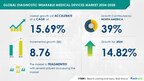
NEW YORK, July 31, 2024 /PRNewswire/ — The global diagnostic wearable medical devices market size is estimated to grow by USD 8.76 billion from 2024-2028, according to Technavio. The market is estimated to grow at a CAGR of 15.69% during the forecast period. Increasing prevalence of chronic diseases is driving market growth, with a trend towards increasing penetration of diagnostic wearable medical devices in medical sector. However, issues with user acceptance and adherence to diagnostic wearable medical devices poses a challenge. Key market players include Activinsights Ltd., AliveCor Inc., Alphabet Inc., Apple Inc., Boyd Corp., BTS Bioengineering Corp., Cleveland Medical Devices Inc., Dragerwerk AG and Co. KGaA, Johari Digital India Ltd., Koninklijke Philips N.V., Medtronic Plc, Meril Life Sciences Pvt. Ltd., Molex LLC, Murata Vios, Inc., OMRON Corp., ResMed Inc., Sanmina Corp., VitalConnect Inc., Wellue Health, and Intelesens Ltd..
Get a detailed analysis on regions, market segments, customer landscape, and companies – Click for the snapshot of this report
Forecast period
2024-2028
Base Year
2023
Historic Data
2018 – 2022
Segment Covered
Device (Vital signs monitors, Sleep and activity monitors, Fetal and obstetric monitoring devices, Neuromonitoring devices, and ECG monitors), Application (Home healthcare, Sports and fitness, and Remote patient monitoring), and Geography (North America, Europe, Asia, and Rest of World (ROW))
Region Covered
North America, Europe, Asia, and Rest of World (ROW)
Key companies profiled
Activinsights Ltd., AliveCor Inc., Alphabet Inc., Apple Inc., Boyd Corp., BTS Bioengineering Corp., Cleveland Medical Devices Inc., Dragerwerk AG and Co. KGaA, Johari Digital India Ltd., Koninklijke Philips N.V., Medtronic Plc, Meril Life Sciences Pvt. Ltd., Molex LLC, Murata Vios, Inc., OMRON Corp., ResMed Inc., Sanmina Corp., VitalConnect Inc., Wellue Health, and Intelesens Ltd.
Key Market Trends Fueling Growth
The diagnostic wearable medical devices market is experiencing significant innovation, with companies introducing new technologies to cater to growing consumer demands. Consumers seek additional applications, indications, and user-friendly designs. In response, businesses are enhancing their offerings’ features, diagnosis capabilities, and outcomes. For instance, Philips provides wearable diagnostic devices for individuals with chronic obstructive pulmonary disease, featuring a digital biosensor and cloud-based HealthSuite Digital Platform for real-time health data access. Notable innovations include Samsung Fitness Tracker, Google Glass for fitness, Nike + Fuelband, and Misfit Shine. In April 2022, Fitbit gained clearance for its passive cardiac rhythm monitoring technology, which periodically checks wearers’ heart rhythms and alerts them of atrial fibrillation, a condition associated with a higher risk of stroke. The emergence of innovative diagnostic wearable medical devices is expected to drive market growth during the forecast period.
The Diagnostic Wearable Medical Devices market is experiencing significant growth with the rise of smartwatches and fitness trackers. These consumer-grade devices, now featuring EKG capabilities, are transforming healthcare. Companies like Respira Labs, BioIntelliSense, and Medicalgorithmics, are leading the charge with innovative solutions. Glucose monitoring systems, such as Smart Vital Ultra and GOQii Stream, are revolutionizing diabetes management. Wearable activity monitors, like the Oura ring and Xiaomi Corporation’s Biosensor BX100, focus on lifestyle management and home healthcare applications. However, challenges like consumer privacy, cybersecurity attacks, and battery life remain. Advancements in 5G networks, AR, VR, and spatial computing aim to address these concerns. Clinical-grade devices, such as ECG wearable units, Qpatch, and Lifesense, offer remote patient monitoring for chronic diseases and lifestyle-related disorders. The British Heart Foundation and Rockefeller Neuroscience Institute are also exploring opportunities in this space. Overall, the future of wearable medical devices is bright, with a focus on improving healthcare accessibility and efficiency.
Discover 360° analysis of this market. For complete information, schedule your consultation- Book Here!
Market Challenges
The diagnostic wearable medical devices market faces a significant challenge in ensuring user acceptance and adherence to continuous monitoring. Discomfort and inconvenience associated with prolonged wear can deter individuals, particularly those with chronic conditions like diabetes, from using devices such as continuous glucose monitoring systems. Social and psychological implications of wearing visible monitoring devices, especially for mental health wearables, can also act as barriers. Additionally, the constant influx of health data may overwhelm consumers, leading to disengagement. To overcome these hurdles, a user-centric approach is essential. This includes designing devices for comfort, educating users on the importance of collected data, and ensuring actionable insights are provided to enable effective self-management. Widespread acceptance is crucial for the growth of the global diagnostic wearable medical devices market.The Diagnostic Wearable Medical Devices market is experiencing rapid growth with innovative products like Qpatch and Lifesense leading the way. Smartphone-based healthcare devices and wireless connectivity are making remote patient monitoring and home healthcare applications more accessible. Lifestyle management and fitness tracking capabilities are popular consumer features, but challenges include consumer privacy and cybersecurity attacks. 5G networks, AR, VR, and spatial computing offer new opportunities. Battery life is a concern for trackers, patches, smart clothing, and consumer-grade devices. Clinical-grade devices from Rockefeller Neuroscience Institute, Oura ring, Xiaomi Corporation, and others, are addressing chronic diseases and lifestyle-related disorders. Companies like BD, Audere, and OMRON Corporation are also making strides with mHealth Intelligence. Retail pharmacies and online distribution channels expand market reach, while payers like Premera Blue Cross collaborate for better patient care. New devices from Fitbit, Gizmore, and Demant A/S continue to shape the market. Biosensor BX100 and HealthPulse TestNow are also making waves in cardiovascular diseases monitoring. The future of wearable diagnostics is promising, with advancements in technology and partnerships driving innovation.
For more insights on driver and challenges – Download a Sample Report
Segment Overview
This diagnostic wearable medical devices market report extensively covers market segmentation by
Device 1.1 Vital signs monitors1.2 Sleep and activity monitors1.3 Fetal and obstetric monitoring devices1.4 Neuromonitoring devices1.5 ECG monitorsApplication 2.1 Home healthcare2.2 Sports and fitness2.3 Remote patient monitoringGeography 3.1 North America3.2 Europe3.3 Asia3.4 Rest of World (ROW)
1.1 Vital signs monitors- The diagnostic wearable medical devices market is experiencing significant growth, with vital signs monitors leading the way. Consumers prioritize proactive health monitoring, leading to increased demand for wearable gadgets that continuously monitor vital indications such as heart rate, blood pressure, and oxygen saturation. Companies like Apple and Fitbit are releasing innovative diagnostic wearables with integrated vital signs monitoring capabilities, fueling market expansion. However, concerns over data privacy, legal constraints, and accuracy limitations pose challenges. The shift towards personalized healthcare, sensor technology advancements, and AI for data analysis are driving market growth. As technological improvements enhance the capabilities of vital sign monitors, they provide valuable health information to users and contribute to the global trend of preventive and personalized healthcare. Consequently, the diagnostic wearable medical devices market is projected to experience substantial growth during the forecast period.
For more information on market segmentation with geographical analysis including forecast (2024-2028) and historic data (2018 – 2022) – Download a Sample Report
Research Analysis
The Diagnostic Wearable Medical Devices market is experiencing rapid growth due to the increasing prevalence of chronic diseases and lifestyle-related disorders. Smartwatches and fitness trackers with advanced capabilities, such as EKG capabilities and glucose monitoring systems, are leading the charge in this sector. Devices like Smart Vital Ultra, GOQii Stream, Respira Labs, and Lifesense are transforming healthcare by providing real-time health data and wireless connectivity. Smartphone-based healthcare devices, wearable activity monitors, and chronic disease management solutions are also gaining popularity. The Rockefeller Neuroscience Institute, Oura ring, Xiaomi Corporation, and Gizmore are some of the companies pioneering this technology. Devices with fitness tracking capabilities, cardiovascular disease monitoring, and home healthcare applications are revolutionizing lifestyle management and improving patient outcomes. Other notable devices include the GizFit Flash smartwatch and Biosensor BX100, which offer advanced health monitoring features.
Market Research Overview
The Diagnostic Wearable Medical Devices market is experiencing significant growth due to the integration of advanced technologies such as EKG capabilities, glucose monitoring systems, and blood pressure tracking into smartwatches and fitness trackers. These consumer-grade devices offer lifestyle management features, home healthcare applications, and remote patient monitoring for chronic diseases and lifestyle-related disorders. Smart Vital Ultra and GOQii Stream are examples of wearable devices with ECG capabilities, while Respira Labs focuses on respiratory health monitoring. Wireless connectivity, 5G networks, and mHealth Intelligence enable real-time data sharing and analysis. However, consumer privacy and cybersecurity concerns persist, along with the potential for cyber attacks. Augmented reality (AR), virtual reality (VR), and spatial computing are emerging technologies that could enhance wearable medical devices. Battery life, trackers, patches, smart clothing, and clinical-grade devices are other essential aspects of the market. Key players include British Heart Foundation, BioIntelliSense, Medicalgorithmics, and Rockefeller Neuroscience Institute, among others. Retail pharmacies, online distribution channels, and insurance companies like Premera Blue Cross also play a role in the market. Devices like the Oura ring, Xiaomi Corporation’s Biosensor BX100, Gizmore’s GizFit Flash smartwatch, Fitbit Versa 4, Fitbit Sense 2, Fitbit Inspire 4, and BD’s HealthPulse TestNow offer various features for cardiovascular diseases, fitness tracking, and home healthcare applications. Companies like Audere, Rockley Photonics, and OMRON Corporation are also making strides in the market with innovative solutions like the BioButton and Qpatch.
Table of Contents:
1 Executive Summary
2 Market Landscape
3 Market Sizing
4 Historic Market Size
5 Five Forces Analysis
6 Market Segmentation
DeviceVital Signs MonitorsSleep And Activity MonitorsFetal And Obstetric Monitoring DevicesNeuromonitoring DevicesECG MonitorsApplicationHome HealthcareSports And FitnessRemote Patient MonitoringGeographyNorth AmericaEuropeAsiaRest Of World (ROW)
7 Customer Landscape
8 Geographic Landscape
9 Drivers, Challenges, and Trends
10 Company Landscape
11 Company Analysis
12 Appendix
About Technavio
Technavio is a leading global technology research and advisory company. Their research and analysis focuses on emerging market trends and provides actionable insights to help businesses identify market opportunities and develop effective strategies to optimize their market positions.
With over 500 specialized analysts, Technavio’s report library consists of more than 17,000 reports and counting, covering 800 technologies, spanning across 50 countries. Their client base consists of enterprises of all sizes, including more than 100 Fortune 500 companies. This growing client base relies on Technavio’s comprehensive coverage, extensive research, and actionable market insights to identify opportunities in existing and potential markets and assess their competitive positions within changing market scenarios.
Contacts
Technavio Research
Jesse Maida
Media & Marketing Executive
US: +1 844 364 1100
UK: +44 203 893 3200
Email: media@technavio.com
Website: www.technavio.com/
View original content to download multimedia:https://www.prnewswire.com/news-releases/diagnostic-wearable-medical-devices-market-size-is-set-to-grow-by-usd-8-76-billion-from-2024-2028–increasing-prevalence-of-chronic-diseases-to-boost-the-market-growth-technavio-302209951.html
SOURCE Technavio







 Coin Market5 days ago
 Technology5 days ago
 Coin Market4 days ago
 Coin Market4 days ago
 Coin Market5 days ago
 Technology5 days ago
 Technology5 days ago
 Technology5 days ago