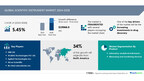
NEW YORK, July 31, 2024 /PRNewswire/ — The global scientific instrument market size is estimated to grow by USD 19.96 billion from 2024-2028, according to Technavio. The market is estimated to grow at a CAGR of over 5.45% during the forecast period. Increasing investments in drug discovery is driving market growth, with a trend towards growing adoption of portable scientific instruments. However, lack of trained professionals poses a challenge. Key market players include ABB Ltd., ACMAS Technologies Pvt. Ltd., Agilent Technologies Inc., Alcon Scientific, Bio Rad Laboratories Inc., Bruker Corp., Carl Zeiss AG, Danaher Corp., Hitachi Ltd., HORIBA Ltd., Labappara, M.K.Scientific Instruments, MAC, Merck KGaA, Oxford Instruments plc, Shimadzu Corp., SM Scientific Instruments Pvt. Ltd., Thermo Fisher Scientific Inc., Thorlabs Inc., and Waters Corp..
Get a detailed analysis on regions, market segments, customer landscape, and companies- View the snapshot of this report
Scientific Instrument Market Scope
Report Coverage
Details
Base year
2023
Historic period
2018 – 2022
Forecast period
2024-2028
Growth momentum & CAGR
Accelerate at a CAGR of 5.45%
Market growth 2024-2028
USD 19966.9 million
Market structure
Fragmented
YoY growth 2022-2023 (%)
4.77
Regional analysis
North America, Europe, Asia, and Rest of World (ROW)
Performing market contribution
North America at 34%
Key countries
US, China, Germany, UK, and India
Key companies profiled
ABB Ltd., ACMAS Technologies Pvt. Ltd., Agilent Technologies Inc., Alcon Scientific, Bio Rad Laboratories Inc., Bruker Corp., Carl Zeiss AG, Danaher Corp., Hitachi Ltd., HORIBA Ltd., Labappara, M.K.Scientific Instruments, MAC, Merck KGaA, Oxford Instruments plc, Shimadzu Corp., SM Scientific Instruments Pvt. Ltd., Thermo Fisher Scientific Inc., Thorlabs Inc., and Waters Corp.
Market Driver
The scientific instrument market is experiencing a significant shift towards miniaturized and portable equipment due to the need for space efficiency and convenience in laboratory settings. Vendors are redesigning industry-standard instruments using miniaturization technologies such as fluidics and integrated printed circuit boards (PCBs) to create compact versions of laboratory equipment. Traditional scientific instruments often have complex wiring and components at the bottom and rear, but miniaturization allows for the removal of these elements, making the equipment more compact. Advancements in sensors and wireless connectivity further enable the creation of portable instruments, freeing them from the need for complex wires and cables. Integration of multiple laboratory functions and features onto a single chip through very large-scale integration technologies also saves money, space, and manpower for both vendors and end-users. Miniaturization and nanotechnology have revolutionized point-of-care testing and led to the manufacturing of portable equipment like miniaturized centrifuges from companies such as Bio-Rad Laboratories, Thermo Fisher Scientific, and Merck. These portable analyzers offer quick decision-making capabilities with advanced technologies like X-ray fluorescence (XRF), near-infrared (NIR), Raman, and Fourier transform infrared spectroscopy (FTIR), and an easy-to-use interface. The benefits of miniaturized and portable scientific instruments are driving their demand, and this trend is expected to continue during the forecast period.
The Scientific Instruments market is thriving, driven by trends in various sectors. Product microscopes, spectrometers, X-ray diffraction, thermal analyzers, and other lab equipment are in high demand. Handheld and portable instruments are popular for field research in healthcare companies, retail sales, and online sales. Biotechnology, materials science, environmental science, private organizations, and academic institutions are major buyers. Electron microscopes, mass spectrometers, DNA sequencers, particle accelerators, and molecular analyzers are key tools for precision medicine, genetic sequencing, drug development, and molecular interactions. Biomarker detection systems, drug safety, and automated solutions are essential for disease mechanisms research in genomics and proteomics. Pharmaceutical companies, analytical instruments manufacturers, startups, and research institutions are investing heavily in this sector. Trends include portable instruments, data analysis, drug safety, and solutions for chronic and target diseases.
Discover 360° analysis of this market. For complete information, schedule your consultation – Book Here!
Market Challenges
The scientific instrument market is experiencing significant technological advancements at an accelerated pace. Keeping up-to-date with these changes and maintaining a workforce with advanced technical skills is a challenge for end-users due to the high costs of training. Calibration of scientific instruments is crucial for accurate results, yet line inspectors may not possess the necessary technical capabilities. Additionally, interpreting data from these instruments and effectively handling accompanying software requires specialized knowledge. The scarcity of professionals with both medical expertise and software proficiency, coupled with frequent software upgrades and increasing instrument features, poses a critical challenge to the growth of the global scientific instrument market.The Scientific Instrument Market faces several challenges in various sectors. In the healthcare industry, accurate measurement and analysis of urine, tissue, glucose levels, cholesterol levels, and blood cell counts are crucial for medical diagnosis and treatment planning. Infectious diseases, cancer, and chronic conditions like diabetes, respiratory diseases, and cardiovascular diseases require advanced diagnostic tools. Clinical laboratories and hospitals rely on clinical analyzers for quick and accurate results. The biotech and pharmaceutical research sectors need instruments for measuring physical quantities, remodeling, and theoretical research. In the pharmaceutical sectors, verifying the efficacy of therapeutics is essential. Public health emergencies require rapid diagnostic tools for outpatients and inpatients. The research segment focuses on developing instruments for mutated diseases and neurological diseases. Laboratory automation is a key trend to improve efficiency and reduce errors. Overall, meeting the demands of these sectors while ensuring accuracy, reliability, and affordability is a significant challenge for the Scientific Instrument Market.
For more insights on driver and challenges – Request a sample report!
Segment Overview
This scientific instrument market report extensively covers market segmentation by
Product 1.1 Laboratory analytical instruments and consumables1.2 Measuring and monitoring devicesEnd-user 2.1 Pharmaceutical and biotechnology companies2.2 Hospitals and diagnostic laboratories2.3 OthersGeography 3.1 North America3.2 Europe3.3 Asia3.4 Rest of World (ROW)
1.1 Laboratory analytical instruments and consumables- The global scientific instrument market’s laboratory analytical instruments and consumables segment encompasses mass spectrometers, chromatographs, and other tools that assist in diagnosing and analyzing specific infections. These instruments are extensively utilized in life science research, particularly in metabolomics, genomics, and proteomics, employing spectroscopy, mass spectrometry, electrochemical analysis, thermal analysis, separation analysis, and microscopy. The pharmaceutical industry is witnessing a growing demand for Raman spectroscopy to develop new drugs. Raman spectroscopy employs spectrometers and the spectroscopic technique to uncover the chemical structure, concentration, identity, and behavior of molecules in various forms. In pharmaceuticals, Raman spectroscopy is utilized for drug discovery by defining the structural composition of therapeutic drug agents and investigating intermolecular interactions. Post-approval, it ensures the correct compound’s manufacturing and guards against hazardous substances from packaging. Consumables, including funnels, flasks, syringes, and needles, are crucial for drug development and significantly contribute to market expansion due to recurring purchases for diverse testing purposes. Reagents and buffers are among the essential consumables, with their repeated usage in scientific tests and experiments. The variety of reagents required for different testing objectives presents an opportunity for consumables manufacturers to cater to end-users’ diverse needs. Technological advances in reaction buffers have resulted in heightened stability and longevity for reagents and enzymes, driving the growth of the laboratory analytical instruments and consumables segment and the market as a whole.
For more information on market segmentation with geographical analysis including forecast (2024-2028) and historic data (2017-2021) – Download a Sample Report
Research Analysis
The scientific instrument market encompasses a wide range of tools used for measuring, analyzing, verifying, and understanding physical quantities in various sectors. Key product categories include microscopes for observing and examining samples at the microscopic level, spectrometers for identifying and quantifying materials based on their light interaction, X-ray diffraction for determining crystal structures, and thermal analyzers for studying material properties under temperature changes. Handheld and benchtop instruments, as well as portable versions, cater to field research and on-site analysis. Laboratories in pharmaceutical sectors, government, universities, and research institutions utilize these instruments for drug safety, automated solutions, and data analysis. In addition, clinical analyzers are essential in hospitals for public health emergencies and diagnostic purposes. Theoretical research and remodeling also benefit from these tools, ensuring accuracy and advancing scientific knowledge.
Market Research Overview
The scientific instrument market encompasses a wide range of products designed for measuring, analyzing, and verifying physical quantities in various fields. Key product categories include Microscopes (Product and Electron), Spectrometers (Handheld, Benchtop, and Portable), X-ray Diffraction, Thermal Analyzers, and various analyzers like Chromatographs and Particle Analyzers. These instruments find applications in laboratories, healthcare companies, retail and online sales, biotechnology, materials science, environmental science, private organizations, academic institutions, and pharmaceutical companies. Areas of focus include biomarker detection systems, drug development, molecular interactions, biological processes, disease mechanisms, genomics and proteomics, drug discovery, personalized healthcare, and quality control. Additionally, scientific instruments are used in aerospace engineering for cameras, celestial bodies, and planetary exploration, as well as in avionics technology and environmental monitoring. In the healthcare sector, instruments are used for medical diagnosis, treatment planning, infectious diseases, clinical laboratories, and cancer research. In the pharmaceutical sector, instruments play a crucial role in drug safety, automated solutions, data analysis, and pharmaceutical research. The market also includes startups, focusing on areas like drug safety, precision medicine, and automation. Instruments are used in various sectors like chromatographs, particle analyzers, scientific clinical analyzers, and for analyzing biological samples like blood, urine, and tissue. Instruments are used to measure and analyze glucose levels, cholesterol levels, and blood cell counts, among other physical quantities. The market also includes instruments for remodeling, theoretical research, and measuring various physical quantities. In summary, the scientific instrument market caters to a diverse range of applications and industries, enabling advancements in fields like biotechnology, healthcare, pharmaceuticals, and aerospace engineering.
Table of Contents:
1 Executive Summary
2 Market Landscape
3 Market Sizing
4 Historic Market Size
5 Five Forces Analysis
6 Market Segmentation
ProductLaboratory Analytical Instruments And ConsumablesMeasuring And Monitoring DevicesEnd-userPharmaceutical And Biotechnology CompaniesHospitals And Diagnostic LaboratoriesOthersGeographyNorth AmericaEuropeAsiaRest Of World (ROW)
7 Customer Landscape
8 Geographic Landscape
9 Drivers, Challenges, and Trends
10 Company Landscape
11 Company Analysis
12 Appendix
About Technavio
Technavio is a leading global technology research and advisory company. Their research and analysis focuses on emerging market trends and provides actionable insights to help businesses identify market opportunities and develop effective strategies to optimize their market positions.
With over 500 specialized analysts, Technavio’s report library consists of more than 17,000 reports and counting, covering 800 technologies, spanning across 50 countries. Their client base consists of enterprises of all sizes, including more than 100 Fortune 500 companies. This growing client base relies on Technavio’s comprehensive coverage, extensive research, and actionable market insights to identify opportunities in existing and potential markets and assess their competitive positions within changing market scenarios.
Contacts
Technavio Research
Jesse Maida
Media & Marketing Executive
US: +1 844 364 1100
UK: +44 203 893 3200
Email: media@technavio.com
Website: www.technavio.com/
View original content to download multimedia:https://www.prnewswire.com/news-releases/scientific-instrument-market-size-is-set-to-grow-by-usd-19-96-billion-from-2024-2028–increasing-investments-in-drug-discovery-boost-the-market-technavio-302210020.html
SOURCE Technavio








 Coin Market5 days ago
 Technology5 days ago
 Coin Market4 days ago
 Technology5 days ago
 Technology5 days ago
 Technology5 days ago
 Technology4 days ago
 Coin Market4 days ago