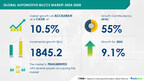
NEW YORK, Nov. 1, 2024 /PRNewswire/ — Report with market evolution powered by AI – The global automotive MLCCs market size is estimated to grow by USD 1.84 billion from 2024-2028, according to Technavio. The market is estimated to grow at a CAGR of 10.5% during the forecast period. Increasing adoption of EVS globally is driving market growth, with a trend towards introduction of new MLCC products by vendors. However, rising competition from alternative technologies poses a challenge.Key market players include Bourns Inc., Fenghua HK Electronics Ltd, HEICO Corp., Holy Stone Enterprise Co. Ltd., Johanson Dielectrics Inc., Knowles Corp., KOA Speer Electronics Inc., KYOCERA AVX Components Corp., MARUWA CO. LTD., Murata Manufacturing Co. Ltd., NIC COMPONENTS CORP., Nippon Chemi-Con Corp., Panasonic Holdings Corp., Samsung Electro-Mechanics, Shenzhen Eyang Technology Development Co. Ltd., TAIYO YUDEN Co. Ltd., TDK Corp., Vishay Intertechnology Inc., Walsin Technologies Corp., and Yageo Corp..
AI-Powered Market Evolution Insights. Our comprehensive market report ready with the latest trends, growth opportunities, and strategic analysis- View your snapshot now
Forecast period
2024-2028
Base Year
2023
Historic Data
2018 – 2022
Segment Covered
Type (Class 2 MLCCs and Class 1 MLCCs), Application (Power electronics, Infotainment systems, Advanced driver-assistance systems, Lighting systems, and Others), and Geography (APAC, Europe, North America, Middle East and Africa, and South America)
Region Covered
APAC, Europe, North America, Middle East and Africa, and South America
Key companies profiled
Bourns Inc., Fenghua HK Electronics Ltd, HEICO Corp., Holy Stone Enterprise Co. Ltd., Johanson Dielectrics Inc., Knowles Corp., KOA Speer Electronics Inc., KYOCERA AVX Components Corp., MARUWA CO. LTD., Murata Manufacturing Co. Ltd., NIC COMPONENTS CORP., Nippon Chemi-Con Corp., Panasonic Holdings Corp., Samsung Electro-Mechanics, Shenzhen Eyang Technology Development Co. Ltd., TAIYO YUDEN Co. Ltd., TDK Corp., Vishay Intertechnology Inc., Walsin Technologies Corp., and Yageo Corp.
Key Market Trends Fueling Growth
The global automotive MLCCs market is experiencing a notable trend as vendors, including Murata Manufacturing Co., Ltd. And TDK Corporation, introduce new products to meet the demand for compact and high-performance electronic components. On September 19, 2024, Murata, led by President Norio Nakajima, unveiled the world’s smallest MLCC, measuring 0.16 mm x 0.08 mm (006003-inch size), reducing volume by 75% compared to the previous smallest MLCC (0.25 mm x 0.125 mm, 008004-inch size). This ultra-compact MLCC addresses the need for high-density component mounting solutions, particularly in advanced smartphones. On September 12, 2023, TDK Corporation expanded its CN series of MLCCs with advanced low-resistance soft termination types. These MLCCs feature a unique design where resin layers cover only the board mounting side, reducing electrical resistance. TDK’s new lineup includes automotive grade (AEC-Q200 compliant) and commercial grade MLCCs, offering capacitances up to 22 microfarads in 3216 size and 47 microfarads in 3225 size. These capacitors cater to the demand for high-reliability, large-capacitance applications. Vendors’ commitment to innovation and addressing the evolving needs of the automotive sector is underscored by these new product launches. As electronic devices become more compact and sophisticated, the demand for advanced MLCCs that offer high performance, reliability, and miniaturization continues to grow, driving advancements in the global automotive MLCCs market.
The Automotive MLCCs market is experiencing significant growth due to trends in automation and connectivity, high voltages, and energy storage. MLCCs are essential electronic components used in automotive applications such as circuitry for engine control modules (ECMs) and electric vehicle (EV) power distribution. With the rise of electric vehicles (EVs) and fuel cell electric vehicles (FCEVs), high voltage batteries require MLCCs with high temperature resistance, leakage proof, and low equivalent series resistance. MLCCs also play a crucial role in 5G telecommunications, DC converters, and noise suppression in ECUs and ECMs. The compact designs and energy-efficient features of MLCCs make them ideal for smart mobility solutions, hydrogen stations, and renewable energy applications. However, chip shortages may impact production, and autonomous vehicles will increase the demand for MLCCs in various applications.
Insights on how AI is driving innovation, efficiency, and market growth- Request Sample!
Market Challenges
The automotive MLCCs market experiences intense competition from alternative capacitor technologies, including polymer, tantalum, aluminum electrolytic, and film capacitors. Among these, polymer capacitors are gaining popularity due to their superior performance in automotive applications. They offer lower equivalent series resistance (ESR) and enhanced stability, ensuring high reliability and performance. These advantages make polymer capacitors an ideal choice for aerospace, medical, and commercial sectors, where compact form factors and efficient power management solutions are essential. Additionally, polymer capacitors’ superior voltage smoothing capabilities in DC-DC converters and stable voltage rails make them preferred in high-speed applications. Their superior performance and reliability compared to electrolytic capacitors further solidify their role in advanced electronic systems. This increasing preference for polymer capacitors poses a significant challenge to the global automotive MLCCs market, requiring continuous innovation to maintain competitiveness.The Automotive MLCC market is experiencing significant growth due to the increasing demand for electric and hybrid vehicles. However, challenges persist in reducing carbon emissions and managing battery systems effectively. High voltage MLCCs are essential for battery management systems, onboard chargers, and inverters in BEVs, HEVs, and PHEVs. The charging infrastructure, including publicly accessible chargers and fast chargers, also relies on MLCCs for efficient power conversion. On-board electrical circuits, including AC and DC converters, BMS circuits, and onboard chargers, require high-reliability MLCCs with metallic electrodes and dielectric ceramic. The integration of consumer electronics, infotainment systems, self-driving cars, ADAS, IoT, AI, and cloud integration in vehicles further increases the demand for compact capacitors made of palladium and nickel. Engines and powertrains also utilize MLCCs in control circuits, making them an indispensable component in the automotive industry. The use of MLCCs in capacitor technology for subsystem electronics enhances the overall performance and efficiency of vehicles. Despite these benefits, the challenges of component integration and cost remain key considerations for the automotive MLCC market.
Insights into how AI is reshaping industries and driving growth- Download a Sample Report
Segment Overview
This automotive mlccs market report extensively covers market segmentation by
Type 1.1 Class 2 MLCCs1.2 Class 1 MLCCsApplication 2.1 Power electronics2.2 Infotainment systems2.3 Advanced driver-assistance systems2.4 Lighting systems2.5 OthersGeography 3.1 APAC3.2 Europe3.3 North America3.4 Middle East and Africa3.5 South America
1.1 Class 2 MLCCs- Class 2 MLCCs play a vital role in the automotive industry due to their high capacitance density and compact size. These capacitors, utilizing dielectric materials like X7R and Y5V, offer higher capacitance values compared to Class 1 capacitors, making them suitable for applications where space is limited and high capacitance is necessary. Extensively used in automotive electronic systems, Class 2 MLCCs are essential for power management circuits, filtering applications, and Advanced Driver Assistance Systems (ADAS). Yageo Corporation’s X5R series of Class II MLCCs are designed for general-purpose applications, capable of operating at temperatures up to 85 degrees Celsius. These capacitors are known for their high reliability, lack of polarity issues, and RoHS-compliance, making them suitable for a wide range of applications, including servo motor control, programmable logic controllers (PLC), automation equipment, and safety devices. YAGEO has expanded its automotive-grade MLCC offerings to include Class II X7R capacitors with a rated voltage of 1000 volts. These capacitors, available in case sizes starting at 1206 and capacitances up to 1 nF, cater to the growing demand for high-power battery systems. The advancements in these capacitors enable improved power output, leading to shorter battery charging times and extended driving ranges. Additionally, they allow for thinner and lighter charging lines for motors, significantly enhancing the efficiency of electric vehicle power systems. In conclusion, the growing use of Class 2 MLCCs will continue to drive the growth of the automotive MLCC market during the forecast period. These capacitors’ high capacitance density, compact size, and reliability make them an essential component in the automotive industry’s shift towards more efficient and compact electronic solutions.
Download complimentary Sample Report to gain insights into AI’s impact on market dynamics, emerging trends, and future opportunities- including forecast (2024-2028) and historic data (2018 – 2022)
Research Analysis
Multi-Layer Ceramic Capacitors (MLCCs) are essential electronic components in the automotive industry, providing power distribution, noise suppression, signal conditioning, and voltage regulation in various applications. Compact designs and energy-efficient features make MLCCs ideal for use in electric vehicles (EVs) and hybrid vehicles, where they support on-board electrical circuits, high voltage MLCCs for the onboard inverter, AC and DC converters, BMS circuits, onboard chargers, and battery electric vehicles (BEV) and battery management systems. MLCCs are also used in consumer electronics, telecommunications, 5G, IoT, and electronic control units (ECU), featuring metallic electrodes and dielectric ceramic materials that can handle high voltages and circuitry in energy storage systems.
Market Research Overview
The Automotive Multi-Layer Ceramic Capacitors (MLCCs) market is a significant segment of the electronic components industry, focusing on power distribution, noise suppression, signal conditioning, and voltage regulation in automotive applications. Compact designs and energy-efficient solutions are essential in this market, as they cater to the growing demand for smart mobility solutions, including Electric Vehicles (EVs), Fuel Cell Electric Vehicles (FCEVs), and Hydrogen stations. MLCCs play a crucial role in battery management systems, onboard chargers, and charging infrastructure, reducing greenhouse gas emissions and improving overall efficiency. MLCCs are also integral to the onboard electrical circuits of Battery Electric Vehicles (BEVs), Hybrid Electric Vehicles (HEVs), and Plug-in Hybrid Electric Vehicles (PHEVs), as they help manage high voltages and provide reliable capacitance in various subsystems, such as onboard inverters, AC and DC converters, and BMS circuits. MLCCs with metallic electrodes and dielectric ceramics are preferred due to their high reliability and ability to withstand high temperatures. As the automotive industry evolves, MLCCs continue to play a vital role in advanced technologies like self-driving cars, ADAS, IoT, AI, and 5G, enabling automation and connectivity in onboard electronics, engines, powertrains, infotainment systems, and engine control modules (ECMs/ECUs). With the increasing focus on energy storage and reducing carbon emissions, the demand for high-performance MLCCs is expected to grow significantly in the coming years. However, challenges such as chip shortages and the need for leakage-proof and high-voltage MLCCs must be addressed to ensure continued growth in this market.
Table of Contents:
1 Executive Summary
2 Market Landscape
3 Market Sizing
4 Historic Market Size
5 Five Forces Analysis
6 Market Segmentation
TypeClass 2 MLCCsClass 1 MLCCsApplicationPower ElectronicsInfotainment SystemsAdvanced Driver-assistance SystemsLighting SystemsOthersGeographyAPACEuropeNorth AmericaMiddle East And AfricaSouth America
7 Customer Landscape
8 Geographic Landscape
9 Drivers, Challenges, and Trends
10 Company Landscape
11 Company Analysis
12 Appendix
About Technavio
Technavio is a leading global technology research and advisory company. Their research and analysis focuses on emerging market trends and provides actionable insights to help businesses identify market opportunities and develop effective strategies to optimize their market positions.
With over 500 specialized analysts, Technavio’s report library consists of more than 17,000 reports and counting, covering 800 technologies, spanning across 50 countries. Their client base consists of enterprises of all sizes, including more than 100 Fortune 500 companies. This growing client base relies on Technavio’s comprehensive coverage, extensive research, and actionable market insights to identify opportunities in existing and potential markets and assess their competitive positions within changing market scenarios.
Contacts
Technavio Research
Jesse Maida
Media & Marketing Executive
US: +1 844 364 1100
UK: +44 203 893 3200
Email: media@technavio.com
Website: www.technavio.com/
View original content to download multimedia:https://www.prnewswire.com/news-releases/automotive-mlccs-market-to-grow-by-usd-1-84-billion-2024-2028-as-ev-adoption-increases-globally-ai-redefined-market-landscape-report—technavio-302291144.html
SOURCE Technavio








 Technology4 days ago
 Technology4 days ago
 Coin Market4 days ago
 Technology4 days ago

 Technology4 days ago
 Technology4 days ago