
Technology
STAGWELL INC. (NASDAQ: STGW) REPORTS RESULTS FOR THE THREE AND TWELVE MONTHS ENDED DECEMBER 31, 2024

Published
2 years agoon
By
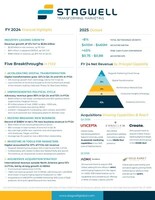
Q4 YoY Revenue Growth of 20%, With 22% Growth in Digital Transformation
Q4 YoY Net Revenue Growth of 14%, Organic Net Revenue Growth of 10%, Digital Transformation Net Revenue Growth of 15%
Q4 Net Income Attributable to Stagwell Inc. Common Shareholders of $3 million
Q4 Adjusted EBITDA of $123 million; Adjusted EBITDA Margin of 20%
Q4 EPS of $0.03; Adjusted EPS of $0.24
Eighth Consecutive Quarter of Record LTM Net New Business
Net New Business of $102 million in Q4; LTM Net New Business of $382 million
Introduce Guidance for 2025 of Total Net Revenue Growth of ~8%; Adjusted EBITDA of $410 million to $460 million; Free Cash Flow Conversion in excess of 45%
Stagwell To Host Investor Day on April 2nd 2025
NEW YORK, Feb. 27, 2025 /PRNewswire/ — (NASDAQ: STGW) – Stagwell Inc. (“Stagwell”) today announced financial results for the quarter and year ended December 31, 2024.
FOURTH QUARTER RESULTS:
Q4 Revenue of $789 million, an increase of 20% versus the prior year period; Full Year Revenue of $2.8 billion, an increase of 12% versus the prior yearQ4 Net Revenue of $630 million, an increase of 14% versus the prior year period; Full Year Net Revenue of $2.3 billion, an increase of 7% versus the prior yearQ4 Organic Net Revenue increased 10% versus the prior year period; Full Year Organic Net Revenue increased 5% versus the prior yearQ4 Net Income attributable to Stagwell Inc. Common Shareholders of $3 million versus $1 million in the prior year period; Full Year Net Income attributable to Stagwell Inc. Common Shareholders of $2 million versus $0.1 million in the prior yearQ4 Adjusted EBITDA of $123 million, an increase of 30% versus the prior year period; Full Year Adjusted EBITDA of $411 million, an increase of 14% versus the prior yearQ4 Adjusted EBITDA Margin of 20% on net revenue; Full Year Adjusted EBITDA Margin of 18% on net revenueQ4 Earnings Per Share Attributable to Stagwell Inc. Common Shareholders of $0.03 versus $0.00 in the prior year period; Full Year Earnings Per Share Attributable to Stagwell Inc. Common Shareholders of $0.02 versus $0.00 in the prior yearQ4 Adjusted Earnings Per Share attributable to Stagwell Inc. Common Shareholders of $0.24 versus $0.12 in the prior year period; Full Year Adjusted Earnings Per Share attributable to Stagwell Inc. Common Shareholders of $0.77 versus $0.57 in the prior yearNet new business of $102 million in the fourth quarter, last twelve-month net new business of $382 million
See “Non-GAAP Financial Measures” below for explanations and reconciliations of the Company’s non-GAAP financial measures.
Mark Penn, Chairman and CEO of Stagwell, said, “2024 was a breakthrough year for Stagwell and has fueled a strong start to 2025. We re-established ourselves as the fastest growing business in the industry, accelerated rapidly in Digital Transformation, took advantage of an unprecedented U.S. election cycle, and made strategic investments to expand our capabilities and geographical reach. I’m looking forward to a strong 2025.”
Frank Lanuto, Chief Financial Officer, commented: “Stagwell posted strong results in the fourth quarter with double-digit revenue growth in 4 of our 5 principal capabilities. We delivered fourth quarter revenue of $789 million. Simultaneously, we grew our adjusted EBITDA to $123 million, representing a 20% margin on net revenue, an improvement of approximately 230 bps over the prior year period, as we lowered our comp to revenue ratio to 57.5%, a company record. These results give us confidence in the year ahead.”
Financial Outlook
2025 financial guidance is announced as follows:
Total Net Revenue growth of approximately 8%Adjusted EBITDA of $410 million to $460 millionFree Cash Flow Conversion in excess of 45%Adjusted EPS of $0.75 – $0.88Guidance includes anticipated impact from acquisitions or dispositions.
* The Company has excluded a quantitative reconciliation with respect to the Company’s 2025 guidance under the “unreasonable efforts” exception in Item 10(e)(1)(i)(B) of Regulation S-K. See “Non-GAAP Financial Measures” below for additional information.
Video Webcast
Management will host a video webcast on Thursday, February 27, 2025, at 8:30 a.m. (ET) to discuss results for Stagwell Inc. for the quarter and year ended December 31, 2024. The video webcast will be accessible at https://bit.ly/3EVAIAk. An investor presentation has been posted on our website at www.stagwellglobal.com and may be referred to during the webcast.
A recording of the webcast will be accessible one hour after the webcast and available for ninety days at www.stagwellglobal.com.
Stagwell Inc.
Stagwell is the challenger network built to transform marketing. We deliver scaled creative performance for the world’s most ambitious brands, connecting culture-moving creativity with leading-edge technology to harmonize the art and science of marketing. Led by entrepreneurs, our specialists in 40+ countries are unified under a single purpose: to drive effectiveness and improve business results for their clients. Join us at www.stagwellglobal.com.
Contacts
For Investors:
Ben Allanson
IR@stagwellglobal.com
For Press:
Beth Sidhu
PR@stagwellglobal.com
Non-GAAP Financial Measures
In addition to its reported results, Stagwell Inc. has included in this earnings release certain financial results that the Securities and Exchange Commission (SEC) defines as “non-GAAP Financial Measures.” Management believes that such non-GAAP financial measures, when read in conjunction with the Company’s reported results, can provide useful supplemental information for investors analyzing period to period comparisons of the Company’s results. Such non-GAAP financial measures include the following:
(1) Organic Net Revenue: “Organic net revenue growth” and “Organic net revenue decline” reflects the year-over-year change in the Company’s reported net revenue attributable to the Company’s management of the entities it owns. We calculate organic net revenue growth (decline) by subtracting the net impact of acquisitions (divestitures) and the impact of foreign currency exchange fluctuations from the aggregate year-over-year increase or decrease in the Company’s reported net revenue. The net impact of acquisitions (divestitures) reflects the year-over-year change in the Company’s reported net revenue attributable to the impact of all individual entities that were acquired or divested in the current and prior year. We calculate impact of an acquisition as follows: (a) for an entity acquired during the current year, we present the entity’s prior year net revenue for the same period during which we owned it in the current year as impact of the acquisition in the current year; and (b) for an entity acquired in the prior year, we present the entity’s prior year net revenue for the period during which we did not own the entity in the prior year as impact of the acquisition in the current year. We calculate impact of a divestiture as follows: (a) for a divestiture in the current year, we present the entity’s prior year net revenue for the same period during which we no longer owned it in the current year as impact of the divestiture in the current year; and (b) for a divestiture in the prior year, we present the entity’s prior year net revenue for the period during which we owned it in the prior year as impact of the divestiture in the current year. We calculate the impact of any acquisition or divestiture without adjusting for foreign currency exchange fluctuations. The impact of foreign currency exchange fluctuations reflects the year-over-year change in the Company’s reported net revenue attributable to changes in foreign currency exchange rates. We calculate the impact of foreign currency exchange fluctuations for the portion of the reporting period in which we recognized revenue from a foreign entity in both the current year and the prior year. The impact is calculated as the difference between (1) reported prior period net revenue (converted to U.S. dollars at historical foreign currency exchange rates) and (2) prior period net revenue converted to U.S. dollars at current period foreign exchange rates.
(2) Net New Business: Estimate of annualized revenue for new wins less annualized revenue for losses incurred in the period.
(3) Adjusted EBITDA: defined as Net income excluding non-operating income or expense to achieve operating income, plus depreciation and amortization, stock-based compensation, deferred acquisition consideration adjustments, and other items. Other items include restructuring costs, acquisition-related expenses, and non-recurring items.
(4) Adjusted Diluted EPS is defined as (i) Net income (loss) attributable to Stagwell Inc. common shareholders, plus net income attributable to Class C shareholders, excluding amortization expense, impairment and other losses, stock-based compensation, deferred acquisition consideration adjustments, discrete tax items, and other items, divided by (ii) (a) the per weighted average number of common shares outstanding plus (b) the weighted average number of Class C shares outstanding, (if dilutive). Other items includes restructuring costs, acquisition-related expenses, and non-recurring items, and subject to the anti-dilution rules.
(5) Free Cash Flow: defined as Adjusted EBITDA less capital expenditures, change in net working capital, cash taxes, interest, and distributions to minority interests, but excludes contingent M&A payments. Free Cash Flow Conversion is the percentage of adjusted EBITDA.
Included in this earnings release are tables reconciling reported Stagwell Inc. results to arrive at certain of these non-GAAP financial measures.
This document contains forward-looking statements within the meaning of Section 27A of the Securities Act of 1933, as amended (the “Securities Act”), and Section 21E of the Securities Exchange Act of 1934, as amended (the “Exchange Act”). The Company’s representatives may also make forward-looking statements orally or in writing from time to time. Statements in this document that are not historical facts, including, statements about the Company’s beliefs and expectations, future financial performance, growth, and future prospects, the Company’s strategy, business and economic trends and growth, technological leadership and differentiation, potential and completed acquisitions, anticipated and actual operating efficiencies and synergies and estimates of amounts for redeemable noncontrolling interests and deferred acquisition consideration, constitute forward-looking statements. Forward-looking statements, which are generally denoted by words such as “ability,” “aim,” “anticipate,” “assume,” “believe,” “build,” “consider,” “continue,” “could,” “create,” “develop,” “drive,” “estimate,” “expect,” “focus,” “forecast,” “foresee,” “future,” “goal,” “guidance,” “in development,” “intend,” “likely,” “look,” “maintain,” “may,” “ongoing,” “opportunity,” “outlook,” “plan,” “possible,” “potential,” “predict,” “probable,” “project,” “should,” “target,” “will,” “would” or the negative of such terms or other variations thereof and terms of similar substance used in connection with any discussion of current plans, estimates and projections are subject to change based on a number of factors, including those outlined in this section.
Forward-looking statements in this document are based on certain key expectations and assumptions made by the Company. Although the management of the Company believes that the expectations and assumptions on which such forward-looking statements are based are reasonable, undue reliance should not be placed on the forward-looking statements because the Company can give no assurance that they will prove to be correct. The material assumptions upon which such forward-looking statements are based include, among others, assumptions with respect to general business, economic and market conditions, the competitive environment, anticipated and unanticipated tax consequences and anticipated and unanticipated costs. These forward-looking statements are based on current plans, estimates and projections, and are subject to change based on a number of factors, including those outlined in this section. These forward-looking statements are subject to various risks and uncertainties, many of which are outside the Company’s control. Therefore, you should not place undue reliance on such statements. Forward-looking statements speak only as of the date they are made, and the Company undertakes no obligation to update publicly any of them in light of new information or future events, if any.
Forward-looking statements involve inherent risks and uncertainties. A number of important factors could cause actual results to differ materially from those contained in any forward-looking statements. Such risk factors include, but are not limited to, the following:
risks associated with international, national and regional unfavorable economic conditions that could affect the Company or its clients;demand for the Company’s services, which may precipitate or exacerbate other risks and uncertainties;inflation and actions taken by central banks to counter inflation;the Company’s ability to attract new clients and retain existing clients;the impact of a reduction in client spending and changes in client advertising, marketing and corporate communications requirements;financial failure of the Company’s clients;the Company’s ability to retain and attract key employees;the Company’s ability to compete in the markets in which it operates;the Company’s ability to achieve its cost saving initiatives;the Company’s implementation of strategic initiatives;the Company’s ability to remain in compliance with its debt agreements and the Company’s ability to finance its contingent payment obligations when due and payable, including but not limited to those relating to redeemable noncontrolling interests and deferred acquisition consideration;the Company’s ability to manage its growth effectively;the Company’s ability to identify and complete acquisitions or other strategic transactions that complement and expand the Company’s business capabilities and successfully integrate newly acquired businesses into the Company’s operations, retain key employees, and realize expected cost savings, synergies and other related anticipated benefits within the expected time period;the Company’s ability to identify and complete divestitures and to achieve the anticipated benefits therefrom;the Company’s ability to develop products incorporating new technologies, including augmented reality, artificial intelligence, and virtual reality, and realize benefits from such products;the Company’s use of artificial intelligence, including generative artificial intelligence;adverse tax consequences for the Company, its operations and its stockholders, that may differ from the expectations of the Company, including that future changes in tax laws, potential increases to corporate tax rates in the United States and disagreements with tax authorities on the Company’s determinations that may result in increased tax costs;adverse tax consequences in connection with the business combination that formed the Company in August 2021, including the incurrence of material Canadian federal income tax (including material “emigration tax”);the Company’s ability to establish and maintain an effective system of internal control over financial reporting, including the risk that the Company’s internal controls will fail to detect misstatements in its financial statements;the Company’s ability to accurately forecast its future financial performance and provide accurate guidance;the Company’s ability to protect client data from security incidents or cyberattacks;economic disruptions resulting from war and other geopolitical tensions (such as the ongoing military conflicts between Russia and Ukraine and in the Middle East), terrorist activities, natural disasters, and public health events;stock price volatility; andforeign currency fluctuations.
Investors should carefully consider these risk factors, other risk factors described herein, and the additional risk factors outlined in more detail in our 2023 Form 10-K, filed with the Securities and Exchange Commission (the “SEC”) on March 11, 2024, and accessible on the SEC’s website at www.sec.gov, under the caption “Risk Factors,” and in the Company’s other SEC filings.
SCHEDULE 1
STAGWELL INC.
UNAUDITED CONSOLIDATED STATEMENTS OF OPERATIONS
(amounts in thousands, except per share amounts)
Three Months Ended
December 31,
Year Ended
December 31,
2024
2023
2024
2023
Revenue
$ 788,708
$ 654,895
$ 2,841,216
$ 2,527,177
Operating Expenses
Cost of services
502,522
419,865
1,842,978
1,621,174
Office and general expenses
203,887
179,871
711,803
661,250
Depreciation and amortization
38,771
35,036
151,652
142,831
Impairment and other losses
—
833
1,715
11,395
745,180
635,605
2,708,148
2,436,650
Operating Income
43,528
19,290
133,068
90,527
Other income (expenses):
Interest expense, net
(24,038)
(22,889)
(92,317)
(90,644)
Foreign exchange, net
645
(672)
(1,656)
(2,960)
Gain on sale of business
—
94,505
—
94,505
Other, net
(547)
108
(1,372)
(359)
(23,940)
71,052
(95,345)
542
Income before income taxes and equity in earnings of non-consolidated affiliates
19,588
90,342
37,723
91,069
Income tax expense
3,741
35,560
13,182
40,557
Income before equity in earnings of non-consolidated affiliates
15,847
54,782
24,541
50,512
Equity in income (loss) of non-consolidated affiliates
—
(8,423)
503
(8,870)
Net income
15,847
46,359
25,044
41,642
Net income attributable to noncontrolling and redeemable noncontrolling interests
(12,612)
(45,073)
(22,785)
(41,508)
Net income attributable to Stagwell Inc. common shareholders
$ 3,235
$ 1,286
$ 2,259
$ 134
Earnings Per Common Share:
Basic
$ 0.03
$ 0.01
$ 0.02
$ —
Diluted
$ 0.03
$ —
$ 0.02
$ —
Weighted Average Number of Common Shares Outstanding:
Basic
109,266
112,769
110,890
117,259
Diluted
115,147
119,621
115,752
122,170
SCHEDULE 2
STAGWELL INC.
UNAUDITED COMPONENTS OF NET REVENUE CHANGE
(amounts in thousands)
Net Revenue – Components of Change
Change
Three Months
Ended
December 31,
2023
Foreign
Currency
Net
Acquisitions
(Divestitures)
Organic
Total Change
Three Months
Ended
December 31,
2024
Organic
Total
Integrated Agencies Network
$ 302,137
$ 25
$ 4,800
$ 27,405
$ 32,230
$ 334,367
9.1 %
10.7 %
Brand Performance Network
168,519
75
—
6,046
6,121
174,640
3.6 %
3.6 %
Communications Network
68,229
42
15,757
23,666
39,465
107,694
34.7 %
57.8 %
All Other
12,181
(161)
2,950
(2,048)
741
12,922
(16.8) %
6.1 %
$ 551,066
$ (19)
$ 23,507
$ 55,069
$ 78,557
$ 629,623
10.0 %
14.3 %
Net Revenue – Components of Change
Change
Year Ended
December 31,
2023
Foreign
Currency
Net
Acquisitions
(Divestitures)
Organic
Total Change
Year Ended
December 31,
2024
Organic
Total
Integrated Agencies Network
$ 1,232,798
$ 226
$ 7,208
$ 32,521
$ 39,955
$ 1,272,753
2.6 %
3.2 %
Brand Performance Network
627,810
2,220
2,252
18,948
$ 23,420
651,230
3.0 %
3.7 %
Communications Network
245,261
(28)
22,177
$ 66,385
$ 88,534
333,795
27.1 %
36.1 %
All Other
46,585
(984)
(609)
(6,108)
(7,701)
38,884
(13.1) %
(16.5) %
$ 2,152,454
$ 1,434
$ 31,028
$ 111,746
$ 144,208
$ 2,296,662
5.2 %
6.7 %
(1) See Non-GAAP Financial Measures section above for the definition of Adjusted EBITDA and Other items, net.
Note: The Company made changes to its internal management and reporting structure in the first quarter of 2024, resulting in a change to its reportable segments (Networks). Specifically, certain agencies previously within the Brand Performance Network are now in the Integrated Agencies Network. Periods presented prior to the first quarter of 2024 have been recast to reflect the reclassification of certain reporting units (Brands) between operating segments.
SCHEDULE 3
STAGWELL INC.
UNAUDITED SEGMENT OPERATING RESULTS
(amounts in thousands)
For the Three Months Ended December 31, 2024
Integrated
Agencies
Network
Brand
Performance
Network
Communications
Network
All Other
Corporate
Total
Net Revenue
$ 334,367
$ 174,640
$ 107,694
$ 12,922
$ —
$ 629,623
Billable costs
73,558
13,688
72,150
(311)
—
159,085
Revenue
407,925
188,328
179,844
12,611
—
788,708
Billable costs
73,558
13,688
72,150
(311)
—
159,085
Staff costs
212,062
100,890
54,590
10,364
12,315
390,221
Administrative costs
32,857
23,959
10,940
2,692
5,006
75,454
Unbillable and other costs, net
16,455
19,224
965
4,105
—
40,749
Adjusted EBITDA (1)
72,993
30,567
41,199
(4,239)
(17,321)
123,199
Stock-based compensation
2,083
1,989
643
175
8,345
13,235
Depreciation and amortization
19,345
8,071
5,119
2,780
3,456
38,771
Deferred acquisition consideration
7,600
(1,290)
9,673
(938)
—
15,045
Other items, net (1)
7,388
3,173
1,146
185
728
12,620
Operating income (loss)
$ 36,577
$ 18,624
$ 24,618
$ (6,441)
$ (29,850)
$ 43,528
(1) See Non-GAAP Financial Measures section above for the definition of Adjusted EBITDA and Other items, net.
SCHEDULE 4
STAGWELL INC.
UNAUDITED SEGMENT OPERATING RESULTS
(amounts in thousands)
For the Year Ended December 31, 2024
Integrated
Agencies
Network
Brand
Performance
Network
Communications
Network
All Other
Corporate
Total
Net Revenue
$ 1,272,753
$ 651,230
$ 333,795
$ 38,884
$ —
$ 2,296,662
Billable costs
262,692
100,654
181,345
(137)
—
544,554
Revenue
1,535,445
751,884
515,140
38,747
—
2,841,216
Billable costs
262,692
100,654
181,345
(137)
—
544,554
Staff costs
792,041
397,301
177,629
34,999
47,736
1,449,706
Administrative costs
128,954
93,155
37,057
6,139
16,402
281,707
Unbillable and other costs, net
72,756
65,901
2,235
13,570
—
154,462
Adjusted EBITDA (1)
279,002
94,873
116,874
(15,824)
(64,138)
410,787
Stock-based compensation
27,253
6,977
3,374
904
13,653
52,161
Depreciation and amortization
78,076
34,595
14,126
12,718
12,137
151,652
Deferred acquisition consideration
13,290
(7,744)
18,770
(1,321)
—
22,995
Impairment and other losses
1,500
—
—
—
215
1,715
Other items, net (1)
20,592
19,536
3,250
887
4,931
49,196
Operating income (loss)
$ 138,291
$ 41,509
$ 77,354
$ (29,012)
$ (95,074)
$ 133,068
(1) See Non-GAAP Financial Measures section above for the definition of Adjusted EBITDA and Other items, net.
SCHEDULE 5
STAGWELL INC.
UNAUDITED SEGMENT OPERATING RESULTS
(amounts in thousands)
For the Three Months Ended December 31, 2023
Integrated
Agencies
Network
Brand
Performance
Network
Communications
Network
All Other
Corporate
Total
Net Revenue
$ 302,137
$ 168,519
$ 68,229
$ 12,181
$ —
$ 551,066
Billable costs
51,665
16,921
35,217
26
—
103,829
Revenue
353,802
185,440
103,446
12,207
—
654,895
Billable costs
51,665
16,921
35,217
26
—
103,829
Staff costs
195,953
97,871
43,319
6,292
11,088
354,523
Administrative costs
29,618
23,174
8,568
3,445
(1,871)
62,934
Unbillable and other costs, net
18,111
17,357
277
2,885
—
38,630
Adjusted EBITDA (1)
58,456
30,117
16,065
(441)
(9,217)
94,980
Stock-based compensation
12,015
2,364
1,157
91
6,937
22,564
Depreciation and amortization
19,680
8,090
2,800
2,238
2,228
35,036
Deferred acquisition consideration
3,813
1,739
(3,373)
—
—
2,179
Impairment and other losses
737
96
—
—
—
833
Other items, net (1)
6,403
3,713
198
95
4,669
15,078
Operating income (loss)
$ 15,808
$ 14,115
$ 15,283
$ (2,865)
$ (23,051)
$ 19,290
(1) See Non-GAAP Financial Measures section above for the definition of Adjusted EBITDA and Other items.
Note: The Company made changes to its internal management and reporting structure in the first quarter of 2024, resulting in a change to its reportable segments (Networks). Specifically, certain agencies previously within the Brand Performance Network are now in the Integrated Agencies Network. Periods presented prior to the first quarter of 2024 have been recast to reflect the reclassification of certain reporting units (Brands) between operating segments.
SCHEDULE 6
STAGWELL INC.
UNAUDITED SEGMENT OPERATING RESULTS
(amounts in thousands)
For the Year Ended December 31, 2023
Integrated
Agencies
Network
Brand
Performance
Network
Communications
Network
All Other
Corporate
Total
Net Revenue
$ 1,232,798
$ 627,810
$ 245,261
$ 46,585
$ —
$ 2,152,454
Billable costs
185,913
100,364
88,446
—
—
374,723
Revenue
1,418,711
728,174
333,707
46,585
—
2,527,177
Billable costs
185,913
100,364
88,446
—
—
374,723
Staff costs
768,846
386,803
159,165
37,416
36,938
1,389,168
Administrative costs
122,618
87,337
33,664
4,689
11,472
259,780
Unbillable and other costs, net
71,776
55,891
613
15,087
—
143,367
Adjusted EBITDA (1)
269,558
97,779
51,819
(10,607)
(48,410)
360,139
Stock-based compensation
27,485
6,204
3,334
518
19,638
57,179
Depreciation and amortization
81,957
33,250
11,016
8,390
8,218
142,831
Deferred acquisition consideration
11,931
2,851
30
(1,752)
—
13,060
Impairment and other losses
11,299
96
—
—
—
11,395
Other items, net (1)
20,225
12,206
1,535
1,174
10,007
45,147
Operating income (loss)
$ 116,661
$ 43,172
$ 35,904
$ (18,937)
$ (86,273)
$ 90,527
(1) See Non-GAAP Financial Measures section above for the definition of Adjusted EBITDA and Other items, net.
Note: The Company made changes to its internal management and reporting structure in the first quarter of 2024, resulting in a change to its reportable segments (Networks). Specifically, certain agencies previously within the Brand Performance Network are now in the Integrated Agencies Network. Periods presented prior to the first quarter of 2024 have been recast to reflect the reclassification of certain reporting units (Brands) between operating segments.
SCHEDULE 7
STAGWELL INC.
UNAUDITED RECONCILIATION OF ADJUSTED DILUTED EARNINGS PER SHARE (NON-GAAP MEASURE)
(amounts in thousands, except per share amounts)
For the Three Months Ended December 31, 2024
GAAP
Adjustments
Non-GAAP
Net income attributable to Stagwell Inc. common shareholders
$ 3,235
$ 22,226
$ 25,461
Net income attributable to Class C shareholders
—
40,500
40,500
Net income attributable to Stagwell Inc. and Class C shareholders and adjusted net income
$ 3,235
$ 62,726
$ 65,961
Weighted average number of common shares outstanding
115,147
2,567
117,714
Weighted average number of common Class C shares outstanding
—
151,649
151,649
Weighted average number of shares outstanding
115,147
154,216
269,363
Diluted EPS and Adjusted Diluted EPS (1)
$ 0.03
$ 0.24
Adjustments to Net income
Amortization
$ 30,572
Stock-based compensation
13,235
Deferred acquisition consideration
15,045
Other items, net
12,620
71,472
Adjusted tax expense
(20,040)
51,432
Net income attributable to Class C shareholders
11,294
$ 62,726
Allocation of adjustments to Net income
Net income attributable to Stagwell Inc. common shareholders – add-backs
$ 22,226
Net income attributable to Class C shareholders – add-backs
29,206
Net income attributable to Class C shareholders
11,294
40,500
$ 62,726
(1) Adjusted Diluted EPS is defined within the Non-GAAP Financial Measures section of the Executive Summary.
SCHEDULE 8
STAGWELL INC.
UNAUDITED RECONCILIATION OF ADJUSTED DILUTED EARNINGS PER SHARE (NON-GAAP MEASURE)
(amounts in thousands, except per share amounts)
For the Year Ended December 31, 2024
GAAP
Adjustments
Non-GAAP
Net income attributable to Stagwell Inc. common shareholders
$ 2,259
$ 80,403
$ 82,662
Net income attributable to Class C shareholders
—
123,942
123,942
Net income attributable to Stagwell Inc. and Class C and adjusted net income
$ 2,259
$ 204,345
$ 206,604
Weighted average number of common shares outstanding
115,752
2,234
117,986
Weighted average number of common Class C shares outstanding
—
151,649
151,649
Weighted average number of shares outstanding
115,752
153,883
269,635
Diluted EPS and Adjusted Diluted EPS (1)
$ 0.02
$ 0.77
Adjustments to Net Income
Amortization
$ 122,442
Impairment and other losses
1,715
Stock-based compensation
52,161
Deferred acquisition consideration
22,995
Other items, net
49,196
248,509
Adjusted tax expense
(61,308)
187,201
Net income attributable to Class C shareholders
17,144
$ 204,345
Allocation of adjustments to Net income
Net income attributable to Stagwell Inc. common shareholders – add-backs
$ 80,403
Net income attributable to Class C shareholders – add-backs
106,798
Net income attributable to Class C shareholders
17,144
123,942
$ 204,345
(1) Adjusted Diluted EPS is defined within the Non-GAAP Financial Measures section of the Executive Summary.
SCHEDULE 9
STAGWELL INC.
UNAUDITED RECONCILIATION OF ADJUSTED DILUTED EARNINGS PER SHARE (NON-GAAP MEASURE)
(amounts in thousands, except per share amounts)
For the Three Months Ended December 31, 2023
GAAP
Adjustments
Non-GAAP
Net income (loss) attributable to Stagwell Inc. common shareholders
$ 127
$ (4,705)
$ (4,578)
Net income attributable to Class C shareholders
—
35,780
35,780
Net income attributable to Stagwell Inc. and Class C and adjusted net income
$ 127
$ 31,075
$ 31,202
Weighted average number of common shares outstanding
119,621
—
119,621
Weighted average number of common Class C shares outstanding
—
151,649
151,649
Weighted average number of shares outstanding
119,621
151,649
271,270
Diluted EPS and Adjusted Diluted EPS (1)
$ —
$ 0.12
Adjustments to Net income (loss)
Amortization
$ 27,231
Impairment and other losses
833
Stock-based compensation
22,564
Deferred acquisition consideration
3,338
Gain on sale of business
(94,505)
Other items, net
15,078
(25,461)
Adjusted tax expense
14,768
(10,693)
Net income attributable to Class C shareholders
41,768
$ 31,075
Allocation of adjustments to Net income (loss)
Net loss attributable to Stagwell Inc. common shareholders – add-backs
$ (4,705)
Net loss attributable to Class C shareholders – add-backs
(5,988)
Net income attributable to Class C shareholders
41,768
35,780
$ 31,075
(1) Adjusted Diluted EPS is defined within the Non-GAAP Financial Measures section of the Executive Summary.
SCHEDULE 10
STAGWELL INC.
UNAUDITED RECONCILIATION OF ADJUSTED DILUTED EARNINGS PER SHARE (NON-GAAP MEASURE)
(amounts in thousands, except per share amounts)
For the Year Ended December 31, 2023
GAAP
Adjustments
Non-GAAP
Net income attributable to Stagwell Inc. common shareholders
$ 134
$ 52,712
$ 52,846
Net income attributable to Class C shareholders
—
106,153
106,153
Net income attributable to Stagwell Inc. and Class C and adjusted net income
$ 134
$ 158,865
$ 158,999
Weighted average number of common shares outstanding
122,170
3,628
125,798
Weighted average number of common Class C shares outstanding
—
154,972
154,972
Weighted average number of shares outstanding
122,170
158,600
280,770
Diluted EPS and Adjusted Diluted EPS (1)
$ —
$ 0.57
Adjustments to Net income
Amortization
$ 113,835
Impairment and other losses
11,395
Stock-based compensation
57,179
Deferred acquisition consideration
13,060
Gain on sale of business
(94,505)
Other items, net
45,147
146,111
Adjusted tax expense
(26,312)
119,799
Net income attributable to Class C shareholders
39,066
$ 158,865
Allocation of adjustments to Net income
Net income attributable to Stagwell Inc. common shareholders
$ 52,712
Net income to attributable to Class C shareholders – add-backs
67,087
Net income attributable to Class C shareholders
39,066
106,153
$ 158,865
(1) Adjusted Diluted EPS is defined within the Non-GAAP Financial Measures section of the Executive Summary.
SCHEDULE 11
STAGWELL INC.
UNAUDITED CONSOLIDATED BALANCE SHEETS
(amounts in thousands)
December 31, 2024
December 31, 2023
ASSETS
Current Assets
Cash and cash equivalents
$ 131,339
$ 119,737
Accounts receivable, net
716,415
697,178
Expenditures billable to clients
173,194
114,097
Other current assets
114,200
94,054
Total Current Assets
1,135,148
1,025,066
Fixed assets, net
72,706
77,825
Right-of-use assets – operating leases
219,400
254,278
Goodwill
1,554,146
1,498,815
Other intangible assets, net
836,783
818,220
Other assets
90,038
92,843
Total Assets
$ 3,908,221
$ 3,767,047
LIABILITIES, REDEEMABLE NONCONTROLLING INTERESTS (“RNCI”), AND SHAREHOLDERS’ EQUITY
Current Liabilities
Accounts payable
$ 449,347
$ 414,980
Accrued media
245,883
291,777
Accruals and other liabilities
265,356
233,046
Advance billings
294,609
301,674
Current portion of lease liabilities – operating leases
60,195
65,899
Current portion of deferred acquisition consideration
51,906
66,953
Total Current Liabilities
1,367,296
1,374,329
Long-term debt
1,353,624
1,145,828
Long-term portion of deferred acquisition consideration
50,209
34,105
Long-term lease liabilities – operating leases
245,397
281,307
Deferred tax liabilities, net
47,239
40,509
Other liabilities
59,139
54,905
Total Liabilities
3,122,904
2,930,983
Redeemable Noncontrolling Interests
8,412
10,792
Commitments, Contingencies and Guarantees
Shareholders’ Equity
Common shares – Class A & B
115
118
Common shares – Class C
2
2
Paid-in capital
343,647
348,494
Retained earnings
11,740
21,148
Accumulated other comprehensive loss
(23,773)
(13,067)
Stagwell Inc. Shareholders’ Equity
331,731
356,695
Noncontrolling interests
445,174
468,577
Total Shareholders’ Equity
776,905
825,272
Total Liabilities, Redeemable Noncontrolling Interests and Shareholders’ Equity
$ 3,908,221
$ 3,767,047
SCHEDULE 12
STAGWELL INC.
UNAUDITED SUMMARY CASH FLOW DATA
(amounts in thousands)
Year Ended December 31,
2024
2023
Cash flows from operating activities:
Net income
$ 25,044
$ 41,642
Adjustments to reconcile net income to cash provided by operating activities:
Stock-based compensation
52,161
57,179
Depreciation and amortization
151,652
142,831
Amortization of right-of-use lease assets and lease liability interest
75,117
76,653
Impairment and other losses
1,715
11,395
Deferred income taxes
(10,686)
19,443
Adjustment to deferred acquisition consideration
23,005
13,060
Gain on sale of business
—
(94,505)
Other, net
7,622
8,313
Changes in working capital:
Accounts receivable
8,465
(58,704)
Expenditures billable to clients
(54,350)
(21,477)
Other assets
(6,200)
1,153
Accounts payable
24,438
52,837
Accrued expenses and other liabilities
(28,658)
(24,647)
Advance billings
(22,651)
(41,137)
Current portion of lease liabilities – operating leases
(83,905)
(87,629)
Deferred acquisition related payments
(19,910)
(15,400)
Net cash provided by operating activities
142,859
81,007
Cash flows from investing activities:
Capital expenditures
(18,912)
(14,238)
Acquisitions, net of cash acquired
(103,254)
(23,339)
Capitalized software
(35,094)
(28,175)
Proceeds from sale of business, net
—
229,484
Other
(5,212)
(7,781)
Net cash (used in) provided by investing activities
(162,472)
155,951
Cash flows from financing activities:
Repayment of borrowings under revolving credit facility
(1,755,000)
(1,986,500)
Proceeds from borrowings under revolving credit facility
1,960,000
1,945,500
Shares repurchased and cancelled
(108,249)
(223,835)
Distributions to noncontrolling interests
(26,723)
(24,964)
Payment of deferred consideration
(29,774)
(49,221)
Purchase of noncontrolling interest
(3,316)
—
Debt issuance costs
—
(844)
Net cash provided by (used in) financing activities
36,938
(339,864)
Effect of exchange rate changes on cash and cash equivalents
(5,723)
2,054
Net increase (decrease) in cash and cash equivalents
11,602
(100,852)
Cash and cash equivalents at beginning of period
119,737
220,589
Cash and cash equivalents at end of period
$ 131,339
$ 119,737
View original content to download multimedia:https://www.prnewswire.com/news-releases/stagwell-inc-nasdaq-stgw-reports-results-for-the-three-and-twelve-months-ended-december-31-2024-302387320.html
SOURCE Stagwell Inc.

You may like
Technology
Tech Beats Tariffs: Global Trade Growth Accelerates and Globalization Sets New Record
Published
49 minutes agoon
October 20, 2026By

The AI boom has become a powerful driver of global trade – outweighing tariffs and geopolitical shocks, according to the latest DHL Globalization TrackerThe trade outlook has improved, with growth through 2029 now forecast to outpace the previous decadeSouth and Central Asia to have the second-fastest goods-trade growth over 2026–29, behind only the Middle East & North AfricaIndia continues to strengthen its trade resiliency by developing new trade agreementsGlobalization has reached a record level of 25.8%
NEW DELHI, Oct. 20, 2026 /PRNewswire/ — The global race to build infrastructure for artificial intelligence is giving world trade strong momentum at a time of higher tariffs and geopolitical conflicts.
This is one of the key findings of the latest edition of the DHL Globalization Tracker, released by DHL and New York University’s Stern School of Business. Based on more than 30 million data points, the report analyzes international flows of trade, capital, information, and people. It offers the most comprehensive view of globalization available. This edition marks the report’s first publication under its new name. It was previously known as the “DHL Global Connectedness Tracker”.
AI buildout boosts global trade
The report shows that global goods trade grew faster in the first half of 2026 than in any half-year in the past 15 years, apart from the exceptional Covid rebound. A major driver was strong demand for goods used to build AI infrastructure, such as semiconductors and data-transmission equipment. Trade in AI-enabling goods drove 42% of goods trade growth in 2025, and this share rose to 76% during the first quarter of 2026, according to WTO and OECD analysis.
“The biggest story in global trade right now is AI – not tariffs,” said John Pearson, CEO of DHL Express. “Every AI query ultimately depends on logistics. Chips, networking equipment and the many other goods behind this technology must be in the right place at the right time. DHL connects the businesses and markets behind these complex supply chains. Whenever innovation creates new trade flows, our global network helps keep them moving.”
Global effects of Iran war and tariffs remain limited
At the same time, the Iran war and the closure of the Strait of Hormuz disrupted important trade routes. But the effects remained concentrated. Economies dependent on the Strait were hit particularly hard. For example, the value of trade fell 37% in Saudi Arabia and 7% in the United Arab Emirates in the first five months of 2026 compared with the same period in 2025.
Trade policy created a separate headwind. U.S. tariffs reached their highest levels in decades, but their global impact was limited. One reason is that the U.S. accounted for only 13% of world imports in recent years, with roughly half of those imports exempt from the tariff increases as of August 2026. Another is that most countries refrained from broad retaliation. Many instead increased efforts to secure access to alternative markets through new trade agreements.
Trade outlook upgraded despite recent shocks
Looking ahead, global goods trade is projected to expand by an average of 3.4% per year through 2029. That would be substantially faster than the 2.7% rate recorded over the previous decade.
“The surprise is not only that global trade kept growing through new tariffs and the Iran war,” said Prof. Steven A. Altman, Director of the DHL Initiative on Globalization at NYU Stern’s Center for the Future of Management. “The outlook is now stronger than it was before either shock. This reminds us to look beyond the most visible disruptions and recognize the deeper reasons why trade remains so resilient. The AI trade boom highlights the demand for goods and services that can only be provided efficiently when specialized producers work together across countries. It also shows how companies continually adapt to keep trade moving through disruptions and policy shifts.”
India sits within one of the world’s strongest trade-growth regions, East Asia and the Pacific leads the way in 2026
Among all regions, East Asia and the Pacific recorded the strongest trade growth. The value of its trade rose 24% in the first five months of 2026 compared with the same period in 2025. Europe followed with 12% and Sub-Saharan Africa with 11%. South and Central Asia recorded a trade value growth of 9.6%. Looking forward, the region’s forecast remain the second-fastest for goods-trade growth over 2026–29, behind only the Middle East and North Africa.
East Asia and the Pacific not only recorded the strongest growth, but also saw a larger share of its trade stay within the region. This share increased from 57% in 2025 to 60% in the first five months of 2026. Strong Asian supply chains serving the AI boom contributed to this increase.
India focuses on market diversification
One of the major changes in international flows is the weakening of U.S.–China ties. Yet the global impact remains surprisingly small. For example, trade between the U.S. and China accounted for 3.5% of world trade at its peak in 2015, before falling to only 1.6% during the first five months of 2026. The U.S.–China share of international business investment is even smaller – less than 1%. Meanwhile, close U.S. allies have largely maintained their relationships with China. These findings challenge the idea that U.S.–China decoupling is dividing the world economy into rival blocs.
A closer look also shows that direct trade figures understate U.S. reliance on China. Goods imported into the U.S. from other countries contain growing amounts of Chinese materials and components. When these indirect imports are also taken into account, U.S. reliance on China has declined only slightly through 2024, the latest year for which data are available.
While U.S.-China ties are weakening, India’s trade relationship with the U.S. remains strong. At the same time, trade resilience remains a focus as India continues to expand its trade relationships, developing trade agreements with the European Union, the United Kingdom, the European Free Trade Association, New Zealand, and Oman.
Globalization reaches a new record
Beyond trade and investment patterns, the report tracks the broader development of globalization based on international flows of trade, capital, information and people. It uses a scale from 0% (no cross-border flows) to 100% (borders and distance have no impact). In 2025, globalization reached a record level of 25.8%, supported in part by AI-related trade and investment.
All four flow categories contributed to the new record, reaching higher levels of internationalization. Information flows remain the most globalized, followed by capital and trade flows. People flows remain the least globalized.
The DHL Globalization Tracker
The DHL Globalization Tracker is a concise report and interactive website that provides regular updates on globalization and global trade. It complements the renowned DHL Globalization Report, published regularly since 2011. Drawn from over 25 public, private, and academic sources, the Tracker analyzes more than 30 million data points on international flows of trade, capital, information, and people.
It includes interactive online charts that make it easy for users to explore trends by region, geopolitical alignment, and for individual countries. It also supports easy data and chart downloads for offline use.
The DHL Globalization Tracker is commissioned by DHL and authored by Prof. Steven A. Altman and Caroline R. Bastian of New York University Stern School of Business. It is available, together with further resources, at dhl.com/globalization.
Note: The DHL Globalization Tracker and DHL Globalization Report were formerly known as the “DHL Global Connectedness Tracker” and “DHL Global Connectedness Report”. Their new names more directly reflect the focus of the research. The scope and underlying approach remain unchanged, ensuring continuity with previous editions.
At a glance: The October 2026 edition of the DHL Globalization Tracker
What is the main finding of the report?
The global boom in artificial intelligence is giving world trade strong momentum despite higher tariffs and geopolitical conflicts. Global goods trade grew faster in the first half of 2026 than in any half-year in the past 15 years, apart from the exceptional Covid rebound.
Beyond trade, the report tracks the broader development of globalization based on international flows of trade, capital, information and people. In 2025, globalization reached a record level of 25.8%. The report measures this using a scale from 0% (no cross-border flows) to 100% (borders and distance have no impact). All four types of flows contributed to the record, becoming more international.
What is the outlook for global trade?
The outlook has improved. Global goods trade is projected to grow by an average of 3.4% per year through 2029. That would be significantly faster than the 2.7% annual growth rate recorded over the previous decade. Notably, current forecasts are more optimistic than those made before both the 2025-26 U.S. tariff increases and the Iran war, suggesting that recent shocks have had a smaller impact on the global economy than many expected.
How have tariffs and geopolitical conflicts affected global trade?
Tariffs and geopolitical conflicts continue to create risks and disruptions. But their overall impact on global trade has been limited. While the Iran war affected important shipping routes and hit economies dependent on the Strait of Hormuz particularly hard, the effects remained largely concentrated. U.S. tariffs rose to their highest levels in decades, but the United States accounted for only 13% of world imports in recent years, and roughly half of U.S. imports were exempt from tariff increases as of August 2026. Many countries also avoided broad retaliation and instead expanded trade links with alternative markets. As a result, global trade continued to grow.
Where is trade growing fastest?
East Asia and the Pacific saw the strongest trade growth among all regions. The value of its trade rose 24% in the first five months of 2026 compared with the same period in 2025. Europe followed with 12% and Sub-Saharan Africa with 11%.
East Asia and the Pacific not only recorded the strongest growth, but also saw a larger share of its trade stay within the region. This share increased from 57% in 2025 to 60% in the first five months of 2026. Strong Asian supply chains serving the AI boom contributed to this increase.
Is U.S.–China decoupling splitting the world into rival blocs?
No, not so far. The United States and China have significantly reduced their ties with each other over the past decade. But this has not led to a broader split in the global economy. Close U.S. allies have largely maintained their economic relationships with China. Another reason is that direct U.S.–China ties account for a surprisingly small share of the global economy. For example, trade between the two countries represented 3.5% of world goods trade at its peak in 2015, before falling to 1.6% in the first five months of 2026. The U.S.–China share of international business investment is even smaller – less than 1%.
Has the United States become less dependent on China?
Direct trade between the two countries has declined sharply, but the picture is more complex when supply chains are taken into account. Goods imported into the United States from third countries increasingly contain Chinese materials and components. When these indirect imports are considered, U.S. reliance on China declined only slightly through 2024.
Should companies redesign their supply chains to improve resilience?
For business leaders, the report recommends preparing for disruptions without giving up the advantages of international engagement. While specific economies, industries or trade routes can still face significant risks, overall global flows remain strong. Decisions such as relocating production should therefore balance supply-chain resilience with the benefits of global reach and market access. Companies that pull back from international markets while competitors remain globally active may risk weakening their competitive position.
– End –
The report and further resources are available at dhl.com/globalization.
DHL Group is the world’s leading logistics company. The Group connects people and markets and is an enabler of global trade. It aspires to be the first choice for customers, employees, investors and green logistics worldwide. To this end, DHL Group is focusing on accelerating sustainable growth in its profitable core logistics businesses and Group growth initiatives. The Group contributes to the world through sustainable business practices, corporate citizenship, and environmental activities. By the year 2050, DHL Group aims to achieve net-zero emissions logistics.
DHL Group is home to two strong brands: DHL offers a comprehensive range of parcel, express, freight transport, and supply chain management services as well as e-commerce logistics solutions. Deutsche Post is the largest postal service provider in Europe and the market leader in the German mail market. DHL Group employs approximately 584,000 people in over 220 countries and territories worldwide. The Group generated revenues of approximately 82.9 billion Euros in 2025.
The logistics company for the world.
New York University Stern School of Business, located in the heart of Greenwich Village and deeply connected to the city after which it is named, is one of the United States’ premier management education schools and research centers. NYU Stern offers a broad portfolio of transformational programs at graduate, undergraduate, and executive levels, all of them enriched by the dynamism and deep resources of one of the world’s business capitals. NYU Stern is a welcoming community that inspires its members to embrace and lead change in a rapidly transforming world. Visit www.stern.nyu.edu.
View original content to download multimedia:https://www.prnewswire.com/in/news-releases/tech-beats-tariffs-global-trade-growth-accelerates-and-globalization-sets-new-record-302912407.html
Technology
ASTRI Welcomes Government Appointments of New Board Chairman and Board Members
Published
49 minutes agoon
October 20, 2026By

HONG KONG, Oct. 20, 2026 /PRNewswire/ — The Hong Kong Applied Science and Technology Research Institute (ASTRI) welcomes the Hong Kong SAR Government’s appointment of Prof Chan Chi-hou as the new Board Chairman, effective 21 October 2026, for a two-year term. He succeeds Ir Prof Sunny Lee, who concludes a seven-year tenure as ASTRI’s Board Chairman on 20 October 2026.
Prof Chan Chi-hou said: “I am deeply honoured that the Hong Kong SAR Government has entrusted me to serve ASTRI and contribute to our country and Hong Kong’s technological innovation and development goals outlined in the Nation’s 15th Five-Year Plan and Hong Kong’s first five-year plan. I would also like to thank Ir Prof Sunny Lee for his visionary leadership, particularly in steering the successful merger with the Nano and Advanced Materials Institute (NAMI), which has strengthened ASTRI’s interdisciplinary research and development (R&D) capabilities and heightened its profile at home and abroad.”
“As Hong Kong accelerates investment in technology infrastructure and talent development, I look forward to working closely with fellow Board members and Ir Dr Ted Suen, CEO of ASTRI, to advance innovation, foster collaboration across government, industry, academia, research, and investment communities, and expedite the commercialisation and adoption of research outcomes. Together, we will help enhance Hong Kong’s competitiveness, create greater value for society and reinforce the city’s position as an international innovation and technology (I&T) hub,” he added.
Prof Chan is an internationally-recognised expert in applied electromagnetics, terahertz science and wireless communications. He currently serves as Vice-President (Community Engagement), Director of the State Key Laboratory of Terahertz and Millimetre Waves, and Chair Professor of Electronic Engineering at City University of Hong Kong (CityU). Before joining CityU in 1996, he was a tenured Associate Professor in the Electrical Engineering Department at the University of Washington, and a Visiting Assistant Professor in the Electrical and Computer Engineering Department at the University of Illinois. He obtained his bachelor’s and master’s degrees from The Ohio State University and his doctoral degree from the University of Illinois at Urbana-Champaign. An IEEE Fellow, Prof Chan has received numerous international honours in recognition of his pioneering research and contributions to the field.
Outgoing Chairman Ir Prof Sunny Lee congratulated Prof Chan on the appointment and said: “It has been my great privilege to serve on ASTRI’s Board as a member and Chairman for nearly 14 years to witness its remarkable growth into a leading R&D centre that delivers tangible impact for industry, the economy and society. I am confident that, with Prof Chan’s distinguished expertise, strategic vision and extensive leadership experience, ASTRI will continue to scale new heights, drive impactful innovations and accelerate the translation of research excellence into real-world applications, creating lasting value for Hong Kong and beyond.”
Under Ir Prof Lee’s stewardship, ASTRI has actively supported national development priorities and the Hong Kong SAR Government’s policy agenda. Leveraging Hong Kong’s unique role as a super-connector between Chinese Mainland and the world, ASTRI has reinforced its position bridging stakeholders in the global I&T ecosystem.
Six New Board Members Appointed
In addition, the Hong Kong SAR Government has appointed six new members to the ASTRI Board: Prof Chan Shing-chow, Professor & Associate Dean (Masters), Faculty of Engineering, University of Hong Kong; Mr Ricky Chan Wai-chung, Chief Executive Officer, Jing Mei Automotive Limited; Mr Alan Chiu Chi-wai, Managing Partner, ELLALAN; Ms Irene Chow Man-ling, Director, DSL Investments Limited; Mr Hui Chi-wai, Chief Executive Officer (AXM), ASMPT SEMI China (AXM); and Prof Gary Wong Ka-leung, Associate Provost (Quality Assurance and Accountability) and Chair Professor, Department of Chemistry, City University of Hong Kong. Their two-year terms will run from 21 October 2026 to 20 October 2028.
ASTRI expresses its heartfelt gratitude to outgoing Board Chairman Ir Prof Sunny Lee and members Dr Felix Chow Bok-hin, Mr Theodore Ma Heng, Dr Alfred Ng Man-cheuk, Ir Dr Samson Tai Kin-hon and Mr Anthony Tong Tat-hay for their dedicated service and invaluable guidance.
Effective from 21 October 2026, the members of ASTRI’s Board of Directors are as follows:
Chairman
Prof Chan Chi-hou
Members (listed in alphabetical order of surname)
Prof Chan Shing-chowMr Ricky Chan Wai-chungProf Christopher Chao Yu-hangProf Cheng Shuk-han, MHMr Alan Chiu Chi-waiMr Jason Chiu Tsz-kiu, JPMs Irene Chow Man-ling, JPMr Dennis Ho Chiu-pingMr William Ho TatMr Hui Chi-waiIr Arthur Lee Kam-hungHon Jack Ng Wun-kit, JPArchitect So Ching, JPProf Michael Tse Chi-kongProf Martin Wong Ding-fatProf Gary Wong Ka-leungMr Wilfred Wong Kam-pui, BBS, JP
Official Members
Mr Kevin Choi, JP, Permanent Secretary for Innovation, Technology and IndustryMr Ivan KB Lee, JP, Commissioner for Innovation and Technology
Photos Download: https://bit.ly/4B1pToO
About ASTRI
Founded in 2000 by the HKSAR Government, Hong Kong Applied Science and Technology Research Institute (ASTRI) is the city’s largest government-funded R&D centre. Committed to transforming high-impact research into practical innovations, ASTRI drives market-driven, interdisciplinary advancements across sectors, including Smart City, FinTech, Digital Health and Life Sciences, New Industrialisation and Intelligent Manufacturing, Application-Specific Integrated Circuits (ASIC) and Advanced Electronics, New Energy and Energy Storage, and Green and ESG Technologies. Following its merger with the Nano and Advanced Materials Institute, ASTRI has further strengthened its capabilities, with over 1,500 patents and 2,200 successful cases of technology transfer. Recognised with numerous international awards, ASTRI continues to nurture top I&T talent and foster collaborations among the I&T ecosystem, contributing to Hong Kong’s high-value economic development. For more information, please visit: https://www.astri.org
View original content to download multimedia:https://www.prnewswire.com/apac/news-releases/astri-welcomes-government-appointments-of-new-board-chairman-and-board-members-302913400.html
SOURCE Hong Kong Applied Science and Technology Research Institute (ASTRI)
Technology
Neo’s European Integrated Magnet Project Selected for €126 Million Grant Under EU Innovation Fund
Published
50 minutes agoon
October 20, 2026By

Grant would help fund an expanded integrated rare earth separation, metallization and magnet manufacturing platform in Estonia
TORONTO, Oct. 19, 2026 /CNW/ — Neo Performance Materials Inc. (“Neo” or the “Company”) (TSX: NEO) (OTCQX: NOPMF) today announced that the European Climate, Infrastructure and Environment Executive Agency (“CINEA”) has invited Neo to prepare a grant agreement for its Green Assets from European Union Strategic Supply (“Project GAUSS”) under the European Union’s Innovation Fund. Neo’s Project was selected with a grant of up to €126 million (approximately US$141 million).
Neo’s project, co-funded by the Innovation Fund, would support an expanded rare earth magnet value chain in Estonia, spanning separation, metallization and magnet manufacturing, including adding up to 3,000 metric tonnes of permanent magnets per year. One third of that capacity would be allocated to offshore wind farms in the EU.
The project includes the following scope:
Separation (Silmet 2.0): light and heavy rare earth separation tripling its total separation capacity. Earlier this month, the European Commission designated Silmet 2.0 a Strategic Project under the EU Critical Raw Materials Act.Metallization: conversion of separated light and heavy rare earth oxides into metals.Magnet Manufacturing (Phase 1B): the Phase 1B expansion of the European permanent magnet facility, which is expected to increase its nameplate capacity from its current 2,000 metric tonnes to approximately 5,000 metric tonnes per year, with the addition of capabilities to support offshore wind farms.Digital Infrastructure for Competitiveness: digital twins and artificial intelligence across rare earth separation, metallization and magnet manufacturing, learning from plant data and operator expertise to predict quality, optimize resource use and progressively translate validated insights into physical process control.
“Neo’s strategy includes building the most vertically integrated rare earth magnetics value chain in Europe, and this project brings that strategy together, from separation to metallization and finished magnets,” said Rahim Suleman, President and Chief Executive Officer of Neo. “The EU’s selection of Neo’s project, following the Strategic Project designation of Silmet 2.0 earlier this month, is strong recognition of that plan. This funding would help us further scale magnet production for European customers in wind energy, electromobility and industrial automation. I want to thank the European Commission, CINEA and the Government of Estonia for their continued support.”
Neo expects the value of the project to be approximately €400 million. Neo intends to update the capital cost estimate as project planning and engineering activities progress. The timetable set by CINEA provides for signature of the grant agreement by March 23, 2027 and the project is expected to take between two to three years to complete.
The project remains subject to final investment decisions and a final grant agreement, which include legal entity validation, a financial capacity assessment, a non-exclusion check and ethics and security reviews.
About Neo Performance Materials
Neo manufactures the building blocks of many modern technologies that enhance efficiency and sustainability. Neo’s advanced industrial materials – magnetic powders, rare earth magnets, magnetic assemblies, specialty chemicals, metals, and alloys – are critical to the performance of many everyday products and emerging technologies. Neo’s products fast-forward technologies for the net-zero transition. The business of Neo is organized along three segments: Magnequench, Chemicals & Oxides and Rare Metals. Neo is headquartered in Toronto, Ontario, Canada; with corporate offices in Greenwood Village, Colorado, United States; Singapore; and Beijing, China. Neo has a global platform that includes manufacturing facilities located in Canada, Estonia, China, Germany, Thailand and the United Kingdom, as well as a dedicated research and development center in Singapore.
For more information, please visit www.neomaterials.com.
Cautionary Statements Regarding Forward-Looking Statements
This news release may contain “forward-looking information” within the meaning of applicable Canadian securities legislation. Generally, but not always, forward-looking information and statements can be identified by the use of words such as “plans”, “expects”, “is expected”, “budget”, “scheduled”, “estimates”, “forecasts”, “intends”, “anticipates”, or “believes” or the negative connotation thereof or variations of such words and phrases or state that certain actions, events or results “may”, “could”, “would”, “might” or “will be taken”, “occur” or “be achieved” or the negative connotation thereof. Specific forward-looking statements in this news release include, but are not limited to, the signing and timing of the grant agreement with CINEA, the amount of the grant, final investment decisions, the scope, capacity, development, financing and timing of Project GAUSS, including Silmet 2.0 and Phase 1B, expected emissions avoidance and job creation, and other matters relating thereto. In making the forward-looking information in this news release, the Company has applied certain factors and assumptions that are based on its current beliefs as well as assumptions made by and information currently available to the Company. Although the Company considers these assumptions to be reasonable based on information currently available to it, they may prove to be incorrect, and the forward-looking information in this release are subject to numerous risks, uncertainties and other factors that may cause future results to differ materially from those expressed or implied in such forward-looking information. There are many risk factors associated with the development of a new Project. A number of factors could cause actual results to differ materially from those anticipated by the Company, including but not limited to the risks and uncertainties inherent in the nature of operations including the risks of a material adverse change in the Company’s assets or revenues, or risks of unknown liabilities that may arise.
Readers are cautioned not to place undue reliance on forward-looking information. The Company does not intend, and expressly disclaims any intention or obligation to, update or revise any forward-looking information whether as a result of new information, future events or otherwise, except as required by law.
Funded by the European Union. Views and opinions expressed are however those of the author(s) only and do not necessarily reflect those of the European Union or the European Climate, Infrastructure and Environment Executive Agency (CINEA). Neither the European Union nor the granting authority can be held responsible for them.
For more information on Neo, investors should review Neo’s continuous disclosure filings that are available under Neo’s profile at www.sedarplus.ca.
SOURCE Neo Performance Materials, Inc.


Tech Beats Tariffs: Global Trade Growth Accelerates and Globalization Sets New Record

ASTRI Welcomes Government Appointments of New Board Chairman and Board Members

Neo’s European Integrated Magnet Project Selected for €126 Million Grant Under EU Innovation Fund

Send Rakhi to UK swiftly with UK Gifts Portal

Whiteboard Series with NEAR | Ep: 45 Joel Thorstensson from ceramic.network

Nullmax and Renesas Forge Strategic Partnership to Deliver Competitive ADAS Solutions for the Global Market

Why You Should Build on #NEAR – Co-founder Illia Polosukhin at CV Labs
Whiteboard Series with NEAR | Ep: 45 Joel Thorstensson from ceramic.network

NEAR End of Year Town Hall 2021: The Open Web World, MetaBUILD 2 Hackathon and 2021 recap
Trending
-

 Coin Market4 days ago
OpenAI model helped itself to testnet crypto, then kept quiet about it
-

 Technology4 days ago
Born to Be Open: RoboParty Launches RP1, a Full-Stack Open-Source Humanoid
-

 Coin Market5 days ago
Bitcoin dips to $80.1K as KOSPI closes at its lowest since April
-

 Coin Market4 days ago
MSCI adopts index exclusion rules that could oust Strategy
-

 Technology4 days ago
Tucuvi joins the Microsoft Pegasus Program to scale clinically governed AI Care Management across health systems
-

 Technology4 days ago
FF EAI Robotics (FFR) and FF Jointly Launch FF Nova, First Embodied AI Humanoid Robot Priced Below $2,500 in U.S., FF Nova Mini, Physical AI Spark Program Curriculum, Nova Reinforcement Learning Developer Program and Developer Community Recruitment
-

 Technology4 days ago
Bloomberg Law Brings Dockets and Litigation Intelligence to Microsoft Copilot
-
Technology5 days ago
Media advisory – Minister Lightbound to announce support for Canada’s automobile industry