Connect with us

Technology

Making the Invisible Visible: Microscope Breakthrough Will Open Unprecedented View into Our Cells

Published

on

Biohub and UC Berkeley show that the laser phase plate, a revolutionary device with a laser 100 million times brighter than the Sun, dramatically improves images obtained through cryo-electron microscopy, giving scientists a new window into the molecular underpinnings of disease

BERKELEY, Calif. and REDWOOD CITY, Calif., June 11, 2026 /PRNewswire/ — In a landmark achievement in biological imaging, researchers at Biohub and the University of California, Berkeley today announced the successful demonstration of the laser phase plate, a novel device that dramatically improves the contrast of images produced by cryo-electron microscopes, opening up an entirely new view of human biology.

Cryo-electron microscopy (cryo-EM) is itself a revolutionary, Nobel Prize–winning technology that has become the backbone of structural biology, having revealed the atomic-level architecture of many of the molecular machines that drive nearly every cellular process. But the technique has been hampered by the inability to generate enough contrast to clearly image small molecules — more than 90% of the proteins found inside human cells are too small for cryo-EM to capture clearly.

Building on earlier demonstrations, Biohub and UC Berkeley scientists have now built and integrated a laser phase plate, one of the brightest lasers of its type in the world, into a state-of-the-art cryo-electron microscope, as described in two new publications. The result is a device that will open up views of the cell like never before, allowing scientists to see the processes and interactions that are at the root of health and disease.

“The cell is just filled with everything that you could ever want to know — but we can’t see it, and we can’t find it,” said David Agard, Founding Scientific Director of Imaging at Biohub. “To see all those interactions has been the dream of structural cell biologists for decades, and we’re on the brink of being able to see that. In my view, the laser phase plate is integral to making this happen.”

Potential disease mechanisms and therapeutic targets come into view

The laser phase plate was first proposed more than 15 years ago by physicist Holger Müller and biophysicist Robert Glaeser, both of UC Berkeley, but it was long thought to be nearly impossible to build. After years of effort, they were able to achieve a working prototype and demonstrate its applicability in cryo-EM in an older generation electron microscope.

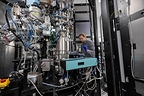
Now Biohub and UC Berkeley researchers have each built a laser phase plate, installed in custom versions of the Thermo Scientific Krios microscope, and demonstrated strong contrast improvements in imaging of small proteins, as reported in two scientific papers. The entire optical cavity housing the laser phase plate — the heart of the system — is less than four inches wide, tucked inside microscopes that stand 14 feet tall.

The UC Berkeley paper, published online today in Science, demonstrates that the laser phase plate provides higher resolution for six different biological samples of different sizes and different sample preparation. Further, they showed that the smaller the sample, the greater the improvement. Specifically, the authors show reconstructed images of a protein from muscle called aldolase, which is relatively easy to image with conventional cryo-EM machines, and of hemoglobin — a protein that carries oxygen in blood — which is at the lower limit for current machines.

“With the more challenging of the two particles, hemoglobin, we saw a strong improvement with the laser, but with the less challenging one, aldolase, the improvement is very small, as expected,” said Jessie Zhang, a postdoc in Müller’s lab who is the co-first author of the study with postdoc Petar Petrov.

Müller, professor of physics at UC Berkeley, said that now that the advantages of the laser phase plate have been clearly demonstrated, he is excited about its potential to solve even more challenging bioimaging problems.

“If you look at all the proteins in a human, they all have various sizes. And all of these proteins are potential disease mechanisms and drug targets,” said Müller, corresponding author of the paper and also a faculty scientist at Lawrence Berkeley National Laboratory. “The problem is, the average human protein is too small to be imaged by cryo-EM. The laser phase plate could fill an enormous gap in our knowledge of protein structures that can’t be processed with today’s cryo-EM.”

Müller spent more than 10 years building a working prototype of the laser phase plate. Then in 2021 Biohub decided to make a big bet on the technology and supported him with a grant, which allowed him to ramp up development, purchase a state-of-the-art cryo-electron microscope, and customize it for the laser phase plate.

In addition to supporting Müller’s efforts, Biohub made an even bigger bet, building a next-generation version of the laser phase plate with twice the complexity, featuring a dual laser system. That system is described in a new preprint on biorxiv.org.

Developed at Biohub’s imaging lab in Redwood City, in collaboration with UC Berkeley and industry partners, the device uses two laser beams oriented perpendicular to each other, each in its own cavity and operating at about half the power required by the single-cavity system used in Müller’s microscope. At lower power, components are less likely to burn and aberrations are reduced, making the system easier to operate.

The concept of a dual laser system was first proposed by Müller and UC Berkeley colleagues two years ago in a paper that was just published last week in Nature Communications.

An engineering feat — and a long time coming

More than a decade ago, Müller and Glaeser first proposed the idea of creating an intense laser to shift the phase of the electron beam in cryo-electron microscopes, but many in the field considered such an instrument far too difficult to build.

Making the laser phase plate a reality required an extraordinary combination of precision, advanced engineering, and complex laser optics to generate the most intense steady-state laser ever. Inside the cavity, a laser beam is bounced back and forth between two concave mirrors almost 10,000 times, building up to an intensity of approximately 350 to 400 gigawatts per square centimeter — an energy 100 million times more intense than the surface of the Sun, concentrated into a spot about 1/1000th the width of a human hair.

The mirrors that make this possible are themselves a remarkable feat of engineering. Each mirror must be polished to “atomic-level smoothness” — a surface roughness of less than one angstrom, approximately the diameter of a single atom.

“The mirrors must be extremely lossless to prevent them from melting, and in fact are so lossless that they barely warm up, despite being bombarded by a laser that could easily cut inches of steel,” Müller said.

The precision required to operate the instrument is equally demanding. The angle of the mirrors must be aligned to within 1/1000th of a degree for the lasers to bounce effectively. Additionally, the laser beam and electron beam must be aligned to within 50 nanometers — on a standing wave that is 500 nanometers across — to maximize contrast while acquiring data.

“It’s like a surfer trying to hold perfectly to the peak of a wave, not for seconds, but for half an hour at a stretch,” said Bridget Carragher, Founding Technical Director of Imaging at Biohub. She and Agard are co-leads of Biohub’s Dynamic Structural Cell Biology group and co-corresponding authors of the Biohub preprint, along with Biohub engineer Pavel Olshin.

The next frontier

While the papers demonstrate the device’s power for imaging individual small proteins, researchers at both institutions believe the next frontier is cryo-electron tomography (cryo-ET) — a powerful newer variant of cryo-EM that captures proteins not in isolation but in their natural cellular environment, revealing how molecular machines actually assemble, interact, and malfunction in disease.

“We believe tomography is where we’ll see the really huge wins for cell biology,” Carragher said. “There’s still work to be done in wrangling the microscope, but we’re optimistic we’ll be doing data collection by the end of the year.”

All of Biohub’s tomography data – including tens of thousands of annotated tomograms – is freely shared with the community at its CryoET Data Portal, which aims to accelerate the entire cryo-ET pipeline.

“Doing a cell biology experiment with cryo-ET today can take up a postdoc’s entire career,” Agard said. “We need to speed that up, and the laser phase plate, along with better processing, all working seamlessly with AI algorithms, will get us there.”

Müller hopes that microscopes fitted with laser phase plates will be commercially available in the coming years, and that labs around the world will have this powerful technology in regular use.

“This technology is a step function change for biology,” said Stephani Otte, Biohub’s Vice President of Imaging Science. “We are going to be able to see how molecular machines operate inside the living cell, in context, for the first time. What was once invisible will become visible — and that changes everything about how we understand disease.”

About Biohub

Biohub is a 501(c)(3) biomedical research organization building the first large-scale initiative to combine frontier AI and frontier biology to solve disease. With its compute capacity, AI research and engineering, and state-of-the-art technology for measuring, imaging, and programming biology, Biohub is enabling scientists worldwide to use AI-powered biology to study how cells operate and organize as systems — ultimately understanding why disease happens and how to cure or prevent it. Learn more at biohub.org.

About UC Berkeley

Founded in 1868, UC Berkeley is the world’s No. 1 public university, with 63 Nobel laureates and 50 graduate programs ranked in the nation’s top 10. Berkeley researchers advance fundamental science while addressing society’s greatest challenges — from artificial intelligence to climate change to human health. The university enrolls nearly 46,000 students, with 28% of undergraduates receiving federal Pell Grants, reflecting its commitment to access. Learn more at berkeley.edu.

View original content to download multimedia:https://www.prnewswire.com/news-releases/making-the-invisible-visible-microscope-breakthrough-will-open-unprecedented-view-into-our-cells-302798374.html

SOURCE Biohub

Continue Reading
Click to comment

Leave a Reply

Your email address will not be published. Required fields are marked *

Technology

More than 60% of Pix Automático users are brand-new subscribers to digital platforms, EBANX data shows

Published

on

By

One year after its launch, Pix Automático has become a key solution for recurring payments in Brazil, with EBANX accounting for 38% of all transactions made through the feature

CURITIBA, Brazil, June 12, 2026 /PRNewswire/ — Ahead of its first anniversary on June 16, Pix Automático—the recurring billing feature of Pix, Brazil’s widely popular instant payment system—has become a key driver of new customer acquisition for global companies with subscription business models operating in the country. New operational data from EBANX, a global technology company specializing in payment services for emerging markets, reveal that 64% of consumers paying with Pix Automático are new users within these digital platforms. For the 60 million Brazilians who lack access to credit cards, according to the country’s Central Bank, the feature is unlocking access to the global digital economy.

EBANX has supported Pix Automático since the feature’s launch. Amazon Prime, with more than 200 million paid members worldwide, is one of the merchants offering the solution in Brazil through EBANX. Prime members in the country can enjoy fast, free shipping, exclusive deals, Prime Video, Amazon Music, and other services, and are able to subscribe using a variety of methods, including Pix Automático, credit and debit cards, ensuring accessibility regardless of their preferred payment option.

Canva, Hotmart, and Nord Security are also among the merchants offering Pix Automático through EBANX. In addition, payment infrastructure providers such as Stripe, Spreedly, and Zuora have partnered with EBANX to enable more international companies to seamlessly access Brazil’s recurring billing market via the Pix feature.

EBANX’s operational data from the first year of Pix Automático reinforces the feature’s strong growth trajectory. Active enrollments grew at an average monthly rate of 177% since June 2025, while transaction total value grew by 53% per month and the number of transactions 161%. EBANX currently processes 38% of all Pix Automático transactions in Brazil.

“One year in, Pix Automático has already delivered one of its most important projections: bringing new consumers into the digital subscription economy,” said Eduardo de Abreu, CPO of EBANX and CEO of EBANX Singapore. “The 64% new-user rate reflects a population that was always willing to subscribe, but never had the right tool to do so,” he added.

The arrival of this new consumer base also brings new payment habits to subscription-based businesses. “We are talking about new users, who might bring new behaviors, and demand new approaches. These differences come alongside an opportunity that simply did not exist before. If only cards were offered, many of these consumers would have never converted in the first place,” said Abreu.

The potential of recurring alternative payment methods (APMs) extends beyond Brazil. Across emerging markets in Asia, Africa, and Latin America, over 1.3 billion adults lack access to credit or debit cards, relying on local APMs to access streaming, SaaS, gaming, and other subscription-based platforms.

EBANX has expanded its recurring APM offering across 12 emerging markets, unlocking a potential base of over 1 billion users for global merchants. Pix Automático is at the forefront of this wave in Latin America, a proof of concept that recurring payments built on local payment rails can work at scale.

Who is using Pix Automático

Brazil’s Central Bank data analyzed by EBANX shows that nearly 4 in 5 Pix Automático transactions are made by users aged 30 and above, with the 40-to-49 age group leading adoption at 24%. “Pix Automático is being embraced by consumers with established purchasing power and longer subscription lifespans, a profile that holds huge potential for merchants,” said Abreu.

Another finding from Pix Automático’s first year of operation relates to its adoption by businesses. While business-to-business (B2B) transactions accounted for less than 5% of all Pix Automático payments, they represented nearly 90% of the financial volume processed through the system. B2B transactions also recorded an average ticket size of approximately USD 3,200, underscoring the feature’s growing role in facilitating high-value recurring commercial payments.

ABOUT EBANX

EBANX is the leading payments platform connecting global businesses to the world’s fastest-growing digital markets. Founded in 2012 in Brazil, EBANX was built with a mission to expand access to international digital commerce. Leveraging proprietary technology, deep market expertise, and robust infrastructure, EBANX enables global companies to offer hundreds of local payment methods across Latin America, Africa, and Asia. More than just payments, EBANX drives growth, enhances sales, and delivers seamless purchase experiences for businesses and end-users alike.

For further information, please visit:

Website: https://www.ebanx.com/en/   
LinkedIn: https://www.linkedin.com/company/ebanx

Media Contact:
Shan Huang
shan.huang@ahgstrategies.com

View original content to download multimedia:https://www.prnewswire.com/apac/news-releases/more-than-60-of-pix-automatico-users-are-brand-new-subscribers-to-digital-platforms-ebanx-data-shows-302797489.html

SOURCE EBANX

Continue Reading

Technology

Bedsure Brings Summer Sleep Solutions to Amazon Prime Day UK

Published

on

By

Save on cooling bedding and everyday comfort essentials from 23–26 June.

LONDON, June 12, 2026 /PRNewswire/ — Bedsure, a leading online bedding brand trusted by millions of customers worldwide, is bringing a selection of cooling and comfort-focused bedding essentials to Amazon Prime Day UK, offering savings from 23–26 June.

With warmer weather making restful sleep more challenging, Bedsure’s Prime Day collection features lightweight, breathable bedding designed to help sleepers stay cool and comfortable throughout the summer.

Featured Amazon Prime Day offerings include:

Bedsure Cooling Blanket – up to 15% off – A lightweight blanket with instant cool-touch fabric and breathable construction for comfortable summer sleep.Bedsure Cooling Comforter – up to 20% off – This Amazon’s Choice cooling duvet features dual-sided cool-touch fabric, moisture-wicking performance and OEKO-TEX-certified materials.Bedsure Rayon Derived from Bamboo Duvet Cover Set – up to 20% off – Made from 100% rayon derived from bamboo, this Amazon’s Choice set offers breathable, cool-to-the-touch comfort for warmer nights.Bedsure 100% Cotton Muslin Throw Blanket – up to 20% off – A lightweight four-layer muslin throw crafted from 100% cotton for breathable comfort and versatile summer layering.Bedsure GentleSoft™ Fleece Throw Blanket – up to 33% off – An ultra-soft fleece throw that combines lightweight warmth with cosy everyday comfort.

Prime Day offers will be available from 23–26 June through the Bedsure Amazon UK store, while stocks last.

About Bedsure

At Bedsure, “Get Cozy” is more than just a slogan—it is at the core of everything we do. We believe cozy is not only a sensation felt through touch, but a series of everyday experiences that enhance the comfort and beauty of home. Rooted in nearly five decades of textile craftsmanship, Bedsure continues to innovate through continuous improvement, verifiable quality standards, and durable product design—making high-quality cozy living more accessible. We are committed to delivering products that go beyond expectations, improving everyday living experiences, and helping every home truly Get Cozy. For more information, visit Bedsure’s official website at bedsurehome.co.uk or the Bedsure Amazon UK Store. Follow @bedsurehome on social media for the latest updates.

Photo – https://mma.prnewswire.com/media/2996210/prime_day_UK.jpg

View original content:https://www.prnewswire.co.uk/news-releases/bedsure-brings-summer-sleep-solutions-to-amazon-prime-day-uk-302795085.html

Continue Reading

Technology

ANBC Brings Brazilian Expertise in Innovation, Trust, and Data Usage to International Credit Industry Conferences in the Philippines

Published

on

By

Association to participate in panels at the ICCR APRCG Meeting and BIIA Conference 2026, contributing to global industry discussions

MANILA, Philippines, June 12, 2026 /PRNewswire/ — The National Association of Credit Bureaus (ANBC) will take part in a series of strategic discussions during the ICCR Asia Pacific Regional Consultative Group (APRCG) Meeting and the BIIA Conference 2026, taking place on June 17–19th at the Grand Hyatt Manila, Philippines.

Representing the association, ANBC President Elias Sfeir will join panels bringing together industry experts, regulators, and credit information leaders from around the world to discuss how technology and trust can drive innovation and positively shape the future of credit reporting.

On June 17th, during the ICCR APRCG Meeting, Sfeir will participate in the panel “Development of Trusted Credit Reporting Systems – Ensuring Data Accuracy,” focused on building trusted credit reporting systems and strengthening data quality and accuracy.

As part of the BIIA Conference agenda on June 18th, ANBC will also participate in the session “Analytics in the Age of Technology – The New Era of Applied Intelligence,” exploring how emerging technologies, artificial intelligence, and advances in analytics are creating value for consumers, businesses, and financial markets.

Sfeir will then join the session “Ensuring Data Governance and Regulatory Compliance – The Regulatory Landscape and How to Ensure Data Trust with Regulators,” which will address regulatory challenges and best practices for leveraging technology to promote transparency, security, and trust in data usage.

ANBC’s participation highlights the growing role of Brazil and Latin America in developing innovative solutions for the credit ecosystem. In a rapidly evolving digital landscape, discussions will focus on how technology continues to strengthen trust-based relationships, placing data quality, AI models, responsible use of data, and human expertise at the core of sustainable growth in credit information markets.

“Participating in discussions across Asia provides valuable insights into markets where implementation speed and socioeconomic development are rapidly translated into practical solutions that can later be shared with local markets. At the same time, showcasing Brazil’s advancements within the global financial ecosystem reinforces the country’s leadership in adopting technology with trust and responsibility,” concludes Sfeir.

View original content:https://www.prnewswire.com/apac/news-releases/anbc-brings-brazilian-expertise-in-innovation-trust-and-data-usage-to-international-credit-industry-conferences-in-the-philippines-302796831.html

SOURCE ANBC

Continue Reading

Trending