Connect with us

Technology

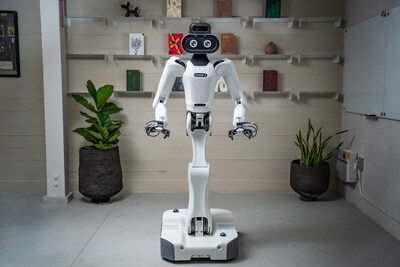
Robot.com Launches R-noid, a Humanoid Built For the Work That Burns People Out. No Legs, All Lift to the Bottom Line.

Published

on

Five solution categories. Nineteen deployable tasks. One platform that goes from initial site visit to autonomous operation in months — ready to show its work at Automate 2026.

SAN FRANCISCO, June 22, 2026 /PRNewswire/ — Robot.com®, the company putting robots to work in the real world, today announces its entry into humanoid labor solutions with the commercial launch of R-noid™, a robot purpose-built for the repetitive, multi-shift, and hard-to-staff jobs. Deployed under a Robot-as-a-Service (RaaS) model, Robot.com can go from the first visit of a customer’s site to autonomous on-site R-noid operation in as few as eight to twelve weeks.

The R-noid launch commences with five initial solution categories — Restaurant Assistant, Packer, Picker, Folder, and Host — deployed across six industry verticals, including industrial, logistics, healthcare, food services, lodging, and experiential. These solutions target the roles operators chronically struggle to fill.

Robot.com will showcase R-noid alongside its proven R-kiwi™, R-kiwi+™, and R-cargo™ solutions at Automate 2026 in Chicago from June 22–25 at Booth 1592 in the Humanoid Pavilion.

The problem R-noid fills is structural and pervasive. Quick-service restaurants experience staff turnover upwards of 130%. Warehouse picker tenure averages just 1.2 years. More than 67% of hotel operators report critical staffing gaps in both housekeeping and laundry. These staffing shortfalls put customer experience at risk as the jobs simply don’t stay filled. R-noid never resigns.

“The future of work isn’t fewer people. It’s people freed from the parts of the job that grind them down, doing more of what they’re good at,” said Felipe Chavez Cortes, CEO and Co-Founder. “We build the robots that make that trade real, taking the repetitive physical work off your team so they can focus on craft, care, and the customer.”

Launching with support from NVIDIA Robotics, Astribot, FieldAI, Formic, Physical Intelligence, Robots for America, and Yukai Engineering, R-noid brings humanoid labor solutions to Robot.com’s broader fleet — R-kiwi for delivery, R-cargo for transport, and R-kiwi+ for advertising — all running on the same software stack and five-phase engagement model.

Robot.com is working with FieldAI to bring its general-purpose Field Foundation Models (FFMs) to R-noid as the autonomy brain. FFMs serve as an operational AI layer that generalizes across robots and environments and serves three roles: enabling safe and reliable operations in dynamic, real-world spaces without prior information or supporting infrastructure; preventing model hallucinations through physics-grounded AI models; and coordinating multiple robots working together.

The body that work runs on is built for reach and stability: dual 7-degree-of-freedom (DoF) arms, a 4-DoF articulated torso with 0 to 1.9m of vertical reach, and a holonomic mobile base that lets R-noid reposition in tight, busy spaces.

For the robot’s design language and character, Robot.com partnered with Yukai Engineering, a Japanese studio known for emotionally expressive consumer robots. Yukai advised on materials, manufacturing, and interaction design, and the collaboration produced R-soul, the expression and behavior system designed to earn people’s trust in seconds. It’s a goal Robot.com has pursued since 2017: building robots that open people’s hearts and minds to the future of technology. R-soul lets the robot communicate intent, status, and personality.

The dexterity comes from Physical Intelligence. R-noid runs on π0.7, Physical Intelligence’s vision-language-action model built for generalist manipulation. It reads a natural-language instruction, looks at the scene in front of it, and produces the arm and hand movements to carry out the task, adapting as objects, layout, and order change. One model spans packing, picking, and folding, so adding a task means extending the same system rather than engineering a new robot for each job.

At launch, R-noid can perform 19 deployable tasks across five categories. Lighthouse deployments are already underway, demonstrating the new humanoids’ speed-to-impact on business performance. The R-noid Packer is live at an award-winning golf course, handling on-site order packing operations. The Packer category is also moving toward production at a major food manufacturing facility, with early results validating R-noid’s end-of-line capabilities at scale. The Picker is designed to integrate directly into existing pick ports across logistics operations, with no facility retrofit required. Formic serves as Robot.com’s deployment partner for humanoid solutions, helping customers pilot, deploy, and scale automation in production environments.

“Our answer to ‘how long will this take?’ is weeks, not years,” said David Rodriguez, Co-Founder of Robot.com. “With thoughtful hardware design, best-in-class software, and our proven platform, we can have a robot doing real work in your facility within weeks of the first conversation. No other humanoid platform can make that claim.”

Robot.com’s fleet is built on NVIDIA’s full robotics stack; the robots run on NVIDIA Jetson modules, which power the robot’s perception, planning, and control stack on-device — delivering the low-latency inference real-world operations demand. Across its development cycle, Robot.com uses NVIDIA Isaac Sim to simulate, validate, and stress-test each robot before deployment, ensuring reliability before any unit touches a customer floor.

In addition to its Automate debut, R-noid will be among the featured players in Robot.com’s first appearance at Cannes Lions, where the company is the official Robotics Innovation Partner for PMG’s AI & Tech Sandbox.

For demos, media availability, or to book time at Automate, contact robot@thekeypr.com.

About Robot.com
Robot.com Holdings Inc., doing business as Robot.com®, is a pioneer in practical robotics solutions powered by advanced AI. The company operates a dual-engine business: Robotic Services, delivering Level 4 autonomous robots for campus delivery, warehouse logistics, and inspection; and Robot.com Media, a national OOH advertising platform powered by its mobile robot fleet. With more than 500 robots deployed across the United States, Canada, Dubai, and MENA, and completing over 2.5 million tasks, Robot.com operates at enterprise scale every day in real environments. Founded in 2017 and headquartered in San Francisco with offices in Colombia, Robot.com partners with enterprise operators, including Sodexo, to solve workforce and logistics challenges today. Robot.com is a founding member of Robots for America, a national coalition advancing the adoption of robotics and American industrial competitiveness.

Forward Looking Statements
This press release contains certain forward-looking statements within the meaning of the Private Securities Litigation Reform Act, as amended, including those relating to certain industry metrics, Company performance metrics and other statements that are predictive in nature. These statements relate to future events, future expectations, plans and prospects. These statements may be identified by the use of forward-looking expressions, including, but not limited to, “expect,” “anticipate,” “intend,” “plan,” “believe,” “estimate,” “potential,” “predict,” “project,” “should,” “would” and similar expressions and the negatives of those terms. Although the Company believes that the expectations reflected in such forward-looking statements are reasonable as of the date made, actual results or outcomes may prove to be materially different from the expectations expressed or implied by such forward-looking statements. Meaningful factors that could cause actual results to differ include, but are not limited to, whether we will have adequate financial resources to enable us to pursue our business successfully, given that we will likely need more financial resources than the additional resources. These statements are only predictions and involve known and unknown risks, uncertainties, and other factors. The Company does not undertake any obligation to release publicly any revisions to forward-looking statements as a result of subsequent events or developments, except as required by law.

Media Contact:
robot@thekeypr.com 

For Investors:
Matt Kreps
Darrow Associates
+1-214-597-8200
mkreps@darrowir.com

View original content to download multimedia:https://www.prnewswire.com/news-releases/robotcom-launches-r-noid-a-humanoid-built-for-the-work-that-burns-people-out-no-legs-all-lift-to-the-bottom-line-302806619.html

SOURCE Robot.com

Continue Reading
Click to comment

Leave a Reply

Your email address will not be published. Required fields are marked *

Technology

IR announces Iris for Card Payments: AI-powered observability that sees transactions end-to-end

Published

on

By

SYDNEY, June 22, 2026 /PRNewswire/ — Leading global observability software provider Integrated Research (“IR”) today announced Iris for Card Payments, the AI‑powered assistant designed to help payments teams detect issues earlier, understand their impact faster, and act before revenue and customer trust are at risk.

As card payments environments grow in scale and complexity, issues can cascade in minutes. Transaction volumes spike, dependencies multiply, and even highly experienced teams can struggle to correlate schemes, response codes, flows, and performance metrics in real-time. AI-powered observability can unlock faster, deeper insight for payments teams at precisely the moment when clarity matters most.

Via natural language prompts, Iris for Card Payments delivers real-time card payments insights, and is built on IR’s core observability platform Prognosis which monitors over 80 billion transactions each year for some of the world’s largest banks and financial institutions.

Iris: AI that truly understands card payments

Extra pair of Expert Eyes: Iris makes deep card payments expertise instantly accessible, reducing reliance on scarce specialists and building confidence 24/7.Purpose-built with context-aware insights: Iris understands card payments end-to-end, with built-in IR correlation logic to explain why something happened, not just what.Natural-language queries: Clear answers about transaction declines, approvals, volumes and performance – no syntax or dashboard stitching required.

Iris for Card Payments is available from May 2026 in Beta to customers globally as part of the release of Prognosis 13.3. Future releases will extend Iris to High Value Payments and Real‑Time Payments domains.

For more information or to request a demo, visit the website.

About IR
At IR, we power elite business performance. Trusted by the world’s largest organizations for more than 30 years, our market-leading observability solutions are powered by Prognosis – the real-time intelligence platform built for multi-vendor infrastructure, UC&CX and payments environments. To find out more, visit www.ir.com.

View original content to download multimedia:https://www.prnewswire.com/news-releases/ir-announces-iris-for-card-payments-ai-powered-observability-that-sees-transactions-end-to-end-302804079.html

SOURCE Integrated Research (IR)

Continue Reading

Technology

Montana-Dakota Utilities Announces Electric Service Agreement with Applied Digital for Proposed AI Factory

Published

on

By

BISMARCK, N.D., June 22, 2026 /PRNewswire/ — MDU Resources Group, Inc.’s (NYSE: MDU) subsidiary, Montana-Dakota Utilities Co., has entered into an electric service agreement (ESA) with Applied Digital Corporation (NASDAQ: APLD) to provide power to Polaris Forge 3, an AI Factory near Center, North Dakota.

At full capacity, the campus would require 430 megawatts of electricity. Under the ESA, Applied Digital would be responsible for the costs of purchasing the energy directly from the market or through other power supply arrangements. Applied Digital anticipates initial operations to commence in August 2027.

Polaris Forge 3 will expand Applied Digital’s footprint in North Dakota, where the company is developing purpose-built campuses designed to support high-density artificial intelligence workloads. Applied Digital has previously announced a 15-year lease with a U.S. based high investment-grade hyperscaler for this site.

“Polaris Forge 3 is another example of how Applied Digital is turning power into operational AI capacity through disciplined execution and long-term partnerships,” said Wes Cummins, Chairman and CEO of Applied Digital. “This campus is expected to create approximately 200 full-time jobs, generate meaningful property tax revenue and support long-term growth across Oliver County and the surrounding region. We believe AI infrastructure should create value well beyond the campus, and we’re proud to continue building in North Dakota.”

Montana-Dakota Utilities currently serves Applied Digital at Polaris Forge 1, its AI Factory near Ellendale, North Dakota, where the companies have worked together to integrate significant power demand while maintaining reliable, cost-effective service for customers, crediting $38.4 million back to North Dakota customers over the past three years.

“This proposed project reflects the growing interest in North Dakota as a location for large energy users,” said Nicole Kivisto, president and CEO of MDU Resources. “We are committed to serving these customers in a way that benefits our communities, supports the regional grid and delivers value to our customers.”

Approval of the ESA and other regulatory filings by the North Dakota Public Service Commission is required for the company to provide power under the agreement with Applied Digital.

About MDU Resources Group, Inc.
MDU Resources Group, Inc., a member of the S&P SmallCap 600 index, strives to deliver safe, reliable, cost-effective and environmentally responsible electric utility and natural gas distribution services to more than 1.2 million customers across the Pacific Northwest and Midwest. In addition to its utility operations, the company’s pipeline business operates a more than 3,800-mile natural gas pipeline network and storage system, ensuring reliable energy delivery across the Northern Plains. With a legacy spanning over a century, MDU Resources remains focused on energizing lives for a better tomorrow. For more information about MDU Resources, visit www.mdu.com or contact the investor relations department at investor@mduresources.com.

About Applied Digital Corporation
Applied Digital (Nasdaq: APLD) named Best Data Center in the Americas 2025 by Datacloud — designs, builds, and operates high-performance, sustainably engineered data centers and colocation services for artificial intelligence, cloud, networking, and blockchain workloads. Headquartered in Dallas, TX, and founded in 2021, the company combines hyperscale expertise, proprietary waterless cooling, and rapid deployment capabilities to deliver secure, scalable compute at industry-leading speed and efficiency, while creating economic opportunities in underserved communities through its award-winning Polaris Forge AI Factory model. Learn more at applieddigital.com or follow @APLDdigital on X and LinkedIn.

Investor Contact: Brent Miller, treasurer, 701-530-1730

Media Contacts:

MDU Resources: Byron Pfordte, director of integrated communications, 208-377-6050

Montana-Dakota Utilities: Jamie Tescher, senior public relations representative, 701-204-8274

Applied Digital: JSA (Jaymie Scotto & Associates), jsa_applied@jsa.net, 856-264-7827


View original content to download multimedia:https://www.prnewswire.com/news-releases/montana-dakota-utilities-announces-electric-service-agreement-with-applied-digital-for-proposed-ai-factory-302806791.html

SOURCE MDU Resources Group, Inc.

Continue Reading

Technology

Florida International University researchers reveal how altered images can bypass AI safeguards

Published

on

By

MIAMI, June 22, 2026 /PRNewswire/ — It may look like a picture of a panda bear to you, but to your business’s AI agent, it can act like a skeleton key, bypassing safety safeguards and potentially causing the model to generate harmful, misleading or policy-violating outputs.

That risk is the focus of new research from Hadi Amini, associate professor at Florida International University’s Knight Foundation School of Computing and Information Sciences. Together with graduate assistant Md Jueal Mia, he is studying how manipulated images can “jailbreak” certain AI systems, pushing them beyond their built-in safeguards.  

“AI models don’t see images the same way humans do,” Amini said. “They see patterns of numbers and pixels. By carefully manipulating those pixels, we can influence how the AI interprets the image and responds.” 

The team’s research demonstrated how small-language AI models – the kind frequently employed by small businesses to execute routine tasks like accounting or customer service – have become particularly susceptible to image-based hacks. As shown in research presented at the 2025 International Conference on Machine Learning and Applications (ICMLA), the team found that by introducing microscopic pixel-level changes called “perturbations” into an image, they could trick these AI systems into generating responses that they would normally block.  

“The manipulated image is like the face of a stranger,” Amini said. “The AI has to learn when a request should be treated with caution before it answers. In order to protect AI systems from attacks, we try to break them ourselves, identify potential vulnerabilities and design defense mechanisms.” 

The researchers then set out to probe the system’s defenses. The more successfully they penetrated the models’ guardrails, the more the systems could be trained to resist future threats. To do this, Amini and his team developed a method called JaiLIP (Jailbreaking with Loss-guided Image Perturbation), which uses an algorithm to determine the optimal degree of pixel-level manipulation.

In tests using BLIP-2, a multimodal AI model used by researchers and developers, Amini and his team found that images modified with JaiLIP significantly increased the likelihood that the system would generate harmful or unsafe responses. In one example, a JaiLIP-altered version of a stoplight tricked the AI model into divulging detailed instructions on how to run the light while avoiding a traffic ticket. Overall, the use of JaiLIP images nearly doubled the number of harmful responses generated by AI models. 

The risk extends beyond users simply prompting AI systems for instructions on illegal activity. As businesses increasingly adopt AI-powered customer service agents, chatbots and automated workflows, vulnerabilities in open-source or lightly protected systems could negatively impact users’ trust or create new avenues for cyberattacks.

“Small businesses and companies can benefit from AI to enhance their efficiency, but they have to be aware of the potential vulnerabilities,” Amini said. “They must make sure they’re deploying sufficient guardrails to maintain the safety and integrity of their AI tools.” 

Amini said there are some basic precautions that everyone should use before integrating AI into their business or workplace, including limiting the sensitive information they provide to AI systems (especially images), restricting who can access those systems and carefully evaluating the security measures built into AI tools before deployment.  

Because safety is paramount, Amini and his team are working to stay one step ahead of potential bad actors in the AI sphere. The more vulnerabilities he and his team can find, the quicker the AI will learn to repair them. The challenge, he said, is ensuring that AI can recognize threats hidden in plain sight — even when humans cannot. 

Photos and videos of Amini’s AI research, including interviews and b-roll, are available for media use via Dropbox

Media Contact:
Brian Zimmerman
305-348-8448
bzimmerm@fiu.edu 
news.fiu.edu
@FIU

View original content to download multimedia:https://www.prnewswire.com/news-releases/florida-international-university-researchers-reveal-how-altered-images-can-bypass-ai-safeguards-302806851.html

SOURCE Florida International University

Continue Reading

Trending