Connect with us

Technology

OnLocation’s U.S. Energy Horizons to 2050 Release: Reference and Advanced Technologies Scenarios for the U.S. Energy Sector

Published

on

VIENNA, Va., June 26, 2024 /PRNewswire/ — The U.S. energy system will continue a significant transition through 2050, driven by new technologies, policies, and consumer choices. These will result in new market dynamics, industry challenges, and changes in energy-related greenhouse gas emissions. OnLocation, a KeyLogic company, produced the U.S. Energy Horizons to 2050 report to explore these issues using its enhanced version of the National Energy Modeling System (OL-NEMS). The Horizons report provides Reference and Advanced Technologies scenarios to illustrate the impacts of clean technology innovation and enabling policies that could lead to deeper decarbonization. OnLocation’s release webinar is on Thursday, June 27 at 2 p.m. (EST).

What is the OnLocation U.S. Energy Horizons to 2050 Report (OL EH)?
OL EH provides a view of the U.S. energy system through 2050 and may be used by various stakeholders to inform policy decisions. If specific actions are taken, it projects potential future effects on energy supply and demand. OL EH considers the impact of existing and potential policies and technologies affecting energy-related greenhouse gas emissions.

OL EH is a series of modeled projections under different sets of consistent input assumptions. Although many input assumptions (e.g., prices, technology development, economic growth, geopolitical developments) are uncertain long-term, OnLocation uses the best judgment of its energy experts, informed by historical trends and expected future changes, to develop quantitative central pathways for model input assumptions. These central pathways produce the OL EH Reference scenario and may be adjusted in sensitivity scenarios to illustrate the impacts of parameter uncertainty on the energy system.

The OL EH Reference scenario serves as a baseline against which policy action may be compared. It assumes current laws and regulations continue throughout the projection period, which allows proposed policy actions or technology improvements to be modeled as a sensitivity scenario. The impact of the OL EH Advanced Technologies scenario is estimated by comparing scenario results with the Reference scenario.

Why is OnLocation Releasing OL EH?
That fact that the energy system is undergoing and will continue rapid and complex change is neither a singular nor recent phenomenon. To assist policymaking in this dynamic environment, the U.S. Energy Information Administration (EIA) routinely captures the existing state of knowledge about the U.S. energy system in its Annual Energy Outlook (AEO). Citing the need for more time to incorporate new features to the underlying NEMS model to reflect recent energy system changes, EIA announced they would not release an AEO for 2024. This is the first year since the early 1980’s that EIA did not produce an AEO.

OnLocation decided to produce the OL EH this year to benefit the energy & climate modeling community. Over its 40-year history, OnLocation has worked with EIA to build and maintain parts of NEMS, the energy-economy model used to produce AEOs. OnLocation developed its own version of the model, OL-NEMS, based on AEO 2023, including new features and policy updates to address energy system issues and CO2 mitigation strategies important to OnLocation’s clients. OL EH brings together the best of OnLocation’s energy system expertise in a modeling framework familiar to users of the AEO.

How Did OnLocation Develop the OL EH?
OL-NEMS is based on AEO 2023. OnLocation updated this model with publicly available data, policy updates, and new capabilities, making OL EH markedly different from EIA’s AEO 2023. OnLocation is solely responsible for OL EH assumptions and results.

A full report will include a full list of OL-NEMS model updates and OL EH scenario assumptions. Key updates include:

Hydrogen production, storage, and trade (including low-carbon hydrogen sources).Improved representation of carbon capture and sequestration (CCS) and carbon markets.Other CO2 mitigation technologies such as direct air capture (DAC) and sustainable aviation fuel.Updated regulations including new EPA greenhouse gas standards for power plants and vehicles.Greater data center electricity demand growth in the commercial sector.Lower cost assumptions for renewables, carbon capture, and electric vehicles.

How Does OL EH Compare to AEO 2023?
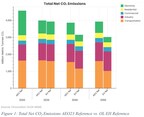
Our key modifications lead to greater CO2 reductions in most energy sectors by 2050 compared to AEO 2023, especially in the power and transportation sectors, as shown in Figure 1. These reductions are due to a more rapid phase-out of conventional fossil fuels in favor of clean energy sources such as renewable energy and electric vehicles in EH Ref compared to AEO.

What the EH Scenarios Reveal
While Reference scenario CO2 emissions decline over time, net emissions in the Advanced Tech scenario are much lower than the Reference scenario (Figure 2).

An important contributor to these reductions is that the power sector achieves net zero CO2 by 2040 with a combination of new renewables, battery storage, and CO2 capture including bioenergy with carbon capture (BECCS). Some other sectoral emissions are offset by net negative emissions from both DAC and BECCS in industry, biofuels, and hydrogen production.

Conclusion
OL EH is accessible to organizations aiming to explore potential future projections of the U.S. energy system more effectively and identify strategies for influencing its direction. Additional OnLocation reports on Data Center (AI & Cryptocurrency) Energy Demands, Employment Impacts of the U.S. Energy Transition, and Critical Materials Demands of the U.S. Energy Sector are planned for later this year.

OnLocation helps public and private groups apply quantitative tools to assess structural and regulatory challenges facing the U.S. energy system. For more information or to book a free consultation, please visit our website or email contact@onlocationinc.com.

View original content to download multimedia:https://www.prnewswire.com/news-releases/onlocations-us-energy-horizons-to-2050-release-reference-and-advanced-technologies-scenarios-for-the-us-energy-sector-302183798.html

SOURCE Keylogic

Continue Reading
Click to comment

Leave a Reply

Your email address will not be published. Required fields are marked *

Technology

The Building & Furniture Category Highlights Sustainable and Human‑Centric Design at the 139th Canton Fair

Published

on

By

GUANGZHOU, China, April 26, 2026 /PRNewswire/ — Phase 2 of the 139th Canton Fair has seen the Building & Furniture category emphasize green Infrastructure and human-centric design.

A major highlight of the building and decorative materials section is the introduction of photovoltaic marble-textured cladding. This innovative surfacing material bridges the gap between high-end aesthetics and renewable energy. Unlike traditional solar panels that rely on glass, this non-opaque cladding uses precise microscopic structures to guide light to internal PV cells.

This technology offers 60% higher efficiency than traditional transparent solar systems while reducing carbon emissions by over 50%. Its ability to reproduce stone, wood, or brick‑like 3D textures allows architects to integrate power generation into a wide range of building styles without the industrial appearance of traditional solar panels.

Indoor environments are also becoming smarter and safer. Manufacturers are showcasing high-efficiency antibacterial surfacing, utilizing visible light catalysis to provide 24-hour protection against mold and bacteria. These advanced decorative papers and panels are becoming the new standard for high-end interior decoration, prioritizing long-term hygiene in residential and commercial spaces.

The sanitary ware sector is increasingly focused on the aging global population and those with limited mobility. A standout innovation is the electric lift-and-rotate shower chair. Designed for the dry-wet separation bathroom layout, it allows users to sit in a dry area and be safely rotated and lifted into the shower via remote control. This waterproof, low-voltage system provides dignity and independence for the elderly while reducing the physical strain on caregivers.

Hygiene and ease of maintenance have also seen a breakthrough with wall-mounted toilets. By moving the lid connection to the tank wall and adopting a mortise‑and‑tenon structure, the design eliminates the hard‑to‑clean areas where bacteria typically accumulate. Many of these units also incorporate ergonomic grab bars directly into the frame, blending safety with a minimalist aesthetic.

In the sports and leisure industry, the shift toward sustainability is seen in non-infill synthetic turf. This next-generation football grass eliminates the need for rubber granules or sand, providing a natural touch and superior shock absorption while significantly reducing maintenance costs and microplastic pollution.

All these innovations demonstrate how the Building & Furniture sector is advancing toward greener materials, smarter functionality, and more human‑centered design, setting new benchmarks for the future of living spaces.

For pre-registration, please click: https://buyer.cantonfair.org.cn/register/buyer/email?source_type=16

Photo – https://mma.prnewswire.com/media/2965701/Image1.jpg

View original content:https://www.prnewswire.co.uk/news-releases/the-building–furniture-category-highlights-sustainable-and-humancentric-design-at-the-139th-canton-fair-302753654.html

Continue Reading

Technology

Nexteer’s Global First Steer-by-Wire Goes into Production

Published

on

By

BEIJING, April 26, 2026 /PRNewswire/ — Nexteer Automotive helped a leading Chinese new energy vehicle (NEV) manufacturer bring the world’s first production passenger vehicle with a full drive‑by‑wire chassis to market. The vehicle features Nexteer’s steer‑by‑wire (SbW) system as a key enabler.

The SbW featured in this vehicle marks Nexteer’s first SbW system in mass production, representing a major step forward for the technology — moving from development and validation to full-scale production. Certified in late 2025, this system achieved the world’s first ASIL D functional safety approval from DAkkS (German Accreditation Body) through close collaboration with the OEM. This certification reflects global top-tier performance in fault diagnosis, redundancy, and safety monitoring. Key features include:

Multi-layered redundancy design: Dual controllers, dual power supplies, multiple communication links, and dual actuation paths — achieving redundancy at system, hardware, and software levels. This ensures that in the event of a single fault, the backup path takes over within milliseconds with no loss of steering function.Full‑scenario functional safety mechanism: Multi‑level monitoring and fault handling strategies covering sensors, controllers, actuators, and communication links.Variable steering ratio: Automatically adjusts steering angle and effort based on vehicle speed and driving mode, balancing agility and comfort.Intuitive road‑feel simulation technology: Software‑defined steering feedback delivers a more responsive and precise driving experience, adaptable to a wide range of driving scenarios.Open interface for autonomous driving: As a key actuation layer for ADAS and autonomous driving systems, it provides real‑time, precise control capabilities, supporting the development of intelligent transportation systems.

Steer-by-Wire: Electronic Signals Replace Mechanical Links, Flexible Configurations for Diverse Needs

By decoupling the mechanical link between the hand wheel and the road wheels, steer-by-wire replaces conventional mechanical connections with electronic signals and actuators — and is quickly becoming a foundational technology for next-generation intelligent chassis and autonomous driving platforms. As a motion control technology company with 120 years of engineering heritage, Nexteer offers a flexible, off-the-shelf portfolio of steering feel simulators and road wheel actuators. This modular approach allows us to meet the diverse needs of different vehicle models and driving scenarios efficiently and cost-effectively.

From Steering to Braking: Expanding Full-Stack Motion Control Capabilities

Building on its deep expertise in steering systems, Nexteer has expanded into braking with its Brake-by-Wire solution, the Electro-Mechanical Brake (EMB). EMB has completed full development and rigorous validation and is ready for mass production. Together with SbW, Brake-by-Wire (EMB), Rear-Wheel Steering, and the MotionIQ™ Software Suite make up Nexteer’s broader Motion-by-Wire™ portfolio.

With Nexteer, OEMs get more than steer-by-wire and brake-by-wire components: they get a complete, proven, production-ready and cost-effective drive-by-wire chassis motion control solution that’s shaping the future of the software-defined chassis and enabling faster development, lower costs and safter, smarter and more exciting driving experiences.

During Auto China 2026, we cordially invite you to visit Nexteer at Booth W1B03, Hall W1, China International Exhibition Center (Shunyi) in Beijing, to experience firsthand the breakthrough innovations of steer-by-wire and Motion-by-Wire™ technologies.

ABOUT NEXTEER AUTOMOTIVE

Nexteer Automotive (HK 1316) is a global leading motion control technology company accelerating mobility to be safe, green and exciting. Our innovative portfolio supports Motion-by-Wire™ chassis control, including electric and hydraulic power steering systems, steer-by-wire and rear-wheel steering systems, steering columns and intermediate shafts, driveline systems, software solutions and brake-by-wire. Celebrating 120 years of automotive innovation in 2026, Nexteer builds on a strong legacy of engineering excellence while continuing to shape the future of mobility. The company solves motion control challenges across all megatrends – including electrification, software/connectivity, ADAS/automated driving and shared mobility – for global and domestic OEMs around the world including BMW, Ford, GM, RNM, Stellantis, Toyota and VW, as well as automakers in India and China including BYD, Xiaomi, ChangAn, Li Auto, Chery, Great Wall, Geely, Xpeng and others. www.nexteer.com  

Links to Nexteer Media Center

Logo – https://mma.prnewswire.com/media/2368187/5937537/nexteer_Logo.jpg

View original content:https://www.prnewswire.com/in/news-releases/nexteers-global-first-steer-by-wire-goes-into-production-302753641.html

Continue Reading

Technology

World IP Day 2026: PitchMark launches Ideas.Exchange to help creators safeguard and license ideas in the age of AI

Published

on

By

SINGAPORE, April 26, 2026 /PRNewswire/ — To mark World IP Day 2026, PitchMark® today launched Ideas.Exchange, a first‑of‑its‑kind platform designed to help creators assert intellectual property rights, license ideas, and formalise creative conversations in an increasingly AI‑driven economy.

Unveiled at Safeguard Your IP in the Age of AI, a media briefing hosted by CNBC’s Sri Jegarajah, the platform responds to growing concern that ideas are routinely used, reused or absorbed without attribution, consent or compensation—often with limited legal or commercial recourse.

“AI has amplified both the reach and the risk for creators,” said Mark Laudi, Managing Partner of PitchMark LLP. “Ideas.Exchange gives creators a way to protect themselves while still participating confidently in the market for ideas.”

At its core, the platform focuses on three interventions for creators:

Asserting IP rights by establishing proof of authorship and precedenceLicensing ideas without giving them away for freeFormalising conversations so pitches and evaluations are governed rather than informal

Ideas.Exchange is powered by three proprietary resources developed by PitchMark. These include a blockchain‑driven clearing house where ideas and creative works can be listed and licensed; smart contracts that automate usage terms and reduce disputes; and an IP Governance Certification Program designed to signal responsible handling of ideas, particularly in enterprise and AI contexts.

The result, PitchMark says, is three concrete outcomes: deterrence of idea theft, new ways to monetise ideas through structured licensing and price discovery, and a more level playing field that allows creators to pitch to clients and platforms on equal terms.

The launch comes amid renewed scrutiny of how intellectual property is treated in the AI era. While idea theft is rarely reported, its impact is significant. Beyond visible financial losses, organisations and creators often absorb hidden costs through talent attrition, innovation suppression and abandoned market opportunities.

“Most idea theft occurs informally and never reaches the courts,” said Prof David Llewelyn, Professor Emeritus of Law at Singapore Management University. “Introducing governance, traceability and standards is a meaningful step toward addressing that gap.”

Spokespeople including Prof Llewelyn, technology lawyer Bryan Ghows, and Mark Laudi are available for interview.

About PitchMark

PitchMark® deters idea theft and enables creatives to get paid by providing a trusted way to share and license ideas with prospects and clients.


View original content:https://www.prnewswire.com/apac/news-releases/world-ip-day-2026-pitchmark-launches-ideasexchange-to-help-creators-safeguard-and-license-ideas-in-the-age-of-ai-302753571.html

SOURCE PitchMark

Continue Reading

Trending