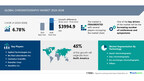
NEW YORK, Aug. 14, 2024 /PRNewswire/ — The global chromatography market size is estimated to grow by USD 3.99 billion from 2024-2028, according to Technavio. The market is estimated to grow at a CAGR of about 6.78% during the forecast period. Increasing number of conferences and symposiums is driving market growth, with a trend towards technological advances. However, high costs and lack of skilled technicians poses a challenge. Key market players include Agilent Technologies Inc., Bio Rad Laboratories Inc., Centurion Scientific, Danaher Corp., Hamilton Co., Hitachi Ltd., Merck KGaA, Perkin Elmer Inc., Regis Technologies Inc., Restek Corp., Sartorius AG, Scientific Repair Inc., SCION Instruments NL BV, Shimadzu Corp., Siemens AG, Thermo Fisher Scientific Inc., Tosoh Corp., Valco Instruments Co. Inc., Waters Corp., and ZirChrom Separations Inc..
Get a detailed analysis on regions, market segments, customer landscape, and companies – Click for the snapshot of this report
Forecast period
2024-2028
Base Year
2023
Historic Data
2018 – 2022
Segment Covered
Technology (Liquid chromatography, Gas chromatography, Ion-exchange chromatography, and Others), End-user (PBC, RFAI, and Others), and Geography (North America, Europe, Asia, and Rest of World (ROW))
Region Covered
North America, Europe, Asia, and Rest of World (ROW)
Key companies profiled
Agilent Technologies Inc., Bio Rad Laboratories Inc., Centurion Scientific, Danaher Corp., Hamilton Co., Hitachi Ltd., Merck KGaA, Perkin Elmer Inc., Regis Technologies Inc., Restek Corp., Sartorius AG, Scientific Repair Inc., SCION Instruments NL BV, Shimadzu Corp., Siemens AG, Thermo Fisher Scientific Inc., Tosoh Corp., Valco Instruments Co. Inc., Waters Corp., and ZirChrom Separations Inc.
Key Market Trends Fueling Growth
The chromatography market is experiencing significant growth due to the increasing demand for advanced and automated systems. These systems offer improved accuracy, efficiency, and lower costs, making them essential for sectors like biotechnology and pharmaceuticals. Automated chromatography technologies have revolutionized research centers by enabling advancements in cancer research, drug screening, and cytotoxicity testing. In response to this trend, vendors are introducing fully automated molecular platforms, such as Thermo Fisher’s Vanquish Horizon UHPLC System and Shimadzu’s Nexis GC-2030, which offer high sample capacity, industry-leading performance, and customizable workflows. Thermo Fisher’s 2021 Chromatography Innovation Series is another example of cutting-edge technology designed to address complex analytical challenges. These product offerings are driving sales and high-volume production, contributing to the growth of the global chromatography market.
Chromatography market trends include advancements in healthcare, automation, sample handling, efficiency, and throughput in laboratories. Chromatography instruments are evolving with technological innovations in differential partitioning using both liquid and gas phases. Stationary phases and mobile phases are becoming more compact and portable, enabling on-site analysis and point-of-care testing. Miniaturization and microfluidic technologies are enhancing sensitivity and capabilities of analytical instruments. Column technologies offer higher resolution, and compact, portable chromatography systems cater to various industries, including pharmaceutical, food, and environmental. Regulatory standards require efficient sample processing and rapid separations. The market comprises various components, such as chromatography equipment, gas supplies, columns, and consumables.
Discover 360° analysis of this market. For complete information, schedule your consultation- Book Here!
Market Challenges
Chromatography is a widely used separation technique in various industries, including biotechnology, pharmaceutical, chemical, cosmetic, food and beverage, and environmental testing. It is essential for isolating, purifying, and analyzing molecules from complex compounds. However, the implementation of chromatography systems comes with significant capital expenditures and the requirement of skilled laboratory technicians. For instance, gas chromatography (GC) is a crucial technique for chemical compound separation and analysis. Benchtop GC systems are heavy, power-intensive, and expensive, making them a challenge for small players and research laboratories. Portable GC systems are an alternative, but affordability remains a concern. Similarly, High-Performance Liquid Chromatography (HPLC) is a dominant technology in drug analysis laboratories worldwide. However, the high cost of these systems and the need for specialized training pose challenges. For example, Agilent Technologies’ Agilent 1290 UHPLC Infinity DAD System is priced at USD39,500, while the Agilent 1200 Preparative HPLC System is priced at USD39,000. Thermo Fisher’s UltiMate 3000 is priced at USD23,000, Waters corporation’s 2695 HPLC Separations Module (ELS 2420) System is priced at USD14,900, and the Waters Alliance 2790 HPLC Separations Module with 996 PDA Detector is priced at USD11,999. The high cost of chromatography systems will restrict the growth of the global chromatography market during the forecast period.
The Chromatography Market faces several challenges in various industries, including the petrochemical sector and the petroleum industry. Gas chromatography columns are essential for analyzing complex mixtures, but their manufacturing cost and volume can be high. In protein therapeutics, column chromatography plays a crucial role in purification, but equilibration, wash, elution, regeneration, and sanitization processes require careful optimization. In biopharmaceuticals, manufacturing cost and volume are key concerns, along with the need for automated sample handling, data processing, and stringent quality standards. Alternative techniques, such as antibody-based chromatography, are being explored to reduce costs and improve analytical performance. Prepacked columns, autosampler accessories, flow management accessories, solvents/reagents/adsorbents, detectors, and mobile phase accessories are essential column accessories. Pressure regulators, fraction collectors, and prepacked columns are vital for efficient chromatography in various applications, including proteomics, metabolomics, drug development, and quality control. The market for chromatography is vast and diverse, encompassing applications in pharmaceuticals, biotechnology, and environmental science. Chromatography’s ability to analyze new drugs, biologics, monoclonal antibodies, vaccines, and other complex molecules continues to drive innovation and growth in this field.
For more insights on driver and challenges – Download a Sample Report
Segment Overview
This chromatography market report extensively covers market segmentation by
Technology 1.1 Liquid chromatography1.2 Gas chromatography1.3 Ion-exchange chromatography1.4 OthersEnd-user 2.1 PBC2.2 RFAI2.3 OthersGeography 3.1 North America3.2 Europe3.3 Asia3.4 Rest of World (ROW)
1.1 Liquid chromatography- The liquid chromatography segment dominated the global chromatography market in 2023, driven by its extensive applications in various industries. This analytical technique is crucial for separating, identifying, and quantifying small molecules in mixtures. The pharmaceutical sector is a significant adopter of liquid chromatography systems due to their use in analyzing raw materials for novel drug development, purifying drug components, and isolating proteins like insulin, plasma fractionation, and enzymes. Liquid chromatography also plays a pivotal role in DNA fingerprinting and bioinformatics. Manufacturers like Agilent Technologies offer advanced liquid chromatography systems, such as the Agilent 1290 Infinity II LC System, which features multi-wash capabilities for detecting complex compounds. Agilent’s recent introduction of the Agilent 6495D LC/TQ and the Agilent Revident LC/Q-TOF further strengthens their product portfolio. Institutions, such as the Academy of Applied Pharmaceutical Sciences (AAPS) in Canada, provide training on liquid chromatography techniques, making graduates eligible for employment in various sectors like pharmaceuticals, biopharmaceuticals, food, chemical, environmental, healthcare, and clinical research. The availability of training programs and certifications, including HPLC – Intermediate and HPLC – Advanced Method Validation and Technology Transfer, increases awareness and adoption of liquid chromatography products, fueling the market’s growth. These factors are expected to drive the growth of the liquid chromatography market during the forecast period.
For more information on market segmentation with geographical analysis including forecast (2024-2028) and historic data (2018 – 2022) – Download a Sample Report
Learn and explore more about Technavio’s in-depth research reports
The Global Gas Chromatography Market is experiencing robust growth, driven by advancements in pharmaceutical and biotechnology industries. This market is expected to expand significantly due to increased demand for precise and efficient analytical techniques. Similarly, the Global Affinity Chromatography Reagents Market is growing rapidly, fueled by rising research activities in drug discovery and development. The adoption of affinity chromatography in biopharmaceuticals is enhancing the market’s potential, making it a crucial component in the purification and analysis of biomolecules.
Research Analysis
Chromatography is a versatile analytical technique used to separate, identify, and quantify components in complex mixtures. Liquid chromatography (LC), a type of chromatography, includes variations such as high-pressure LC (HPLC), ultra-pressure LC (UPLC), flash chromatography, ion-exchange chromatography, partition chromatography, and size exclusion chromatography. These techniques find extensive applications in Pharmaceutical R&D for purifying drugs and investigating their mechanisms of action. In the Food industry, they ensure food safety by detecting contaminants. Gas chromatography (GC), another chromatographic method, is essential in the Oil & gas industry for petrochemical applications and the Petroleum industry. Environmental pollution monitoring also benefits from chromatography. Capillary columns and small- & medium-sized companies, academic institutions, and even alternative techniques contribute to the market’s growth. Column chromatography’s analytical performance depends on factors like equilibration, wash, elution, regeneration, and sanitization. Protein therapeutics and antibodies are significant areas of interest. The market faces challenges in manufacturing cost and volume. Different chromatographic techniques cater to various industries, with GC columns for volatile compounds and LC columns for non-volatile ones.
Market Research Overview
Chromatography is a powerful analytical technique used for separating, identifying, and quantifying compounds based on their physical or chemical properties. Liquid chromatography (LC), a type of chromatography, includes sub-techniques such as high-pressure LC (HPLC), ultra-pressure LC (UPLC), flash chromatography, ion-exchange chromatography, partition chromatography, and size exclusion chromatography. These techniques find extensive applications in various industries, including Pharmaceutical R&D for purifying biologics like protein therapeutics, monoclonal antibodies, and vaccines; food safety concerns; oil & gas industry for petrochemical applications and petroleum industry; and environmental pollution control. Capillary columns, gas chromatography (GC), and GC columns are other essential components of chromatography. Small- & medium-sized companies and academic institutions also contribute significantly to the market. Technological advancements in column chromatography, equilibration, wash, elution, regeneration, sanitization, and alternative techniques have led to improved analytical performance, chromatographic efficiency, and sensitivity. Chromatography is used in various fields, including drug development, quality control, testing, new drugs, stringent quality standards, and biotechnology. It is also applied in environmental science, healthcare, automation, sample handling, proteomics, metabolomics, and other areas. Chromatography instruments, column accessories, autosampler, autosampler accessories, flow management accessories, solvents/reagents/adsorbents, detectors, mobile phase accessories, fraction collectors, pressure regulators, prepacked columns, and empty columns are essential components of chromatography systems.
Table of Contents:
1 Executive Summary
2 Market Landscape
3 Market Sizing
4 Historic Market Size
5 Five Forces Analysis
6 Market Segmentation
TechnologyLiquid ChromatographyGas ChromatographyIon-exchange ChromatographyOthersEnd-userPBCRFAIOthersGeographyNorth AmericaEuropeAsiaRest Of World (ROW)
7 Customer Landscape
8 Geographic Landscape
9 Drivers, Challenges, and Trends
10 Company Landscape
11 Company Analysis
12 Appendix
About Technavio
Technavio is a leading global technology research and advisory company. Their research and analysis focuses on emerging market trends and provides actionable insights to help businesses identify market opportunities and develop effective strategies to optimize their market positions.
With over 500 specialized analysts, Technavio’s report library consists of more than 17,000 reports and counting, covering 800 technologies, spanning across 50 countries. Their client base consists of enterprises of all sizes, including more than 100 Fortune 500 companies. This growing client base relies on Technavio’s comprehensive coverage, extensive research, and actionable market insights to identify opportunities in existing and potential markets and assess their competitive positions within changing market scenarios.
Contacts
Technavio Research
Jesse Maida
Media & Marketing Executive
US: +1 844 364 1100
UK: +44 203 893 3200
Email: media@technavio.com
Website: www.technavio.com/
View original content to download multimedia:https://www.prnewswire.com/news-releases/chromatography-market-size-is-set-to-grow-by-usd-3-99-billion-from-2024-2028–increasing-number-of-conferences-and-symposiums-to-boost-the-market-growth-technavio-302221957.html
SOURCE Technavio










 Coin Market5 days ago
 Technology5 days ago
 Technology5 days ago
 Technology5 days ago
 Technology4 days ago


 Technology5 days ago