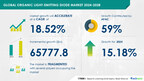
NEW YORK, Sept. 19, 2024 /PRNewswire/ — Report with the AI impact on market trends- The global organic light-emitting diode market size is estimated to grow by USD 65.78 billion from 2024-2028, according to Technavio. The market is estimated to grow at a CAGR of 18.52% during the forecast period. Increasing number of patent-related activities by market vendors is driving market growth, with a trend towards increasing adoption of oled displays in automotive sector. However, availability of less expensive substitutes poses a challenge. Key market players include AUO Corp., BOE Technology Group Co. Ltd., Futaba Corp., Innolux Corp., Japan Display Inc., Konica Minolta Inc., Kopin Corp., Kyocera Corp., LG Electronics Inc., Lumiotec Inc., Nippon Seiki Co. Ltd., OLEDWorks LLC, OSRAM Licht AG, RiTdisplay Corp., Samsung Electronics Co. Ltd., Sharp Corp., Sumitomo Chemical Co. Ltd., Tianma Microelectronics Co. Ltd., Truly International Holdings Ltd., Universal Display Corp., and Visionox Co..
Key insights into market evolution with AI-powered analysis. Explore trends, segmentation, and growth drivers- View the snapshot of this report
Organic Light-Emitting Diode Market Scope
Report Coverage
Details
Base year
2023
Historic period
2018 – 2022
Forecast period
2024-2028
Growth momentum & CAGR
Accelerate at a CAGR of 18.52%
Market growth 2024-2028
USD 65777.8 million
Market structure
Fragmented
YoY growth 2022-2023 (%)
15.18
Regional analysis
APAC, North America, Europe, South America, and Middle East and Africa
Performing market contribution
APAC at 59%
Key countries
China, US, South Korea, Japan, and Taiwan
Key companies profiled
AUO Corp., BOE Technology Group Co. Ltd., Futaba Corp., Innolux Corp., Japan Display Inc., Konica Minolta Inc., Kopin Corp., Kyocera Corp., LG Electronics Inc., Lumiotec Inc., Nippon Seiki Co. Ltd., OLEDWorks LLC, OSRAM Licht AG, RiTdisplay Corp., Samsung Electronics Co. Ltd., Sharp Corp., Sumitomo Chemical Co. Ltd., Tianma Microelectronics Co. Ltd., Truly International Holdings Ltd., Universal Display Corp., and Visionox Co.
Market Driver
The automotive industry is experiencing a shift towards advanced visual technologies, with organic light-emitting diode (OLED) displays gaining significant traction. OLED technology offers vibrant colors, high contrast ratios, and exceptional color reproduction, making it an ideal choice for various in-vehicle applications. The market for OLED displays in the automotive sector is projected to grow at a CAGR of over 14% between 2019 and 2023. This growth is driven by the increasing demand for reality-based technologies and autonomous vehicles. OLED displays are revolutionizing in-vehicle infotainment systems, providing advanced features such as navigation, multimedia systems, driver assistance, connected vehicle functions, and improved communication between drivers and vehicles. Luxury car manufacturers and original equipment manufacturers (OEMs) are incorporating OLED panels into their vehicles due to the technology’s high design flexibility and energy efficiency. Renowned car companies such as Volkswagen, Jaguar Land Rover, Toyota, GM, Mercedes-Benz, and Audi are already using OLED displays in their vehicles. Automotive display manufacturers are actively exploring the potential applications of OLED displays in the automotive sector, with commercial availability of such displays expected to grow. OLED displays offer enhanced brightness, vibrant colors, and interactive functionalities, making them ideal for GPS navigation, driver assistance displays, entertainment systems, and digital dashboards. The increasing adoption of OLED displays in the automotive sector is driving a transformation in in-vehicle visual displays, offering new standards for automotive display technology. In-vehicle information systems are becoming more prevalent in automobiles, and the demand for OLED displays is expected to rise during the forecast period, supporting the growth of the global organic light-emitting diode market.
The Organic Light-Emitting Diode (OLED) market is experiencing significant growth, surpassing Traditional display technologies like LCDs and LED. OLED technology offers several advantages, including high contrast ratio, wide viewing angles, and fast response time. This makes OLED displays ideal for various applications in consumer electronics, such as smartphones, televisions, wearables, automotive displays, lighting solutions, and more. OLED’s thinness and lightweight design provide flexibility for manufacturers to create innovative products. OLED displays offer uniform illumination, color rendering, and transparency, enhancing image quality for devices like smartwatches, tablets, automotive dashboards, infotainment systems, electric vehicles (EVs), foldable smartphones, curved TVs, rollable displays, and wearable devices. OLED lighting solutions provide energy efficiency and cost reduction, making them an attractive alternative to traditional lighting. OLED technology’s environmental considerations and sustainability are essential factors driving its adoption. OLED displays use organic molecules as emitters and conductors, ensuring bright controls and fast motion. Overall, OLED’s unique features make it a game-changer in the display industry.
Request Sample of our comprehensive report now to stay ahead in the AI-driven market evolution!
Market Challenges
The Organic Light-Emitting Diode (OLED) market faces challenges due to the widespread use and production efficiency of alternative display technologies, such as Plasma, TFT-LCD, and LED displays. These displays have been in large-scale production for an extended period, resulting in economies of scale and minimal defects. In contrast, OLED production capacity is limited, and manufacturing costs are high. OLEDs encounter challenges during production, including inadequate surface tension, low-performing blue emitters, and non-uniform deposition. Furthermore, OLEDs have a shorter lifespan compared to LCDs, LEDs, and Plasma Display Panels (PDPs), with blue OLEDs lasting approximately 14,000 hours to half brightness. This is significantly lower than other display technologies. Despite these challenges, the high production capacity and mass adoption of other display technologies have hindered the market growth of OLEDs. Display manufacturers prioritize producing high-resolution displays for notebooks, smartphones, tablets, and TVs using TFT-LCD technology for a cost-effective and energy-efficient balance. The per meter square Average Selling Price (ASP) of LCDs is substantially lower than that of OLEDs, making LCDs a more attractive option for manufacturers and consumers. Technavio predicts that the high cost of manufacturing OLED displays will keep their ASPs elevated compared to other display technologies. Consequently, the availability and affordability of alternative display technologies will continue to hinder the growth of the OLED market during the forecast period.The Organic Light-Emitting Diode (OLED) market is experiencing rapid advancement in various industries, including smartwatches, tablets, automotive dashboards, infotainment systems, electric vehicles, foldable smartphones, curved TVs, rollable displays, wearable devices, and OLED lighting. Challenges for OLED technology include fast response time, image quality, uniform illumination, and color rendering. Cost reduction and sustainability are also major factors as organic molecules and conductors are used in OLED production. Thinness, lightweight, design flexibility, transparency, and high contrast are key benefits. Major industries like luxury car manufacturers are adopting OLED technology for HUDs, instrument clusters, and central stack displays. Urbanization and energy saving are driving the demand for OLED displays, which offer fast motion, bright controls, high contrast, and flexibility. Retina display technology and television are significant applications, with AMOLED displays becoming increasingly popular. However, environmental considerations and the need for sustainable production methods remain important challenges for the OLED market.
Discover how AI is revolutionizing market trends- Get your access now!
Segment Overview
This organic light-emitting diode market report extensively covers market segmentation by
Product 1.1 OLED display1.2 OLED lightingType 2.1 Rigid2.2 FlexibleGeography 3.1 APAC3.2 North America3.3 Europe3.4 South America3.5 Middle East and Africa
1.1 OLED display- The Organic Light-Emitting Diode (OLED) market is witnessing a shift as prominent LCD vendors, such as Samsung Electronics and LG Electronics, transition towards OLED production due to declining profit margins in LCD panels. The oversupply of LCD panels, driven by low-cost fabs from China, has resulted in a downward trend in the average selling price (ASP) of LCD panels. OLED displays, though more expensive due to high raw material costs, offer vendors patent rights and intellectual property (IP), ensuring higher profitability. The demand for OLED displays is increasing across various end-use industries, particularly in consumer electronics. In the smartphone segment, the medium and premium segments are driving the growth of the OLED display market due to the demand for high-end features and advanced displays. Mobile PCs, including tablets and notebooks, are also integrating OLED displays for larger screens, high-resolution, and connectivity options. Wearable electronic devices, such as smartwatches and smart glasses, are increasingly using OLED displays for their thin, lightweight, and flexible properties. In the automotive industry, OLED displays are being adopted due to their flexibility, efficiency, and suitability for internal vehicle spaces. The global OLED display market for automobiles is expected to grow significantly due to the increasing adoption of autonomous and energy-efficient vehicles. Major TV manufacturers, including LG Electronics, Samsung Electronics, and Sony, are focusing on OLED TVs due to their superior picture quality, enhanced resolution, and optimal power consumption. Partnerships between OLED vendors and automotive OEMs, such as LG Electronics and Daimler AG, are driving the adoption of OLED displays in vehicles. The OLED display market is poised for growth across these industries due to the unique advantages of OLED technology.
Download a Sample of our comprehensive report today to discover how AI-driven innovations are reshaping competitive dynamics
Research Analysis
The Organic Light-Emitting Diode (OLED) market represents a significant advancement in display technology, offering several advantages over traditional LCDs and LEDs. OLED displays use organic materials to emit light, resulting in high contrast ratio, wide viewing angles, fast motion, and bright controls. These displays are finding widespread adoption in various industries, including consumer electronics, particularly in smartphones and televisions, wearables, automotive displays, and lighting solutions. OLED technology offers flexibility and transparency, making it a major factor in the development of retina display technology. The market for OLED displays is experiencing rapid advancement, with AMOLED displays becoming increasingly popular due to their improved image quality and energy efficiency. The major factors driving the growth of the OLED market include the increasing demand for high-quality displays in various applications and the continuous innovation in OLED technology.
Market Research Overview
The Organic Light-Emitting Diode (OLED) market is experiencing rapid advancement in various industries due to its unique features compared to Traditional display technologies like LCDs and LED. OLED displays offer high contrast ratio, wide viewing angles, and fast response time, making them ideal for use in consumer electronics such as smartphones, televisions, wearables, and automotive displays. OLED technology utilizes organic molecules and conductors to produce light, providing uniform illumination, flexibility, transparency, and design flexibility. In consumer electronics, OLED displays offer major advantages in image quality, fast motion, and bright controls for devices like smartwatches, tablets, automotive dashboards, infotainment systems, electric vehicles (EVs), foldable smartphones, curved TVs, rollable displays, and wearable devices. OLED lighting solutions provide energy savings, thinness, and lightweight properties, making them a popular choice for various applications. Cost reduction and environmental considerations are also driving the growth of the OLED market, with sustainability being a major factor. Luxury car manufacturers are increasingly using OLED displays for HUDs, instrument clusters, central stack displays, and other applications, while urbanization and the shift towards LED-based lighting are also contributing to the market’s growth. The OLED market is expected to continue its expansion in the coming years due to its numerous benefits and the ongoing technological innovations in this field.
Table of Contents:
1 Executive Summary
2 Market Landscape
3 Market Sizing
4 Historic Market Size
5 Five Forces Analysis
6 Market Segmentation
ProductOLED DisplayOLED LightingTypeRigidFlexibleGeographyAPACNorth AmericaEuropeSouth AmericaMiddle East And Africa
7 Customer Landscape
8 Geographic Landscape
9 Drivers, Challenges, and Trends
10 Company Landscape
11 Company Analysis
12 Appendix
About Technavio
Technavio is a leading global technology research and advisory company. Their research and analysis focuses on emerging market trends and provides actionable insights to help businesses identify market opportunities and develop effective strategies to optimize their market positions.
With over 500 specialized analysts, Technavio’s report library consists of more than 17,000 reports and counting, covering 800 technologies, spanning across 50 countries. Their client base consists of enterprises of all sizes, including more than 100 Fortune 500 companies. This growing client base relies on Technavio’s comprehensive coverage, extensive research, and actionable market insights to identify opportunities in existing and potential markets and assess their competitive positions within changing market scenarios.
Contacts
Technavio Research
Jesse Maida
Media & Marketing Executive
US: +1 844 364 1100
UK: +44 203 893 3200
Email: media@technavio.com
Website: www.technavio.com/
View original content to download multimedia:https://www.prnewswire.com/news-releases/oled-market-to-grow-by-usd-65-78-billion-from-2024-2028–increasing-patents-and-ai-driven-market-transformation-fuel-growth–technavio-302253220.html
SOURCE Technavio










 Technology4 days ago
 Coin Market5 days ago
 Coin Market4 days ago
 Technology4 days ago
 Technology4 days ago
 Technology4 days ago