Technology
The Best-Kept Secret in Surgical Robotics Ecosystems AI
Published
2 hours agoon
By
At the Society of Robotic Surgery’s 2026 meeting, one message is clear: surgical robotics has evolved beyond standalone devices into integrated, software-driven ecosystems spanning AI, digital OR workflows, telesurgery, and regulatory coordination. The industry’s “best-kept secret” isn’t a single breakthrough—it’s the network of specialized partners enabling these complex systems behind the scenes. Leaders increasingly succeed not by building everything in-house, but by focusing on core differentiation while collaborating across software, hardware, connectivity, AI, and compliance. Key players like MedAcuity, NVIDIA, RTI, and Kinova exemplify this model, working together across complementary layers—from real-time data infrastructure and AI simulation to medical-grade robotics and regulated software development. Their repeated collaboration highlights a scalable, ecosystem-based approach that accelerates innovation, reduces risk, and supports modern surgical demands. As SRS 2026 emphasizes AI adoption, distributed care, training, and regulatory evolution, it reinforces a pivotal shift: the future of surgical robotics belongs to companies that master partnership as much as technology.
WESTFORD, Mass., June 16, 2026 /PRNewswire-PRWeb/ —
The Best-Kept Secret in Surgical Robotics
When the Society of Robotic Surgery convenes this July in Hollywood, Florida, the official program makes one thing unmistakable: surgical robotics is no longer just a device story. The 2026 meeting spans regulatory boundaries, simulation and education, hospital administration, AI as a health-system priority, digital OR workflows, distributed surgical care, and telesurgery adoption. That is a strong signal that the field has moved from isolated products to integrated operating ecosystems.
That is also why the industry’s best-kept secret is not a stealth startup or a single breakthrough feature. It is the quietly powerful ecosystem of specialist partners working behind the brands that get the awards, the first-case press releases, and the market recognition. In a field where performance, latency, AI, clinical workflow, cybersecurity, interoperability, and regulatory evidence all have to work together, the companies that insist on building every layer alone are often not the most disciplined operators. The smarter companies are increasingly the ones that know exactly what to own and exactly where to partner.
The signal hiding in the agenda
The SRS agenda reads less like a traditional device conference and more like a blueprint for the modern robotics stack. On one side are sessions on “Global Regulatory Perspectives on Digital and Robotic Surgery,” “Telerobotic and distributed surgical care,” and “Cross-Cutting Evidence Expectations.” On another are workshops on simulation, credentialing, competency-based training, and AI for the learning surgeon. Add sessions on “Artificial Intelligence: From Hype to Health System Priority,” “The Digital OR,” and “Financing, Governance, and Innovation for Scalable Telesurgery,” and the message is clear: success now depends on coordinated expertise across software, hardware, networks, data, compliance, and clinical adoption.
That breadth matters because it exposes the weakness in the old assumption that the best, fastest, and cheapest path is always to keep everything in-house. In surgical robotics, the problem is rarely a lack of ambition. It is usually the multiplication of layers. A team may be excellent at instruments or procedure design, but much less differentiated in low-latency connectivity, runtime AI infrastructure, teleoperation controls, secure-by-design architecture, or the documentation rigor needed for regulated software. The agenda is practically a map of those seams.
Why the all-in-house myth is breaking down
The case against “build everything ourselves” is not philosophical. It is architectural. The U.S. Food and Drug Administration continues to stress cybersecurity design, premarket documentation, threat modeling, lifecycle management, and the need for manufacturers and healthcare organizations to work together on risk management. At the same time, the SRS program shows that remote surgery, rural deployment, structured training, and AI-enabled workflows are no longer hypothetical side topics; they are central operating concerns. The more the field becomes software-defined and networked, the less credible it is to assume one internal team should master every enabling layer equally well.
That does not mean outsourcing indiscriminately. It means being honest about where differentiation lives. If your value is procedural insight, surgeon workflow, clinical evidence, or a specific therapy category, then your highest-return move may be to keep that core in-house while assembling proven partners for the parts that are necessary but not uniquely yours to invent. MedAcuity and Kinova make that point directly in their public requirements work: poorly defined requirements create rework, budget inflation, and compliance problems, while a unified hardware-software requirements approach reduces rework, supports modularity, and improves time to market.
The partnership stack behind the leaders
MedAcuity publicly positions itself around complex medical and robotics software; NVIDIA around AI, simulation, and deployment for healthcare robotics; Real-Time Innovations (RTI) around real-time, data-centric connectivity for intelligent physical systems; and Kinova around off-the-shelf and tailored medical-grade robotic systems. That is why the quiet network represented by MedAcuity and its robotics leaders Shawn Vanseth and Tom Amlicke, NVIDIA and healthcare/medical leader David Niewolny, RTI market leaders Jim Bentley, Darren Porras and Kevin Meyer, and Kinova with medical robotics leader François Boucher deserves more attention. These are the people you should be working with.
These companies are not merely adjacent vendors. Their own public materials increasingly describe one another as partners, collaborators, or enabling layers in the same solution path. MedAcuity’s partner page names RTI and Kinova as strategic partners; MedAcuity’s telesurgery content describes teleoperation work with RTI; RTI’s Kinova announcement says the collaboration was developed with MedAcuity; and both RTI and Kinova publicly tie their work to NVIDIA Isaac for Healthcare. This is what a tightly coupled ecosystem looks like in practice: a recurring pattern of companies showing up together because they solve different parts of the same system.
The Partners Who Stop Innovators From Reinventing
MedAcuity is the software-and-systems anchor in this group. The company says it specializes in complex, software-intensive solutions for MedTech, life sciences, and robotics; highlights more than 500 completed projects, more than 100 software engineers, and a repeat-business rate above 90 percent; and explicitly positions its robotics work around robotic-assisted surgery, teleoperation, high-reliability software, real-time control, haptics, 4K video integration, and standards including IEC 62304, ISO 13485, ISO 14971, and FDA quality-system expectations. In other words, MedAcuity sits where architecture, requirements, verification, quality, and regulated delivery converge.
NVIDIA brings the AI and simulation acceleration layer. Isaac for Healthcare is described by NVIDIA as a purpose-built platform for simulation, training, and deployment of AI-enabled medical robotics, with workflows that span surgical and interventional robotics and even include a remote telesurgery reference application. NVIDIA’s broader healthcare robotics messaging emphasizes digital twins, physical AI, real-time execution, and infrastructure built for the safety and regulatory rigor of surgery, imaging, and hospital environments. That is why this is not “AI for AI’s sake.” It is infrastructure for moving from concept to validated robotic behavior with fewer blind spots.
RTI software brings the data plane that too many teams underestimate until integration becomes the bottleneck. RTI Connext is a decentralized, real-time data streaming platform built for intelligent physical systems. It emphasizes low latency, throughput, no single point of failure, and interoperability across sensors, devices, algorithms, and cloud infrastructure. In healthcare and medical robotics, RTI explicitly frames connectivity as the foundation for digital surgery platforms, including remote surgery, monitoring, AI integration, analytics, and distributed applications that must behave like one system. That is not back-office plumbing. In surgical robotics, it is a foundational – and frontline–performance layer.
Kinova brings the hardware and productization layer that many OEMs should not want to build from zero. Kinova accelerates the journey to market through off-the-shelf and tailored medical-grade robotic systems, including arms, actuators, tool drives, and development services. Kinova’s own materials position its medical robotics portfolio around surgical and diagnostic applications, while its public case studies show real-world use in surgical navigation, interventional workflows, and multi-robot frameworks. In practical terms, Kinova lets innovators start from a serious, modular hardware foundation rather than burning years rediscovering what mature robot platforms already solved.
Why the overlap matters more than any single logo
The real power of this ecosystem is not any one company’s strength in isolation. It is the overlap. MedAcuity has shown strategic alignment with RTI and Kinova in its partner ecosystem and telesurgery content. RTI and Kinova have announced an integrated medical robotics platform that simplifies and accelerates product lifecycles, reduces program risk, and connects robotics to larger digital ecosystems that include AI, sensing, visualization, and interoperability. RTI Connext integrates with NVIDIA Isaac for Healthcare and Holoscan, giving healthcare robotics developers a way to connect real-time applications with AI workflows. When these capabilities are assembled intentionally, they become more than a vendor list; they become a repeatable acceleration model.
The public demonstrations are especially telling. MedAcuity, RTI, Kinova, and Haply described a telesurgery prototype built in 60 days, and RTI’s own announcement said a MedAcuity-developed demo allowed users to manipulate a Kinova robotic arm located 3,000 miles away. MedAcuity’s teleoperation content similarly frames remote surgery as an ecosystem problem that requires real-time communication infrastructure, safety-critical architecture, and coordinated integration across operating systems and platforms. That is the quiet proof point behind the larger argument: innovation moves faster when proven layers are composed well.
A look at the public record also suggests how common this partnership model already is. Johnson & Johnson MedTech is working with NVIDIA on AI in surgery, and NVIDIA’s 2026 healthcare robotics messaging also points to work with CMR Surgical and Medtronic in the physical-AI stack. RTI highlights its role with Levita Magnetics and the MARS surgical robotic platform, while Kinova publicly showcases work with Atlas Medical Technologies and other medical robotics efforts. MedAcuity, for its part, reports dozens of surgical robotics clients globally with hundreds of successfully completed projects and a repeat-business rate above 90 percent. The confidential work is invisible by definition; the visible work already tells you the ecosystem is larger than most people think.
What to watch at SRS this summer
If you are walking the halls at SRS in Hollywood, Florida this July, look for the themes that match this ecosystem almost perfectly. Watch the AI track, where David Niewolny is scheduled to speak on AI moving from hype to health-system priority. Watch the telesurgery and distributed care sessions, where the questions are no longer whether remote surgery is exciting, but what it takes to say yes at scale. Watch the simulation and training program, where structured adoption, credentialing, and competency are being treated as strategic infrastructure. And watch the regulatory track, where the unsettled boundaries of digital and robotic surgery are still being actively defined. Kinova will unveil for the first time its new medical-grade robot arm Kima, a system purpose-built for the operating room to accelerate next-generation system development for OEMs.
Then take a look around the exhibit floor and the broader meeting ecosystem. The Society of Robotic Surgery’s 2026 meeting page lists MedAcuity, Kinova, and RTI among the exhibitors and industry supporters, while the agenda puts NVIDIA directly into the healthcare-AI conversation. That is the point of this article and the call to action it leads to: if you are attending SRS this summer in Florida, pay close attention to the companies doing the deeply technical, deeply enabling work that makes other companies look spectacular. They will probably never insist on the credit. The success of their mutual clients, is their success. But once you know what to look for, the best-kept secret in surgical robotics stops being a secret at all.
For more information:
Media Contact
Lisa Burns, MedAcuity, 1 866.376.1931, lburns@medacuity.com, https://www.medacuity.com/
View original content:https://www.prweb.com/releases/the-best-kept-secret-in-surgical-robotics-ecosystems-ai-302801876.html
SOURCE MedAcuity
You may like
Technology
Kachilu unveils AI marketing automation app for macOS with browser-based campaign execution
Published
2 minutes agoon
June 16, 2026By
Kachilu helps marketing, sales, and recruiting teams move from strategy to execution by planning outreach tasks and performing browser-based actions such as posts, replies, DMs, follows, and form submissions.
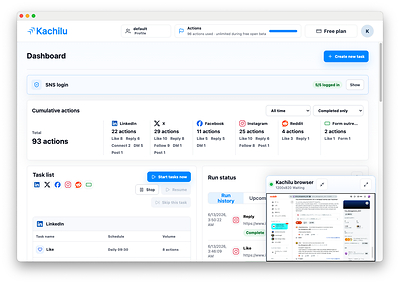
TOKYO, June 16, 2026 /PRNewswire-PRWeb/ — Kachilu today announced the launch of its macOS desktop app, an AI marketing automation agent that helps teams plan and execute campaign workflows in a real browser. Built for marketing, sales, and recruiting teams, Kachilu turns campaign goals into task plans and performs eligible browser-based actions with user visibility and control.
AI tools can generate strategy and copy, but many teams still rely on manual work to post content, reply to messages, follow up with leads, send DMs, and submit contact forms. Kachilu is designed to bridge that gap by organizing goals into tasks, executing eligible actions in a real browser, and pausing when human judgment or authentication is required.
With Kachilu, users can create marketing, sales, or recruiting workflows from a goal, review the AI-generated strategy and task plan, and monitor execution through a desktop dashboard. The product includes Kachilu Browser, which lets users see browser actions as they happen, pause or resume work, add instructions, and review execution history.
Kachilu supports use cases including social media marketing, form-based outreach, and direct recruiting. It is designed for teams that want to scale repetitive outreach while maintaining visibility and control over account-specific activity.
“AI can help teams plan campaigns, but execution often still stops at the browser,” said Ryutaro Imai, founder of Kachilu. “Kachilu helps teams move from intention to action while keeping important decisions under human control.”
The macOS version is available now for Apple silicon Macs running macOS 14 or later. As part of its launch campaign, Kachilu is free to use until June 30, 2026. Paid plans are based on completed actions, starting at $9 per month.
For more information or to download the macOS app, visit https://www.kachilu.com
Media Contact
Kachilu PR Team, Kachilu Inc., 81 7020078468, kachilu-agent@kachilu.com, https://www.kachilu.com/en
View original content to download multimedia:https://www.prweb.com/releases/kachilu-unveils-ai-marketing-automation-app-for-macos-with-browser-based-campaign-execution-302801931.html
SOURCE Kachilu Inc.
Technology
A New Era of XR Begins: XREAL Launches XREAL AURA, Powered by Android XR, This Fall
Published
2 minutes agoon
June 16, 2026By
Reservations for XREAL AURA are available now, enabling customers to secure a spot for the launch later this year
LONG BEACH, Calif., June 16, 2026 /PRNewswire/ — XREAL, the global leader in lightweight XR glasses, today officially unveiled XREAL AURA, powered by Android XR and built with Snapdragon. This represents the company’s next-generation spatial computing glasses built in collaboration with Google and Qualcomm Technologies, Inc. Formerly known as Project Aura, and now confirmed to launch in the Fall, XREAL AURA combines lightweight optical see-through (OST) wired XR glasses, Android XR and deep Gemini integration, and the power of Qualcomm Technologies’ latest Snapdragon® Reality Elite Platform. With all these features working in concert, XREAL AURA delivers a new era of immersive and wearable spatial computing experiences.
XREAL also announced multiple reservation paths for XREAL AURA are now open through XREAL.com/aura. XREAL AURA will make its first public appearance this week at Augmented World Expo in Long Beach, California; attendees can visit the Qualcomm booth (#911) for hands-on demos.
“XREAL AURA sets a new benchmark for OST XR glasses, bringing powerful AI-driven experiences to both work and everyday life,” said Chi Xu, Co-founder and CEO of XREAL. “The new era of portable spatial computing glasses starts now, as XREAL AURA combines rich and cinematic visuals, powerful platforms, and advanced on-device AI capabilities required to realize immersive next-generation XR. From developers who demand more headroom to consumers who expect seamless, premium experiences, Snapdragon Reality Elite and Android XR enable XREAL AURA to excel and lead in defining today’s smart glasses use cases.”
Powered by Android XR and Snapdragon Reality Elite
At the core of XREAL AURA is Google’s Android XR and the newly unveiled Snapdragon Reality Elite, Qualcomm’s latest XR platform. Both are engineered to deliver industry-leading performance, multitasking, multimodal AI, and power optimization for next-generation wearable devices.
“XR adoption continues to expand, evidenced by the global developer and consumer excitement for XREAL Aura,” said Ziad Asghar, Senior Vice President and General Manager of XR, Wearables and Personal AI at Qualcomm Technologies, Inc. “As advanced and integrated XR devices come to market, like XREAL Aura, demand is increasing for XR technologies that deliver better immersive experiences, higher performance, greater intelligence, and improved power optimization. Snapdragon Reality Elite is designed to meet those demands — and it reinforces our leadership in VR and MR as we create purpose-built XR chipsets from the ground up.”
“Android XR is made for everyday life, and XREAL AURA brings XR experiences to life through the most innovative wired XR glasses yet,” said Shahram Izadi, Vice President and General Manager of Android XR, Google. “This is indeed a turning point, and the right teams are united to lead what comes next.”
Built for the Next Generation of Android XR Experiences
XREAL AURA delivers premium spatial computing experiences in a lightweight and portable form factor. Key features include:
A massive 70-degree field of view with a virtually borderless visual canvas
Light, less than 95g optical see-through frames designed for immersive mixed reality experiences
World-facing sensors on the frames support hand tracking, 6DoF tracking, and multimodal AI experiences with user permission
Dual-chip, split-compute architecture designed for portable spatial computing
A dedicated spatial compute unit, powered by Snapdragon Reality Elite for advanced XR performance and power optimization
Inside the frames, the XREAL X1S Spatial Coprocessor supports low-latency spatial display, sensor processing, and stable glasses-based XR experiences
Deep integration with Google’s Android XR platform and helpful support from Gemini
Through the Android XR Catalyst Developer Program that was announced at the Google I/O Developer Conference, hundreds of XREAL AURA developer kits are being distributed to developers around the world, accelerating development across entertainment, productivity, gaming, sports, healthcare, and enterprise applications.
Leading Global Partners Building for XREAL AURA
Because it’s powered by Android XR, millions of Android mobile and tablet apps are available day one on XREAL AURA through the Play Store. There are also over one hundred apps made specifically for XR in development already. Today, XREAL also offered an early peek at the expanding ecosystem of partners developing unbound experiences for Android XR and XREAL AURA.
Sports, Games and Entertainment
Announced today, Project Hail Mary: Journey Among the Stars, will launch on XREAL AURA, powered by Android XR, Google’s groundbreaking spatial computing platform. Developed in partnership with Amazon MGM Studios and featuring a new, original chapter created in collaboration with Andy Weir specifically for the game, Project Hail Mary: Journey Among the Stars allows players to step into the role of Ryland Grace at a pivotal, untold moment in the Hail Mary mission, diagnosing failing ship systems and improvising ingenious scientific solutions as the spacecraft itself bleeds into their real-world environment. Precise hand tracking enables intuitive, tactile interaction with ship panels and zero-gravity objects, while the Hail Mary spacecraft merges seamlessly with the player’s physical surroundings. The result is a new form of spatial storytelling that leverages Android XR, cutting edge XR hardware starting with XREAL AURA, and mixed reality to bring the world of Project Hail Mary directly into the player’s space.
Announced today, Fallout: Factions is the official digital adaptation of the hit tabletop game from Modiphius Entertainment for XR. This turn-based skirmish warfare game set in the Fallout universe combines squad-level tactics and strategy with immersive 3D maps and gesture controls in stunning augmented reality. Compete with friends around the table or around the world as you play as one of three Factions seeking to dominate the devastated landscape of Nuka-World. Each Faction has a unique set of weapons and abilities, creating nearly endless replay-ability. War never changes, but now it’s in your hands! Fallout: Factions launches from Mirrorscape later this year on XREAL AURA and Android XR.
Announced today, “The Nutcracker: A Spatial Awakening” is a pioneering full-scale spatial preservation of a legacy ballet, developed by San Francisco Ballet and YBVR in partnership with Google and XREAL. Captured in stereoscopic 8K with a Blackmagic URSA Cine Immersive three-camera array, the experience places audiences closer than ever to the artistry and emotion of this iconic holiday production. Bringing the breathtaking “Snowfall” sequence directly into the user’s surroundings, the experience showcases how cutting-edge hardware can unlock a profound sense of presence for world-class performing arts, accompanied by the Grammy Award-winning San Francisco Ballet Orchestra. Expect more to come with the official premiere later this year.
Asteroid, a groundbreaking immersive film from acclaimed director Doug Liman, will combine cinematic storytelling, interactive gameplay, live conversational AI, and natural multimodal interaction powered by Gemini. The experience launched exclusively on Android XR and will be free for all XREAL AURA owners. The project is developed by 30 Ninjas.
EMMY and BAFTA award-winning Atlantic Studios is bringing ambitious immersive films to Android XR and XREAL AURA. Atlantic is bringing Hollywood elites to its projects, with more to be revealed soon.
Resolution Games brings its painstakingly crafted turn-based co-op tabletop dungeon crawler, Demeo to XREAL AURA. Demeo is designed from the ground up for XR, and players on AURA can join others on Samsung Galaxy XR, Meta Quest, Apple Vision Pro, PICO and PlayStation VR2, as well as enjoy cross-play with flatscreen players (Steam PC, Mac, iOS, PlayStation 5).
The Fox Sports XR app on XREAL AURA will feature immersive live sports and highlights.
Cubism is one of the most respected puzzle games in XR built around an engaging concept: fit a set of colorful 3D blocks into a target shape, but this time set in your real world thanks to XREAL AURA’s optical see-through headset. Cubism is renowned for its excellent handtracking and strong spatial interaction design.
One of the world’s largest XR video game developers, nDreams, is bringing Oh My Galaxy! to XREAL AURA. Oh My Galaxy! is a beautifully crafted arcade-style physics puzzle game designed from the ground up for spatial computing. XREAL AURA marks the first time the popular game will be available on an OST headset.
Odders is bringing its premier tabletop strategy game, Chess Club to XREAL AURA. Chess Club is the leading chess application across major spatial computing platforms today; its standout feature is its precise native hand-tracking. XREAL AURA marks the first time Chess Club will be available on an OST headset.
South Korean streaming powerhouse, Naver is bringing CHZZK to XREAL AURA. CHZZK is Naver’s massive livestreaming and content creator platform heavily centered around gaming, esports, virtual streamers, music videos and watch parties. CHZZK includes spatialized 180- and 360-degree videos that bring VR entertainment to XREAL AURA without isolating the viewer from the real world around them.
DB Creations is actively developing three XR games for XREAL AURA. Disassemble, mend, and rebuild a variety of gadgets and robot parts while learning about the fantastical world around you in Robo Repair. Fly a jet, pilot a helicopter, and more to complete arcade challenges right in your room with the exciting RC-inspired action of Tiny Motors Arcade. Transform your space into a thriving solarpunk city of the future with easy to connect building block elements in Table Towers.
Productivity, Learning, Enterprise and Healthcare
Announced today, representing next generation geospatial immersion, the Rathausverein of Aachen, Germany, and ZAUBAR are creating a first-of-its-kind location-based AR experience in Aachen’s historic city center. Set around the Krönungssaal (Coronation Hall) in Aachen City Hall and connected to the city’s imperial heritage, including Aachen Cathedral as part of the former Carolingian palace complex and a UNESCO World Heritage Site, the experience brings history to life through an immersive museum-quality exhibition with realistic time travel, lifelike animations, historically accurate reconstructions, and incredible detail, all comfortably enjoyed through XREAL AURA. This exciting project is targeting an on-site launch in mid-2027.
Announced today, in healthcare, apoQlar is bringing their XR HoloMedicine® platform to XREAL AURA that transforms CT, MRI, PET, and other medical imaging data into interactive 3D holographic models that clinicians can view and manipulate in real time. The early apoQlar workflows with XREAL AURA are showing real promise and are already making advanced medical visualization and training more intuitive for clinicians.
Simply Piano XR comes to an OST headset for the first time with XREAL AURA, bringing its finetuned hand tracking and spatial computing to merge physical instruments with digital overlays along with AI-powered real-time feedback for the ultimate XR piano-learning platform.
In enterprise, ShapesXR is moving design work into XREAL AURA’s immersive 70-degree FOV, allowing teams to sketch environments, place UI, storyboard interactions, and test concepts before writing much code. ShapesXR is leading in collaborative spatial creation and for the first time, bringing its highly recognized platform to XR glasses.
Frontline.io turns complex CAD models into interactive digital twins for the enterprise space, letting technicians learn, troubleshoot, and collaborate through XREAL AURA with OST workflows. It’s reshaping remote assist, virtual training, and augmented work instructions — and going further with AI agents that generate, retrieve, and guide maintenance procedures in real time, all hands-free without taking workers’ eyes off the task, making the smart connected worker a reality.
The Plynk Spatial™ app turns stock research, portfolio management, and trading into a spatial experience coming for the first time to OST XR glasses with XREAL AURA. Instead of viewing markets through flat charts on a phone or laptop, through XREAL AURA, Plynk Spatial™ users can explore 3D market visualizations, interact with spatial heatmaps, view sector performance in layouts, analyze portfolio holdings in 3D space, track market movers, and execute trades directly inside AURA, all while not losing sight of their real world surroundings.
Reserve XREAL AURA Now, Secure Your Spot at Launch
Reservations for XREAL AURA are now available for $99 USD at XREAL.com/aura for US, UK and Japan.
For a limited time two-week launch offer, reserve XREAL AURA with a $99 USD Launch Credit and receive $199 USD credit toward your purchase at launch later this year —saving you $100 on the final price. Launch Credit holders will receive priority shipping access when AURA becomes available, along with early customer support and launch updates.
XREAL also announced the XREAL AURA Founder Priority Pass. Starting today, the Founder Priority Pass will be limited to 2,000 reservations globally and is designed for early adopters, developers, creators, and consumers who want XREAL AURA on day one. Those customers who reserve AURA with a $299 USD deposit secure guaranteed launch-day delivery in supported launch regions when XREAL AURA releases later this year plus numbered special edition hardware.
In addition, XREAL announced Best Buy as its first in-store retail partner for the U.S. launch of XREAL AURA.
Coming Later This Year
XREAL is targeting a wave 1 launch of XREAL AURA in the Fall in US, UK, Japan, Canada and South Korea with additional Europe markets* coming soon after.
“With Android XR, Gemini, Snapdragon Reality Elite, and an incredible ecosystem of developers and partners, XREAL AURA marks the beginning of a new era for spatial computing glasses,” said Xu. “The road to release starts now!”
*Europe markets: Austria, Belgium, Bulgaria, Croatia, Cyprus, Czechia (Czech Republic), Denmark, Estonia, Finland, France, Germany, Greece, Hungary, Ireland, Italy, Latvia, Lithuania, Luxembourg, Malta, Netherlands, Poland, Portugal, Romania, Slovakia, Slovenia, Spain, Sweden
Snapdragon and Qualcomm branded products are products of Qualcomm Technologies, Inc. and/or its subsidiaries. Qualcomm and Snapdragon are trademarks or registered trademarks of Qualcomm Incorporated.
View original content to download multimedia:https://www.prnewswire.com/news-releases/a-new-era-of-xr-begins-xreal-launches-xreal-aura-powered-by-android-xr-this-fall-302802018.html
SOURCE XREAL
Technology
NetActuate Expands Networking Platform for the Independent, AI-Ready Edge, Adding Cloud Routers, Magic Mesh, Stateful Firewall, and VPC Load Balancing
Published
2 minutes agoon
June 16, 2026By
New capabilities give infrastructure teams hyperscaler-grade networking (Cloud Routers, Magic Mesh, a stateful Firewall, and VPC Load Balancing) with the visibility, control, and cloud independence to build on their own terms, not their provider’s.
RESEARCH TRIANGLE, N.C., June 16, 2026 /PRNewswire/ — NetActuate, a global provider of edge infrastructure and Anycast network solutions across 45+ markets worldwide, today announced a major expansion of its Networking platform. The release introduces Cloud Routers, Magic Mesh, stateful firewalling, and VPC Load Balancing, alongside a redesigned Networking portal that gives customers deeper visibility and full self-service control over their networking resources.
Three forces are reshaping how companies think about infrastructure. AI and real-time workloads are pushing compute, inference, and data closer to users and out to the edge. A growing cost-and-repatriation backlash is exposing the real price of hyperscaler lock-in and egress fees. And tightening data-sovereignty and geographic-compliance requirements are forcing teams to control where their traffic and data actually live. Each points the same direction: companies want infrastructure they own and operate on their own terms, with the routing, resilience, and DDoS protection to back it up. NetActuate’s expanded Networking platform is built for that shift.
“The hyperscaler era trained teams to trade control for convenience, and they’re done making that trade,” said Mark Mahle, CEO of NetActuate. “This release gives customers hyperscaler-grade networking primitives with none of the lock-in. They can architect exactly the network they need and run all of it from a single portal, with the transparency and flexibility that independent infrastructure demands.”
What’s New: Products and Platform Capabilities
Cloud Routers
Cloud Routers let customers deploy fully functional, web UI- and API-managed virtual routers, directly within the NetActuate platform. They support multiple VRFs natively, static and BGP routing, full SNAT and DNAT configuration, and WireGuard tunnels, and they integrate with any NetActuate service. That makes them especially powerful paired with VPC for BGP routing into third-party platforms, Internet Exchanges, or enterprise networks.
Magic Mesh
Magic Mesh interconnects two Cloud Routers with a single click, letting customers build their own overlay networks from the portal or API. Teams can stitch together sites across the NetActuate platform, or across other clouds entirely, to create private, multi-site networks without the manual configuration that usually comes with it. Cross-cloud mesh connectivity is supported out of the box.
Stateful Firewall
A fully stateful Layer 3 firewall is now available for NetActuate’s edge IaaS. Customers can define rule sets, assign them to virtual machines, and have firewalls apply automatically at deployment, all through the portal or API. The result is enterprise-grade network security that travels with the workload, without the per-feature billing and lock-in that come with the hyperscalers’ equivalents.
VPC Load Balancing
VPC Load Balancing lets customers deploy load balancers directly onto VPC resources, bringing traffic distribution and resilience to private cloud environments. It’s the first step on a roadmap toward edge balancers, load balancers deployable to any PoP or fronted by Anycast, that will distribute traffic across the full NetActuate platform and third-party infrastructure alike.
Enhanced BGP Features
The release also brings enhanced BYOIP/BGP unicast capabilities for customers on colocation, bare metal, or VM deployments who aren’t using the BGP Anycast platform. New automation includes on-demand IRR/RPKI updates and hundreds of BGP communities, fully automatable through NetActuate’s suite of DevOps tooling.
Visibility and Control in the Customer Portal
Every one of these capabilities is configurable, monitorable, and manageable from the NetActuate Customer Portal. The release reorganizes the Networking section around the expanded suite and adds new layers of observability: customers can pull analytics on any prefix, with group- and prefix-level views of inbound traffic, the busiest data centers and nodes, and full traffic-source detail.
Together, these capabilities give teams a complete, self-service way to stand up and run their own network infrastructure (unicast, BGP, or Anycast) on infrastructure they control. Take a closer look at the Networking platform and view the NetActuate Portal Demo Overview video.
About NetActuate
NetActuate delivers edge infrastructure and network solutions in over 45 locations worldwide, enabling customers to take control of their workloads anywhere, with low latency, resiliency, and security built in. Our Open Network Edge (ONE) IaaS, built on open-source software and standards, provides everything needed to architect cloud environments and extensible infrastructure. Choose between VMs, Kubernetes, cloud, colocation, bare metal, and storage infrastructure, all with Anycast connectivity. We offer 24×7 support, expert consulting, and flexible, open solutions engineered for scalability and performance.
To schedule a call with NetActuate engineers or learn more, visit netactuate.com. For technical insights on improving reliability, reducing latency, and simplifying architecture at the network level, visit anycast.com.
View original content to download multimedia:https://www.prnewswire.com/news-releases/netactuate-expands-networking-platform-for-the-independent-ai-ready-edge-adding-cloud-routers-magic-mesh-stateful-firewall-and-vpc-load-balancing-302801992.html
SOURCE NetActuate
Kachilu unveils AI marketing automation app for macOS with browser-based campaign execution
A New Era of XR Begins: XREAL Launches XREAL AURA, Powered by Android XR, This Fall
NetActuate Expands Networking Platform for the Independent, AI-Ready Edge, Adding Cloud Routers, Magic Mesh, Stateful Firewall, and VPC Load Balancing
Send Rakhi to UK swiftly with UK Gifts Portal
Whiteboard Series with NEAR | Ep: 45 Joel Thorstensson from ceramic.network
New Gooseneck Omni Antennas Offer Enhanced Signals in a Durable Package
Why You Should Build on #NEAR – Co-founder Illia Polosukhin at CV Labs
Whiteboard Series with NEAR | Ep: 45 Joel Thorstensson from ceramic.network
NEAR End of Year Town Hall 2021: The Open Web World, MetaBUILD 2 Hackathon and 2021 recap
Trending
-
Technology5 days ago
Jennifer Biro Named a 2026 Philadelphia Titan 100 Honoree for Second Consecutive Year
-
Technology5 days agoSmartOrg releases Version 10.x of its Decision Intelligence platform
-
Technology5 days agoCathay Financial Holdings Leverages Open-Source Small Language Models to Identify Customer Intent
-
Technology5 days agoVIAVI Wins Best of Show Awards at Interop Tokyo 2026
-
Coin Market5 days agoCiti launches blockchain marketplace for private companies shares: Report
-
Technology5 days agoFirst Advantage Set to Join S&P SmallCap 600
-
Technology5 days agoAEAMC Bolted Pressure Switch Retrofit Wins Plant Engineering Product of the Year Award
-
Technology5 days agoBedsure Brings Summer Sleep Solutions to Amazon Prime Day UK