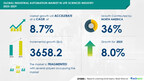
NEW YORK, Jan. 20, 2025 /PRNewswire/ — Report with the AI impact on market trends – The global industrial automation in life sciences industry size is estimated to grow by USD 3.66 billion from 2025-2029, according to Technavio. The market is estimated to grow at a CAGR of 8.7% during the forecast period. Growing global demand for healthcare services is driving market growth, with a trend towards growing adoption of open-process automation. However, infrastructural and integration issues associated with industrial automation poses a challenge. Key market players include ABB Ltd., Applied Materials Inc., Aspen Technology Inc., Azbil Corp., Balluff GmbH, Danaher Corp., Dassault Systemes SE, Emerson Electric Co., Endress Hauser Group Services AG, Festo SE and Co. KG, Honeywell International Inc., Johnson Controls International Plc, Mitsubishi Electric Corp., OMRON Corp., Parker Hannifin Corp., Rockwell Automation Inc., SAP SE, Schneider Electric SE, Siemens AG, and Yokogawa Electric Corp..
AI-Powered Market Evolution Insights. Our comprehensive market report ready with the latest trends, growth opportunities, and strategic analysis- View Free Sample Report PDF
Forecast period
2025-2029
Base Year
2024
Historic Data
2019 – 2023
Segment Covered
Deployment (Onsite and Decentralised), Product (DCS, SCADA, PLC, and MES), and Geography (North America, Europe, APAC, South America, and Middle East and Africa)
Region Covered
North America, Europe, APAC, South America, and Middle East and Africa
Key companies profiled
ABB Ltd., Applied Materials Inc., Aspen Technology Inc., Azbil Corp., Balluff GmbH, Danaher Corp., Dassault Systemes SE, Emerson Electric Co., Endress Hauser Group Services AG, Festo SE and Co. KG, Honeywell International Inc., Johnson Controls International Plc, Mitsubishi Electric Corp., OMRON Corp., Parker Hannifin Corp., Rockwell Automation Inc., SAP SE, Schneider Electric SE, Siemens AG, and Yokogawa Electric Corp.
Key Market Trends Fueling Growth
In the life sciences industry, automation trends like IoT, AI, augmented reality, and Industry 4.0 are transforming the way businesses operate. Semiconductor chips power advanced technologies such as cyber-physical systems, cloud computing, and edge computing. SMEs in the industrial sector are embracing IIoT and wireless sensors for real-time monitoring and control. Control systems are being turbocharged with Programmable Logic Controllers (PLCs), servo, and motion control. Industrial web panels and monitors provide human-machine interfaces, while 5G wireless technology enables faster communication between machines and systems. Digital transformation includes virtual capabilities through software-as-a-service, cloud engineering, and virtual reality. Robots, photoelectric sensors, laser sensors, inductive sensors, AC motors, DC motors, and temperature sensors are essential components of automation in manufacturing, material handling, and networking architectures. Machine learning and advanced analytics are driving innovation in areas like healthcare and automotive. Digitalization is revolutionizing industries like aerospace, heavy engineering, and EV charger stations.
The Open Process Automation (OPA) forum’s vision is gaining momentum in the industrial automation sector, particularly in the life sciences industry. Key industry players are collaborating through this platform to address interoperability challenges. In 2021, ExxonMobil announced a partnership with Yokogawa Electric Corporation, an automation services company. ExxonMobil appointed Yokogawa as their OPA system integrator, responsible for establishing their OPA testbed. This collaboration enables ExxonMobil to evaluate industrial standards, including those used in the pharmaceutical sector, on an integrated testbed platform.
Insights on how AI is driving innovation, efficiency, and market growth- Request Sample!
Market Challenges
In the Life Sciences Industry, IoT, AI, and Industry 4.0 technologies are transforming manufacturing processes. Small and Medium Enterprises (SMEs) face challenges integrating IoT sensors, such as temperature, humidity, and torque sensors, into their Industrial IoT (IIoT) systems. Cyber-physical systems, cloud computing, and edge computing are essential for real-time data processing. Challenges include implementing AI and machine learning algorithms, integrating human-machine interfaces, and ensuring cybersecurity. Programmable Logic Controllers (PLCs), servo systems, and motion control are crucial for automation, while robots and safety systems like light curtains enhance productivity. Industry 4.0 technologies like digital twins, virtual capabilities, and cloud engineering offer Software-as-a-Service (SaaS) solutions. Semiconductor chips, wireless sensors, and networking architectures enable connectivity, while 5G wireless technology and advanced analytics boost efficiency. The automation sector, including robotics, manufacturing, material handling, and networking architectures, benefits from digitalization and virtual reality. Sensors, AC and DC motors, and discrete automation are integral to process automation in sectors like healthcare, automotive, aerospace, and heavy engineering. The industrial sector’s digital transformation requires embracing Industry 4.0 technologies like IIoT, AI, and cloud computing platforms to remain competitive.In the life sciences industry, infrastructure and integration issues pose significant challenges to the growth of industrial automation. High-speed Internet is essential for effective implementation, particularly in cloud-based environments. Connectivity problems, power outages, and slow networks can lead to system downtimes, decreasing productivity. Developing countries and small to medium enterprises face these challenges, as well as healthcare or pharmaceutical companies dealing with heterogeneous systems and proprietary tools. Overcoming these obstacles is crucial for maximizing the benefits of industrial automation in the life sciences sector.
Insights into how AI is reshaping industries and driving growth- Download a Sample Report
Segment Overview
This industrial automation in life sciences industry report extensively covers market segmentation by
Deployment 1.1 Onsite1.2 DecentralisedProduct 2.1 DCS2.2 SCADA2.3 PLC2.4 MESGeography 3.1 North America3.2 Europe3.3 APAC3.4 South America3.5 Middle East and Africa
1.1 Onsite- The onsite segment of the industrial automation market in the life sciences industry holds the largest market share due to enhanced security features. Onsite deployment stores data on dedicated servers, providing better control and security compared to cloud-based models. Large life sciences organizations, handling critical research data, prefer onsite healthcare information software solutions for optimal data security with physical access controls and protocols. However, onsite deployment comes with significant capital investments. Enterprises must purchase software licenses, maintain IT staff, regularly upgrade software, and install data protection solutions. These expenses make onsite automation less favorable for small and medium-scale organizations. Consequently, the global industrial automation market in the life sciences industry is expected to witness growth due to the increasing adoption of cloud-based healthcare information software solutions.
Download complimentary Sample Report to gain insights into AI’s impact on market dynamics, emerging trends, and future opportunities- including forecast (2025-2029) and historic data (2019 – 2023)
Research Analysis
In the life sciences industry, Industrial Automation plays a pivotal role in enhancing productivity, ensuring quality, and reducing costs. IoT and Industry 4.0 technologies, including AI, augmented reality, and cyber-physical systems, are revolutionizing the sector by enabling real-time data collection and analysis. Semiconductor chips and wireless sensors are integral to the IIoT infrastructure, allowing for remote monitoring and control. SMEs are also embracing automation through industrial I/O, motion control, and industrial web panels. Control systems, programmable logic controllers, and 5G wireless technology are driving advancements in robotics and material handling. Networking architectures are evolving to support these technologies, facilitating seamless communication between machines and systems. Turbocharging the sector further are cloud computing and industrial monitors, providing access to critical data and insights in real-time. Overall, automation technologies are transforming the life sciences industry, making it more efficient, agile, and competitive.
Market Research Overview
Industrial automation plays a pivotal role in the life sciences industry, driving innovation and efficiency in various manufacturing processes. IoT and Industry 4.0 technologies, such as AI, augmented reality, and cyber-physical systems, are revolutionizing the sector by enabling real-time data collection and analysis. Semiconductor chips power the digital transformation, while IIoT and wireless sensors facilitate remote monitoring and control. Industry 4.0 also includes motion control systems, industrial web panels, and industrial monitors for enhanced human-machine interaction. Programmable Logic Controllers (PLCs), servo systems, and robots are essential components of discrete and process automation. Advanced technologies like 5G wireless technology, digital twin, cloud engineering, Software-as-a-service (SaaS), virtual reality, edge computing, and machine learning are enhancing industrial capabilities. SMEs in the life sciences industry are also benefiting from these automation trends, with networking architectures, cloud platforms, and electronic devices enabling mobility and connectivity. The automation sector is also transforming industries like healthcare, automotive, aerospace, heavy engineering, and manufacturing verticals, with applications ranging from temperature and humidity sensors to EV charger stations.
Table of Contents:
1 Executive Summary
2 Market Landscape
3 Market Sizing
4 Historic Market Size
5 Five Forces Analysis
6 Market Segmentation
DeploymentOnsiteDecentralisedProductDCSSCADAPLCMESGeographyNorth AmericaEuropeAPACSouth AmericaMiddle East And Africa
7 Customer Landscape
8 Geographic Landscape
9 Drivers, Challenges, and Trends
10 Company Landscape
11 Company Analysis
12 Appendix
About Technavio
Technavio is a leading global technology research and advisory company. Their research and analysis focuses on emerging market trends and provides actionable insights to help businesses identify market opportunities and develop effective strategies to optimize their market positions.
With over 500 specialized analysts, Technavio’s report library consists of more than 17,000 reports and counting, covering 800 technologies, spanning across 50 countries. Their client base consists of enterprises of all sizes, including more than 100 Fortune 500 companies. This growing client base relies on Technavio’s comprehensive coverage, extensive research, and actionable market insights to identify opportunities in existing and potential markets and assess their competitive positions within changing market scenarios.
Contacts
Technavio Research
Jesse Maida
Media & Marketing Executive
US: +1 844 364 1100
UK: +44 203 893 3200
Email: media@technavio.com
Website: www.technavio.com/
View original content to download multimedia:https://www.prnewswire.com/news-releases/industrial-automation-in-life-sciences-market-to-grow-by-usd-3-66-billion-2025-2029-boosted-by-healthcare-demand-report-on-ai-driven-transformation—-technavio-302355269.html
SOURCE Technavio









 Technology4 days ago
 Coin Market4 days ago
 Coin Market4 days ago
 Technology5 days ago
 Coin Market4 days ago
 Coin Market4 days ago
 Technology4 days ago
 Coin Market5 days ago