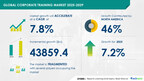
NEW YORK, Feb. 6, 2025 /PRNewswire/ — Report on how AI is driving market transformation – The global corporate training market size is estimated to grow by USD 43.86 billion from 2025-2029, according to Technavio. The market is estimated to grow at a CAGR of 7.8% during the forecast period. Emergence of cost-effective e-learning training modules is driving market growth, with a trend towards emergence of iot and wearable devices. However, technical constraints to implement corporate training poses a challenge. Key market players include Adobe Inc., Articulate Global Inc., Blanchard Training and Development Inc., BTS Group AB, Cegos Group, Cisco Systems Inc., City and Guilds Group, D2L Inc., DEMOS, Development Dimensions International Inc., Educomp Solutions Ltd., Franklin Covey Co., John Wiley and Sons Inc., Korn Ferry, Learning Technologies Group Plc, Mind Gym Plc, NIIT Ltd., Richardson Sales Performance, Simplilearn, and Skillsoft Corp..
Key insights into market evolution with AI-powered analysis. Explore trends, segmentation, and growth drivers- View Free Sample PDF
Corporate Training Market Scope
Report Coverage
Details
Base year
2024
Historic period
2019 – 2023
Forecast period
2025-2029
Growth momentum & CAGR
Accelerate at a CAGR of 7.8%
Market growth 2025-2029
USD 43859.4 million
Market structure
Fragmented
YoY growth 2022-2023 (%)
7.2
Regional analysis
North America, Europe, APAC, South America, and Middle East and Africa
Performing market contribution
North America at 46%
Key countries
US, UK, Germany, Canada, Japan, China, India, South Korea, France, and Italy
Key companies profiled
Adobe Inc., Articulate Global Inc., Blanchard Training and Development Inc., BTS Group AB, Cegos Group, Cisco Systems Inc., City and Guilds Group, D2L Inc., DEMOS, Development Dimensions International Inc., Educomp Solutions Ltd., Franklin Covey Co., John Wiley and Sons Inc., Korn Ferry, Learning Technologies Group Plc, Mind Gym Plc, NIIT Ltd., Richardson Sales Performance, Simplilearn, and Skillsoft Corp.
Market Driver
The corporate training market is thriving as businesses prioritize upskilling and reskilling their employees to meet the demands of a knowledge-based economy. Remote work and workplace learning are trending, with soft skills, diversity initiatives, and digital skills in high demand. Talent development is key to business goals like performance, retention, and competitiveness. Training methods include virtual, continuous, and specialized programs. Budget and time constraints, economic uncertainty, and organizational requirements shape training decisions. Technology implementations, such as digital tools, automation, and artificial intelligence, require digital literacy and skills. Training providers offer personalized learning activities through chatbots and virtual assistants, with continuous measurement and feedback ensuring quality. Employees’ productivity and efficiency depend on a continuous learning culture, employee engagement, and satisfaction. Industries like FMCG, Pharmaceutical and Healthcare, Financial Services, Professional Services, Public Enterprises, and Information Technology all benefit from technology-enabled training programs.
The corporate training market has seen a significant shift towards digital solutions, with the Internet of Things (IoT) and wearable devices playing a pivotal role. Wearable devices, such as smart glasses like Google Glass and smartwatches like the Apple Watch, offer convenience and time-saving benefits. These devices can be used for tracking trainee attendance and monitoring performance in real-time, making training sessions more efficient. In collaboration with educational technologies like augmented reality (AR) and virtual reality (VR), wearable devices have the potential to create accurate, multidimensional simulations for learning and development in modern organizations. This approach enhances the training experience and improves overall performance.
Request Sample of our comprehensive report now to stay ahead in the AI-driven market evolution!
Market Challenges
The corporate training market is a vital aspect of upskilling and reskilling employees to meet business goals in today’s knowledge-based economy. With remote work becoming the new norm, workplace learning has shifted to various learning activities. Soft skills, diversity initiatives, and digital skills are essential for an adaptable workforce in a competitive and sustainable growth environment. However, challenges persist. Economic uncertainty and financial constraints impact budgets for training programs. Time constraints due to work schedules and employee engagement are crucial. Training providers offer virtual training methods for continuous learning and development, but personalization and continuous measurement are key to employee satisfaction and retention. Technological adoption, such as digital tools, automation, and artificial intelligence, necessitates specialized training programs for digital literacy and skills. Organizational requirements and employee performance are closely linked, making quality training essential for productivity and efficiency. Industries like FMCG, Pharmaceutical and Healthcare, Financial Services, Professional Services, Public Enterprises, and Information Technology have unique training needs due to rapid innovation and operational efficiency requirements. Learning Management Systems and mobile devices enable e-learning, making training more accessible. Continuous learning culture, employee morale, and turnover rates are crucial indicators of a successful training program.
Corporate training solutions face technical constraints in the form of customization and integration in the corporate sector. Customization is essential to cater to specific user requirements, reducing time and complexity. However, it increases operating costs, particularly for small-scale companies. Vendors must provide technical support to enhance product functionality, but may withdraw it due to cost reductions. This creates challenges for companies in implementing effective corporate training programs. Customization and documentation facilitate easy upgrades, yet come with added expenses. Companies must weigh these factors to optimize their training investments.
Discover how AI is revolutionizing market trends- Get your access now!
Segment Overview
This corporate training market report extensively covers market segmentation by
ProductTechnical TrainingNon-technical TrainingTypeBlendedE-learningGeographyNorth AmericaEuropeAPACSouth AmericaMiddle East And AfricaIndustriesRetailPharmaceutical And HealthcareFinancial ServicesProfessional ServicesPublic EnterprisesInformation TechnologyOthers Industries
1.1 Technical training- The global corporate training market for non-technical skills is expected to experience significant growth during the forecast period. This growth is driven by the increasing importance of soft skills in enhancing employee productivity and driving business success. Non-technical training covers areas such as leadership development, team-building, problem-solving, and management techniques. These training programs are learner-centric and focus on outcomes that can be measured using behavioral objectives. Organizations are recognizing the value of investing in their employees’ personal and professional development, leading to increased productivity and business growth. Non-technical skills are essential for optimizing technical skills and are in high demand across industries and professions. Training programs are not limited to new employees but are also offered to mid-level and senior management to help them make effective decisions and facilitate business growth. With the increasing focus on people management and the skills gap, senior and HR managers are prioritizing soft skills training. The trend is expected to continue as service-based industries expand and soft skills become increasingly important in client-facing roles and marketing positions. Training providers are responding to this demand by offering mobile and online learning programs to cater to modern learners. For instance, Skillsoft offers a leadership skills development program featuring technology-enabled e-learning solutions, while Vital Smarts provides a leadership training program called Influencer Training. Collaborations between organizations and training vendors to enhance non-technical learning and development programs are expected to fuel the growth of the global corporate training market during the forecast period.
Download a Sample of our comprehensive report today to discover how AI-driven innovations are reshaping competitive dynamics
Research Analysis
The Corporate Training Market is a dynamic and evolving industry focused on upskilling and reskilling employees to meet the demands of the knowledge-based economy. With remote work becoming increasingly common, workplace learning has taken on new meaning, incorporating virtual training methods and learning management systems. Soft skills, such as communication and problem-solving, are in high demand, as are diversity initiatives to foster inclusive workplaces. Business goals, employee performance, and retention are key drivers for corporate training. Technical training spans various industries, including Pharmaceutical and Healthcare, Financial Services, Professional Services, Public Enterprises, and Information Technology. Learning activities are delivered through various methods, including e-learning and mobile devices, and continuous development is essential for staying competitive.
Market Research Overview
The Corporate Training Market is a dynamic and evolving landscape that focuses on upskilling and reskilling employees to meet the demands of a knowledge-based economy. With remote work becoming increasingly prevalent, workplace learning has shifted to include various learning activities that prioritize soft skills, diversity initiatives, and continuous development. Business goals such as performance, retention, and competitiveness drive the need for talent development in various sectors, including FMCG, Pharmaceutical and Healthcare, Financial Services, Professional Services, Public Enterprises, and Information Technology. Training methods have evolved to include virtual training methods, continuous learning, and specialized programs tailored to organizational requirements. Digital transformation and technological adoption have led to the implementation of digital tools, automation, and artificial intelligence, necessitating the development of digital skills and literacy. Training providers offer personalized solutions to address budget constraints, time constraints, and employee engagement, utilizing chatbots, virtual assistants, data analytics, and continuous measurement for feedback and quality training. Employees’ productivity, efficiency, and morale are key indicators of a successful training program, contributing to sustainable growth and adaptation in a rapidly innovating business environment.
Table of Contents:
1 Executive Summary
2 Market Landscape
3 Market Sizing
4 Historic Market Size
5 Five Forces Analysis
6 Market Segmentation
ProductTechnical TrainingNon-technical TrainingTypeBlendedE-learningGeographyNorth AmericaEuropeAPACSouth AmericaMiddle East And AfricaIndustriesRetailPharmaceutical And HealthcareFinancial ServicesProfessional ServicesPublic EnterprisesInformation TechnologyOthers Industries
7 Customer Landscape
8 Geographic Landscape
9 Drivers, Challenges, and Trends
10 Company Landscape
11 Company Analysis
12 Appendix
About Technavio
Technavio is a leading global technology research and advisory company. Their research and analysis focuses on emerging market trends and provides actionable insights to help businesses identify market opportunities and develop effective strategies to optimize their market positions.
With over 500 specialized analysts, Technavio’s report library consists of more than 17,000 reports and counting, covering 800 technologies, spanning across 50 countries. Their client base consists of enterprises of all sizes, including more than 100 Fortune 500 companies. This growing client base relies on Technavio’s comprehensive coverage, extensive research, and actionable market insights to identify opportunities in existing and potential markets and assess their competitive positions within changing market scenarios.
Contacts
Technavio Research
Jesse Maida
Media & Marketing Executive
US: +1 844 364 1100
UK: +44 203 893 3200
Email: media@technavio.com
Website: www.technavio.com/
View original content to download multimedia:https://www.prnewswire.com/news-releases/corporate-training-market-to-grow-by-usd-43-86-billion-2025-2029-driven-by-cost-effective-e-learning-report-with-market-evolution-powered-by-ai—technavio-302368583.html
SOURCE Technavio








 Technology5 days ago
 Coin Market5 days ago
 Technology5 days ago


 Technology4 days ago
 Technology4 days ago
 Technology5 days ago