Connect with us

Technology

HTX Ventures Examines Open USD: How Stablecoin Revenue and Rule-Setting Are Being Redistributed

Published

on

APIA, Samoa, Aug. 13, 2026 /PRNewswire/ — HTX Ventures, the global investment arm of HTX, has released a new report titled Open Infrastructure, Closed Financial Rails: Open USD, Revenue Redistribution, and Participant Governance, examining the shifts underway in stablecoin revenue distribution, channel relationships, and governance following the June 30, 2026 unveiling of Open USD (OUSD).

The report finds that while blockchain technology has established open, global, and programmable technical infrastructure, the industry’s next phase will be determined by how participants contest control rights and the allocation of economic benefits. The technical layer has opened; the economic layer is only beginning to.

Closed Economic Structures atop Open Technology

Stablecoins have moved from settlement tools within crypto trading into instruments for cross-border payments, corporate treasury management, and institutional back-office clearing. Visa’s stablecoin settlement pilot reached an annualized run rate of approximately $7 billion by April 2026 across nine blockchains, while Swift, the Canton Network, Fnality, and Project Agorá explore how tokenized deposits and central bank money can settle within shared environments.

Economic rights, however, remain distributed along established lines. Issuers mint stablecoins against user dollars and allocate reserves into cash and short-term Treasuries, with reserve yields accruing solely to them. Yet the system depends on exchanges and wallets for user access, payment companies to connect merchants, banks for fiat on/off-ramps, custodians for reserves, and market makers for secondary depth. These institutions bear integration, compliance, and liquidity costs, and currently capture revenue mainly through bilateral commercial agreements — where bargaining power depends heavily on their own user scale.

Three Institutional Shifts in OUSD’s Design

Under Open Standard’s framework, enterprises can mint and redeem OUSD free of charge and without volume limits. Open Standard charges a small management fee, with the remaining reserve yields earmarked for partners who adopt and promote OUSD, as well as select partners planning to join its board of directors. The published partner roster exceeds 140 entities, including Visa, Mastercard, American Express, Stripe, Coinbase, BlackRock, and BNY.

HTX Ventures breaks the design into three shifts:

From fee-based access to subsidized distribution, using reserve yields to offset the genuinely expensive investments in customer acquisition, liquidity, regional compliance, and fiat rails;From bilateral negotiations to network-wide revenue sharing, bringing mid-sized payment companies, regional banks, and vertical wallets into a unified framework where partners share revenue based on contribution;From issuer governance to participant governance, giving institutions that bear business and regulatory responsibility a voice in rule-making.

OUSD is slated for launch later in 2026. Notably, it shares the OUSD code with Origin Protocol’s Origin Dollar, launched in 2020, though the two are distinct products.

Execution Details Will Determine Whether the Model Holds

According to HTX Ventures, the model’s viability depends on several specific mechanisms. Revenue-sharing rules directly determine who captures value: allocation by balance favors institutions with greater capital resources, while allocation by transaction volume can be distorted by internal transfers that generate activity without real payments. A workable mechanism would weigh balance retention, actual payments, new customers, and regional compliance investments together. The governance arrangement likewise rests on what the board can actually decide, not on how many institutions appear on the roster.

More fundamentally, a considerable distance separates joining a consortium from migrating core business. What ultimately determines network value is stable balances, real payment volume, market-making depth, and smooth redemptions.

Value Chain Revenue Faces Redistribution

If revenue-sharing models generate sustained payment volumes, the room for issuers to retain the full reserve yield spread will narrow. Exchanges, wallets, and payment companies that control access to users, liquidity, and payment use cases may shift from distribution tools to participants in revenue-sharing and governance arrangements. For banks the impact is two-sided — deposits and correspondent banking revenue may erode, but stablecoins still require reserve custody, fiat on/off-ramps, and FX liquidity. Card networks face limited direct impact, given their role in authorization, fraud management, and merchant acceptance. Across clearing, custody, and data services, fees based on proprietary records may decline while services tied to security and liability expand.

The Next Dimension of Competition

Open USD raises a question that extends beyond stablecoins: when banks, payment processors, exchanges, asset managers, and custodians provide the underlying assets, customer relationships, liquidity, and compliance capabilities, how will the value chain distribute profits and control?

Such shifts are most likely in middle- and back-office infrastructure, where multiple institutions are required and no single platform can independently provide customer reach, regional licensing, fiat rails, and counterparty networks. Institutions need shared infrastructure, yet remain reluctant to cede core operations, client data, and risk authority to a direct competitor. Consortium governance and revenue sharing are therefore not ideological commitments to decentralization, but pragmatic commercial prerequisites for cross-institutional networks.

HTX Ventures notes that along this trajectory, stablecoin competition will move beyond issuance scale and on-chain liquidity toward who contributes network value, who shares infrastructure revenue, who retains customers and data, and who sets operating rules. The next generation of financial infrastructure need not be fully decentralized; more likely, it evolves from single-company control toward networks where regulated participants connect, share returns, and govern major decisions through tiered arrangements. As a research and investment firm with a long-standing focus on payment infrastructure and institutional settlement networks, HTX Ventures will continue tracking how this redistribution of revenue, customers, and rule-setting shapes the industry’s direction.

About HTX Ventures

HTX Ventures is the global investment arm of HTX, integrating investment, incubation, and research to identify and discover the best and most innovative projects in the market. Visit us here.

View original content to download multimedia:https://www.prnewswire.com/news-releases/htx-ventures-examines-open-usd-how-stablecoin-revenue-and-rule-setting-are-being-redistributed-302850617.html

SOURCE HTX Ventures

Continue Reading
Click to comment

Leave a Reply

Your email address will not be published. Required fields are marked *

Technology

Labuan IBFC Inc., ASAS and STEP Malaysia strengthen Islamic wealth planning practices

Published

on

By

Joint initiative highlights integrated approaches to wealth planning, succession and cross-border solutions

KUALA LUMPUR, Malaysia, Aug. 13, 2026 /PRNewswire/ — Labuan IBFC Incorporated Sdn Bhd (Labuan IBFC Inc.), the official marketing agency for Labuan International Business and Financial Centre (Labuan IBFC), together with the Association of Shariah Advisors in Islamic Finance Malaysia (ASAS) and the Society of Trust and Estate Practitioners (STEP) Malaysia  brought together industry practitioners and experts to explore the intersection of Islamic wealth planning, estate administration and Shariah governance, with a focus on cross-border wealth management and family governance.

The forum brought together Islamic estate planning professionals, Shariah advisers, trust and estate practitioners, wealth managers as well as legal experts to explore effective approaches to preserving, managing and transferring wealth. Discussions encompassed estate administration beyond faraid, Shariah estate administration governance, succession planning and the use of trusts, takaful and other wealth structures.

In her welcome address, Mdm. Farah Deba, Branch Chair of STEP Malaysia, said, “Beyond Faraid means faraid is only one part of estate planning. However, this does not mean planning beyond Islamic principles. We come from three different perspectives – where STEP speaks as advisors to families across generations while Labuan IBFC brings the international family wealth and structuring dimension, whereas ASAS brings the core Shariah perspective.”

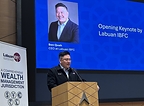
Delivering the keynote address, Mr. Ben Quah, CEO of Labuan IBFC Inc., highlighted Labuan IBFC’s role as a platform for Islamic private wealth planning and cross-border wealth solutions. “As wealth becomes increasingly global, families need flexible solutions that offer asset protection and long-term continuity. Labuan IBFC is well positioned to meet these needs while complementing Malaysia’s leadership in Islamic private wealth through strong ecosystem collaboration,” he said.

The programme opened with “Beyond Faraid – The Real Challenges in Muslim Estate Administration,” examining practical challenges in estate administration, while exploring solutions to translate succession intentions into effective estate planning. This was followed by a dialogue which explored how effective governance and proper documentation can help ensure wealth planning arrangements are implemented consistently with Shariah requirements.

Labuan IBFC was then featured in “Labuan IBFC as a Platform for Islamic Wealth and Family Governance,” showcasing its flexible legal structures and solutions for cross-border wealth management, succession planning and asset structuring.

The afternoon session focused on the practical implementation of wealth plans, covering liquidity, takaful, trusts and other structures. Panellists outlined how these can support wealth preservation, risk management and intergenerational wealth transfer.

The event concluded with a panel discussion on strengthening the Islamic wealth planning ecosystem, bringing together perspectives from wealth management, financial planning, estate administration and Shariah practice. The discussion underscored the importance of collaboration in advancing holistic Islamic wealth planning solutions.

In her closing remarks, Mdm. Yusaini Yusof, EXCO member of ASAS, emphasised, “Shariah governance ensures that the legacy is properly structured, successfully implemented and ultimately serves Maqasid Shariah. ASAS shall continue to support this journey for greater engagements and increased professionalism of the wider Shariah fraternity and practitioners.”

The session builds on the strategic partnership established through the Memorandum of Understanding between Labuan IBFC Inc. and ASAS, while further strengthening engagement with STEP Malaysia and the wider professional community.

For more information on Labuan IBFC and its Islamic finance and wealth management solutions, visit www.labuanibfc.com.

View original content to download multimedia:https://www.prnewswire.com/apac/news-releases/labuan-ibfc-inc-asas-and-step-malaysia-strengthen-islamic-wealth-planning-practices-302850684.html

SOURCE Labuan IBFC Inc.

Continue Reading

Technology

iQIYI Expands Suspense Slate with New Horizontal-Screen Short-Form Drama Brand Undercurrent Theater, Debut Title “Dead of Winter” Tops Charts

Published

on

By

BEIJING, Aug. 13, 2026 /PRNewswire/ — Recently, iQIYI, China’s leading online entertainment platform, has launched Undercurrent Theater, a horizontal-screen short-form suspense brand making a strong debut with its inaugural title “Dead of Winter”. The title has gained rapid audience traction and delivered solid commercial returns, signaling strong market appetite for the format. The launch sets a strong foundation for Undercurrent Theater as iQIYI deepens its leadership in premium suspense content.

Since its August 4 premiere, “Dead of Winter” has reached a peak iQIYI content popularity index, a measure of audience engagement on the platform, of 6,638, the highest for an iQIYI revenue-sharing, a model where production partners share earnings with iQIYI based on viewership, short-form drama since 2024. It has also topped multiple industry rankings across leading Chinese entertainment data providers Enlightent, Maoyan and DataWin. Enlightent data shows its daily market share peaked at 60.9%, making it the second horizontal short-form drama this year to surpass 60%, following iQIYI’s “The Ferry Man 10th Anniversary”, a 10th-anniversary return of the classic IP “The Ferry Man”.

Strong viewership has also translated into commercial momentum. Within five days of release, “Dead of Winter” generated over RMB5 million (approximately US$740,000) in revenue-sharing earnings, with iQIYI projecting total revenue-sharing earnings to exceed RMB10 million (approximately US$1,480,000) within nine days of release.

Set in a small northeastern Chinese city in the late 1990s, “Dead of Winter” is a gritty crime suspense drama rooted in social realism. The series follows two former friends – a community police officer and a criminal investigator – who reunite to solve a series of major cases, unraveling an eight-year family tragedy. Its fast-paced storytelling, strong performances, and distinctive wintry setting have driven significant social buzz. More than 20 derivative short videos have each surpassed 100,000 likes, with audience calls for a second season.

The debut validates both the premium content model and the revenue-sharing approach underpinning Undercurrent Theater, with more titles already in the pipeline. “The VI Group of Fatal Case” (the Chinese title translates as Sixth Criminal Investigation Unit), a prequel to the beloved 2001 crime procedural. “The Murder Truth”, adapted from a highly rated original work, weaves intricate deduction with interconnected serial crimes for a layered viewing experience. Together, the upcoming slate builds on the momentum of “Dead of Winter” as iQIYI continues to deepen its short-form suspense offering and cement its position as the home of premium Chinese suspense storytelling for global audiences.

Contact: 
iQIYI Press
press@qiyi.com 

View original content to download multimedia:https://www.prnewswire.com/apac/news-releases/iqiyi-expands-suspense-slate-with-new-horizontal-screen-short-form-drama-brand-undercurrent-theater-debut-title-dead-of-winter-tops-charts-302850700.html

SOURCE iQIYI Inc.

Continue Reading

Technology

From Chinese AI to Global ETFs: STARTRADER Launches 45 New 24/7 Stock and ETF CFDs Spanning Seven Market Themes

Published

on

By

Available from August 13, 2026, the launch covers seven distinct market themes with no trading-hour restrictions.

DUBAI, UAE, Aug. 13, 2026 /PRNewswire/ — STARTRADER today announced the launch of 45 new 24/7 Stock and ETF CFDs, available from Monday through Sunday, 00:00–24:00 (GMT+3 platform time).

Where previous 24/7 expansions were anchored around specific themes, this one is defined by its breadth. The new instruments span seven areas: Chinese AI, AI infrastructure, technology, crypto and digital assets, energy, other equities, and ETFs.

Among the new additions are Zhipu and MiniMax, two Hong Kong-listed Chinese AI companies that debuted on HKEX in January 2026. Zhipu develops large language models for enterprise and developer markets. MiniMax is an AI company focused on artificial general intelligence (AGI), with investors including Alibaba, Tencent, and Hillhouse Capital, and has attracted sustained market attention since its listing.

STARTRADER builds its product offering around where eligible clients are directing their attention. When significant market narratives emerge in new geographies, ensuring access to them is a core part of that responsibility.

“This launch reflects a deliberate choice to keep pace with how global market interest actually moves, across regions, sectors, and timeframes simultaneously. For eligible clients, the launch provides access to a broader range of instruments across regions, sectors, and market themes.” 
– Peter Karsten, Chief Executive Officer, STARTRADER

As STARTRADER’s 24/7 product range continues to grow, the focus remains consistent: building access that reflects the global market as it is today.

Out-of-hours trading may involve wider spreads, reduced liquidity and price gaps, particularly when underlying markets are closed.

Risk Warning: Trading CFDs involves a significant risk of loss and may not be suitable for all investors. Please ensure you fully understand the risks before trading.

About STARTRADER

STARTRADER is a global multi-asset broker empowering retail and institutional partners to access global markets through a range of platforms, including MetaTrader, STARTRADER APP, and STAR Copy. STARTRADER operates through entities licensed and regulated by authorities including CMA, ASIC, FSCA, FSA and FSC, combining strong governance with a client-first approach, serving both retail clients and partners with a commitment to transparency, reliability, and long-term growth.


View original content to download multimedia:https://www.prnewswire.co.uk/news-releases/from-chinese-ai-to-global-etfs-startrader-launches-45-new-247-stock-and-etf-cfds-spanning-seven-market-themes-302850701.html

Continue Reading

Trending