Connect with us

Technology

Autodesk commits $350 million to prepare the next generation for the AI jobs that design and make the physical world

Published

on

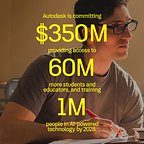
New research finds AI is increasing demand for the people who design, build, manufacture, and create the physical world – and inspiring more young people to pursue those careers. Autodesk’s three-year commitment will give 60 million more students and educators free access to Autodesk’s professional tools, train nearly one million in AI-powered workflows, and help more than 200,000 people earn industry-recognized certifications.

SAN FRANCISCO, June 22, 2026 /PRNewswire/ — As the Class of 2026 enters one of the toughest job markets for new graduates in years,* new research from Autodesk points to an unexpected shift: AI is pulling the next generation toward hands-on, physical-world work.

To help prepare students and today’s workforce for these opportunities, Autodesk has made a $350 million commitment over the next three years to provide free technology access, training, and certifications for the AI-powered jobs that design and make the physical world: the architects, engineers, construction professionals, product designers, manufacturing professionals, creatives, and skilled tradespeople with technical expertise behind everything that’s built. These industries employ nearly 300 million professionals** worldwide and are projected to represent $30 trillion in global economic value by 2027.***

“AI is raising the floor for everyone, but it is human ingenuity that will vault the ceiling,” said Dara Treseder, Chief Marketing Officer at Autodesk. “That is why access matters. The next generation already has the curiosity, creativity, and ambition to solve real problems. What too many young people still lack are the professional tools, training, and experiences that help turn that potential into a career. Preparing them for the future we’re building is a responsibility we all share, and one Autodesk is proud to help lead.”

A $350 million commitment to the future workforce

By the end of 2028, Autodesk will:

Expand free access to Autodesk’s professional technology for 60 million more students and educators: Over the past decade, Autodesk has put its professional tools in the hands of more than 150 million students and educators at more than 160,000 colleges, universities, trade schools, and high schools. Through partnerships with educational institutions, Autodesk is helping shape the next generation of workforce-ready programs, giving students hands-on experience with the tools and technologies used by industry professionals. From the University of Florida’s first-of-its-kind industrialized construction degree to Howard University’s soon-to-launch construction engineering and management program, Autodesk is helping shape modern programs for students that directly apply to their future careers. That work extends globally, including in India, one of the world’s largest talent markets, where Autodesk is helping bring these digital skills to more than 14,500 Industrial Training Institutes (ITIs) and 33 National Skill Training Institutes (NSTIs), while partnering with employers like NAMTECH and ArcelorMittal Nippon Steel on curriculum, faculty training, and certification pathways aligned to India’s industry needs.

Train nearly one million students, educators, job seekers, and professionals in AI-powered Design and Make technology: Access opens the door, but skills create opportunity. Autodesk will embed its technology into school curricula and degree programs, expanding its network of Autodesk Learning Partners – including Authorized Training Centers (ATC®), and Membership Training Providers (MTPs) – and training thousands of trade union and association apprentices in everything from plumbing, pipefitting, HVACR, and welding to the advanced, tech-driven specialties modern jobsites now run on, like Building Information Modeling (BIM), architectural sheet metal, and commercial electrical work. Autodesk will also support organizations that work closely with governments, training partners, and other technology leaders to retrain workers, support policies that help people through job transitions, and initiate new training models tied to what employers need most.

Help more than 200,000 people earn industry-recognized certifications: As AI changes how work gets done, students and professionals need trusted ways to prove they can apply these skills in real workflows, and employers are looking for that proof. In fact, 92% of organizations say they now require or prioritize certifications in their workforce strategy,**** while Autodesk’s survey found only 27% of students are pursuing them – a disconnect between the credentials employers want and the ones students are earning. Working with certification design and testing partners Pearson and Certiport, Autodesk is building a credential pathway that runs from foundational skills, with the Tinkercad 3D Design Certificate and Autodesk Certified User certifications through Autodesk Certified Professional certifications that verify hands-on expertise in industry workflows.

The readiness gap behind this investment

The commitment responds to findings from Autodesk’s second annual AI Jobs Report, also released today. Students have the instinct but not the preparation: 82% are confident using everyday AI tools like ChatGPT and Claude, but only 36% feel confident with the AI specific to their future careers, and nearly two in three say they know only the basics, not the technology that could set them apart. Most are closing the gap alone — 80% are teaching themselves job-relevant skills online, while fewer than one in five build them through internships or real-world experience.

Demand is moving fast in the other direction. AI job listings across architecture, engineering, construction, manufacturing, and design have grown nearly two and a half times in two years, and the fastest-growing roles are creative, not purely technical: design is now the most in-demand skill in AI hiring, and human skills like communication and leadership both rank ahead of coding. This lands as no surprise to the 56% of college students who say they aren’t sure they’re learning the right AI skills to land a job after graduation.

AI is pulling the next generation toward the physical world

The research also overturns a common assumption. Rather than steering young people toward screens, AI is deepening their pull toward the physical world. More than 66% of students say they want careers where they make things or work with their hands – up six points from 2024 – and when asked which work feels more appealing as AI reshapes the workforce, students choose the physical world over digital by more than two to one. Among working professionals, the margin is more than four to one. That instinct is the engine of the Design and Make industries and the reason Autodesk is investing to meet it.

Read more about Autodesk’s education efforts here.
Read Autodesk’s 2026 AI Jobs Report here.

*Federal Reserve Bank of New York, The Labor Market for Recent College Graduates
**World Economic Forum
*** Statista, Statista, Oxford Economics & PWC
**** Pearson’s 2026 Employer Report

Methodology of Autodesk’s 2026 AI Jobs Report
Autodesk’s AI Jobs Report was conducted in partnership with the third-party analytics firm GlobalData, which examined more than 4 million global job postings over a three-year period across the following industries: architecture, engineering, construction, product design, and manufacturing. The analysis also includes dedicated breakouts for media and entertainment and for marketing and advertising.

GlobalData used its proprietary Job Analytics platform to track daily job postings from companies globally. It also used its advanced platform to analyze job postings on company career pages and other trusted sources. All data is anonymized and does not include private or individual recruiter listings.

About the results: The data spans three rolling 12-month periods measured from May to April: the 2024 cycle includes postings from May 2023 through April 2024 (1.289 million job listings), the 2025 cycle includes postings from May 2024 through April 2025 (1.488 million job listings), and the 2026 cycle includes postings from May 2025 through April 2026 (1.463 million job listings). These totals include both AI-related and general job listings. 

“AI-related” roles are defined as those where artificial intelligence is a major component of the position or its primary function—beyond surface-level mentions or general familiarity. This includes roles explicitly centered around AI use, implementation, oversight, and application.

GlobalData also surveyed more than 1,000 students ages 14 to 23 across U.S. high school, university, community college, and vocational/trade schools, as well as more than 500 Design and Make professionals in May 2026.

View original content to download multimedia:https://www.prnewswire.com/news-releases/autodesk-commits-350-million-to-prepare-the-next-generation-for-the-ai-jobs-that-design-and-make-the-physical-world-302806210.html

SOURCE Autodesk, Inc.

Continue Reading
Click to comment

Leave a Reply

Your email address will not be published. Required fields are marked *

Technology

Heidrick & Struggles Strengthens Board with Appointment of AI and Talent Leaders Aseem Datar and Leanne Wood

Published

on

By

New Appointments Bring Strategic Expertise to Support Firm’s Next Chapter of Growth

CHICAGO, June 22, 2026 /PRNewswire/ — Heidrick & Struggles today announced the appointments of Aseem Datar, Corporate Vice President, AI Platform and Quantum at Microsoft, and Leanne Wood, former Chief Human Resources Officer at Vodafone, to the firm’s Board of Managers, the company’s governing body. The appointments follow the recent designation of Tom Monahan, who continues to serve as Chief Executive Officer of Heidrick & Struggles, as Vice Chairman of the Board, alongside the appointment of Tom Murray, President of Heidrick & Struggles, to the Board. Together, these appointments further strengthen the Board’s expertise across technology, leadership, talent, and organizational transformation as the firm enters its next phase of growth as a private company.

Datar and Wood bring significant expertise across technology innovation, leadership, organizational transformation, and global business strategy as Heidrick & Struggles continues advancing its long-term growth strategy and leadership advisory capabilities worldwide.

“We are delighted to welcome Aseem and Leanne to our Board of Managers,” said Tom Monahan, Chief Executive Officer and Vice Chairman of the Board of Heidrick & Struggles. “Our Board’s expertise reflects some of the most consequential forces shaping the future of leadership and business today. Aseem’s experience at the forefront of AI innovation and enterprise technology, combined with Leanne’s distinguished leadership across talent, culture, and organizational transformation, will provide invaluable perspectives as we continue investing in innovation and helping clients navigate increasingly complex leadership challenges around the world.”

Datar is Corporate Vice President, AI Platform and Quantum at Microsoft, where he leads the company’s strategy and execution across advanced AI and next-generation computing. Over more than two decades at Microsoft, he has scaled some of its most significant businesses, holding senior leadership roles in business and product strategy, operations, and cloud and AI platform growth — including as Chief Operating Officer for Microsoft Azure. He also brings experience working with emerging technology and venture-backed companies through his time at Madrona Venture Group.

Wood is an accomplished global business and board leader with extensive experience across talent strategy, organizational transformation, and corporate governance. Most recently, she served as Chief Human Resources Officer at Vodafone, where she led global people and organizational transformation initiatives across more than 100,000 employees and operations spanning Europe and Africa. Her experience also includes global senior leadership roles at Burberry and Diageo, where she helped guide complex business transformation, leadership succession, and culture initiatives. She also brings prior board experience, having served as Chair of Vodafone Shared Operations Limited and as a Non-Executive Director at Compass Group and Vodacom Africa.

“As Heidrick & Struggles continues building on its strong market position following the recent transition to private ownership, attracting world-class leaders to our Board remains a critical priority,” said Carmine Di Sibio, Chairman of the Board of Heidrick & Struggles. “Aseem and Leanne each bring highly relevant experience across technology innovation, talent leadership, and organizational transformation that will help guide the firm as it continues investing in innovation and delivering exceptional value for clients globally.”

Following the company’s take-private transaction led by Advent International, Corvex Private Equity, and a global network of strategic investors in late 2025, Heidrick’s Board of Managers reflects a combination of firm leadership and investor representation alongside independent business leaders. The Board is chaired by Carmine Di Sibio, Operating Partner at Advent International and Former Global Chair and CEO of EY. Tom Monahan, Chief Executive Officer of Heidrick & Struggles, was recently appointed Vice Chairman of the Board, and Tom Murray, President of Heidrick & Struggles, was recently appointed to the Board. Additional Board members include Joe Costa, Managing Partner of Corvex Private Equity; John DiCola, Managing Director at Advent; Mark Dirzulaitis, Director at Advent; and Chris Satti, President of Salem Capital Management. Chris Egan, Managing Partner at Advent, and Paul Yun, Managing Director at Mousse Partners, serve as Board observers.

About Heidrick & Struggles 
Heidrick & Struggles is the world’s foremost advisor on executive leadership, driving superior client performance through premier human capital leadership advisory services. For more than 70 years, we have delivered value for our clients by leveraging unrivaled expertise to help organizations discover and enable outstanding leaders and teams. Learn more at www.heidrick.com.

Media Contact
Bianca Wilson
Global Director, Public Relations
Heidrick & Struggles 
bwilson@heidrick.com 

View original content to download multimedia:https://www.prnewswire.co.uk/news-releases/heidrick–struggles-strengthens-board-with-appointment-of-ai-and-talent-leaders-aseem-datar-and-leanne-wood-302806502.html

Continue Reading

Technology

Chainguard Named a Leader in Inaugural Gartner® Magic Quadrant™ for Software Supply Chain Security

Published

on

By

Chainguard positioned furthest right for Completeness of Vision among all vendors evaluated

KIRKLAND, Wash., June 22, 2026 /PRNewswire/ — Chainguard, the trusted source for open source, today announced it has been named a Leader in the inaugural Gartner® Magic Quadrant™ for Software Supply Chain Security. Chainguard is positioned furthest right for Completeness of Vision among all vendors evaluated. Chainguard has made secure-by-default the standard for software supply chain security, delivering open source that’s secure and ready for production.

As AI-assisted development accelerates and attackers exploit new vulnerabilities in a matter of minutes, organizations can no longer rely on scanning artifacts after the fact. Prevention is the only solution. Chainguard’s platform has grown to cover more than 2,500 container projects and millions of language library versions, as well as virtual machines, CI/CD workflows, agent skills, and OS packages. Chainguard Factory, which has processed more than 1 billion unique build manifests to date, is the agentic engine that enables the company to scale to tens of thousands of packages, remediate CVEs within hours rather than days, and deliver security at industry-leading velocity.

“The software supply chain threat landscape is changing faster than traditional security tools were designed to handle. AI is only widening that gap, giving attackers new ways to find and exploit vulnerabilities before most teams even know they exist. We believe the Gartner recognition of Software Supply Chain Security as a category is a critical step in helping organizations understand the threat they’re up against, and what it takes to stay ahead of it,” said Patrick Donahue, Senior Vice President of Product, Chainguard. “Chainguard builds your supply chain from the ground up, with trusted source, hardened artifacts, secured pipelines, and clean provenance by default. Prevention is the only viable strategy for this new AI era, and Chainguard was built for this moment.”

Securing the software supply chain from source to production

The software supply chain has become the most consequential attack surface in modern infrastructure. Malware campaigns have targeted language libraries, CI/CD pipelines, and AI coding tools, while AI models are accelerating the discovery and exploitation of vulnerabilities faster than traditional remediation workflows can respond. Chainguard addresses this across every layer of the stack.

Chainguard’s catalog of trusted open source is continuously rebuilt from verified source code in an isolated environment through the Chainguard Factory. Chainguard Libraries are malware-resistant, Chainguard Containers ship with zero known CVEs, and Chainguard Actions and Agent Skills leverage hardening rulesets to continuously assess the security posture of critical AI and CI/CD open source artifacts. All artifacts come with cryptographic signatures, signed SBOMs, and SLSA L3-aligned provenance, so engineers have confidence in what they are running in production, and security teams have the compliance evidence to match.

By delivering container images with near-zero known CVEs, Chainguard eliminates vulnerability noise before it ever reaches customer pipelines, so security teams spend less time triaging alerts and more time mitigating risks that actually matter. Chainguard’s preventive foundation helps organizations meet regulatory mandates such as FedRAMP, the NIS2 Directive, and the EU CRA without relying on reactive security management.

To learn more about Chainguard’s recognition as a Leader in the 2026 Gartner Magic Quadrant for Software Supply Chain Security report and read a complimentary copy, visit https://get.chainguard.dev/gartnermq2026.

Gartner Disclaimer
Gartner does not endorse any company, vendor, product or service depicted in its publications, and does not advise technology users to select only those vendors with the highest ratings or other designation. Gartner publications consist of the opinions of Gartner’s business and technology insights organization and should not be construed as statements of fact. Gartner disclaims all warranties, expressed or implied, with respect to this publication, including any warranties of merchantability or fitness for a particular purpose.

Gartner and Magic Quadrant are a trademark of Gartner, Inc., and/or its affiliates.

About Chainguard
Chainguard is the trust layer for open source software. Its solutions provide engineers and AI agents with the hardened, trusted, and production-ready artifacts they rely on, so organizations can build fast while staying compliant and protecting against AI supply chain attacks. Customers include Fortune 500 enterprises and global industry leaders, including Anduril, Canva, Fortinet, Hewlett Packard Enterprise, OpenAI, Snap Inc., and Snowflake. Chainguard is venture-backed by leading investors, including Amplify, IVP, Kleiner Perkins, Lightspeed Venture Partners, Mantis VC, Redpoint Ventures, Sequoia Capital, and Spark Capital. For more information, visit: https://www.chainguard.dev/

View original content to download multimedia:https://www.prnewswire.com/news-releases/chainguard-named-a-leader-in-inaugural-gartner-magic-quadrant-for-software-supply-chain-security-302806535.html

SOURCE Chainguard

Continue Reading

Technology

In HelloNation, Wealth Advisor Matt Cuplin Explains How Taxes Affect Retirement Income

Published

on

By

The article examines how taxes can affect retirement income from multiple sources long after employment ends.

MADISON, Wis., June 22, 2026 /PRNewswire/ — How can taxes affect the retirement income you’ve worked years to build?

HelloNation has published an article that provides the answer by explaining how different income sources may be taxed during retirement and why those tax consequences deserve careful attention.

The article features insights from Matt Cuplin of Midwest Financial Group and explains why taxation is often an overlooked part of retirement planning. While many people spend decades building savings and investments, the article notes that understanding how retirement income is taxed can be just as important as accumulating assets.

The HelloNation article explains that one of the most common sources of retirement income comes from retirement accounts. Traditional retirement accounts often provide tax advantages during working years, but retirement account withdrawals may be subject to ordinary income taxes after retirement. According to the article, many retirees are surprised by how retirement account withdrawals can influence their overall taxable income and spending power.

Another important source of retirement income discussed in the article is Social Security benefits. While some retirees assume Social Security benefits are always tax-free, the article explains that a portion of Social Security benefits may be taxable depending on income levels and individual circumstances. Because Social Security benefits often work alongside other income sources, understanding their role within a broader tax strategy is essential.

The article also highlights the importance of investment income. Retirement income may include interest, dividends, capital gains, and earnings generated from taxable accounts. Unlike retirement account withdrawals, investment income may be taxed under different rules. Understanding how investment income affects taxable income can help retirees gain a more complete view of their financial situation.

According to the article, the challenge for many retirees is that multiple income sources often work together. A retiree may receive Social Security benefits, take distributions from retirement accounts, and generate investment income simultaneously. Each source can affect taxable income differently, making tax planning an important component of effective retirement planning.

The article emphasizes that tax planning does not end when employment income stops. In many cases, retirement introduces new tax considerations that did not exist during working years. Required distributions, evolving financial goals, and changing income streams can all influence retirement income and future tax obligations.

Another key point discussed in the article is the importance of evaluating long-term outcomes. Retirement often lasts for decades, and decisions made early can affect future retirement income and tax consequences. Incorporating tax planning into retirement planning allows individuals to better understand how current decisions may influence future financial flexibility.

The article also notes that many retirees focus primarily on how much income they expect to receive rather than how much may remain after taxes. A retirement income strategy that appears sufficient before taxes can look very different once taxable income and tax liabilities are considered. Evaluating these factors together can provide a more realistic understanding of available spending power.

According to the article, every retiree’s situation is unique. Account balances, filing status, retirement accounts, investment holdings, and income sources can all affect taxable income differently. Understanding how each component contributes to retirement income helps support more informed decision-making.

The article concludes that careful attention to retirement income, retirement account withdrawals, Social Security benefits, and investment income can help retirees avoid unexpected tax surprises. By making tax planning a consistent part of retirement planning, individuals can gain greater clarity about taxable income and build a stronger foundation for long-term financial confidence.

The Hidden Tax Risks of Retirement Income features insights from Matt Cuplin, Wealth Advisor of Madison, WI, in HelloNation.

About HelloNation

HelloNation is America’s Good News Network, a premier media platform built on the idea that good news travels faster when real people tell real stories. Through its community-focused publications and innovative “edvertising” approach, HelloNation delivers content that informs, inspires, and spotlights the leaders making a meaningful impact in their communities.

View original content to download multimedia:https://www.prnewswire.com/news-releases/in-hellonation-wealth-advisor-matt-cuplin-explains-how-taxes-affect-retirement-income-302806557.html

SOURCE HelloNation

Continue Reading

Trending